The Democratic Party's centrist wing has spent the last several weeks telling anyone who will listen that it stands for capitalism, law enforcement, and fiscal discipline. What it has been less eager to discuss is who is paying for that message.
A Thursday investigation by Sludge, reported by Common Dreams, traced the financial architecture behind the "Promise to America" — a political manifesto signed by more than a dozen House Democrats including Reps. Josh Gottheimer (D-NJ), Tom Suozzi (D-NY), Adam Gray (D-Calif.), Vincente Gonzalez (D-Texas), and Don Davis (D-NC). The manifesto debuted publicly at the annual conference of the Welcome Party, a political organization whose PAC has received more than 60 percent of its $10.8 million in individual contributions over the last five years from billionaires.
The specific names attached to that money are worth pausing on. LinkedIn founder Reid Hoffman contributed $1.8 million. James Murdoch — son of Rupert, former CEO of 21st Century Fox — and his wife Kathryn donated $2.5 million. Bain Capital co-founder Joshua Bekenstein, former New York City Mayor Michael Bloomberg, and multiple members of the Walton family — heirs to the Walmart fortune — also appear on the donor list. These are not small-donor progressives alarmed by the left's direction. These are people whose accumulated wealth depends on the continuation of the economic arrangements that democratic socialists want to change.
Sludge's investigation also found that additional billionaires may have contributed to the Welcome Party's two "dark money" nonprofit arms, which are not required to disclose their donors publicly. The full scope of billionaire investment in this ideological project remains, by design, unknown. As Tinsel News has previously covered, dark money structures exist precisely to prevent the public from drawing the lines between donors and political outcomes.
Here is what the Promise to America's signatories are asking voters to believe: that their decision to publicly oppose democratic socialism, to champion capitalism and "fiscal discipline" at this particular political moment, is an independent act of conviction — not a service rendered to the class of people who funded the infrastructure that launched the manifesto. That is a significant ask.
The political context matters. The Promise to America did not emerge in a vacuum. It appeared immediately after a series of progressive primary victories that rattled the Democratic establishment. Its timing was reactive, and Rep. Alexandria Ocasio-Cortez (D-NY) said as much in a recent interview with political commentator Santita Jackson. "Okay fine, if you're against [democratic socialists], that's okay," Ocasio-Cortez said. "But what do you believe? And that I think is the core of the weaknesses from that wing at this moment. There's no affirmative vision really coming from most places in the Democratic Party with the exception of democratic socialism."
That critique is sharper than it might appear. The Promise to America is essentially a declaration of what its signatories oppose — socialism, it turns out, and also presumably anything that would materially inconvenience the Walton family or the Bain Capital model. What it does not contain, according to Ocasio-Cortez's reading, is a coherent account of what the signatories intend to do for the tens of millions of Americans who cannot afford healthcare, housing, or retirement. The manifesto's "fiscal discipline" framing is particularly telling: it is the language of austerity dressed in the clothes of responsibility, and it has historically functioned as a justification for cutting the programs that working people depend on.
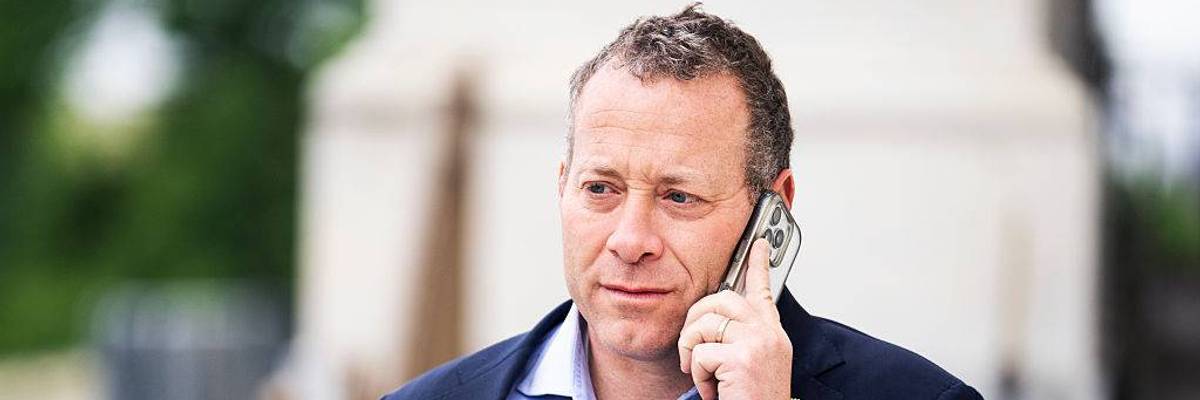
Rep. Ro Khanna (D-Calif.) offered a different read of the political moment on the House floor last week. "The progressive movement is winning across the country, from the heart of New York to Michigan to Maine," Khanna said. "The people are saying no to foreign wars and they're saying no to genocide in Gaza. They're saying no to the unfair and lopsided economy that has allowed a few people to hoard extreme wealth and power, and they're saying yes to Medicare for All." Khanna's speech was, in structural terms, the mirror image of the Promise to America: where the manifesto names what it opposes, Khanna named what he is for.
The ideological battle inside the Democratic Party is not new. What the Sludge investigation adds to that story is financial specificity — and financial specificity is, in political analysis, the most clarifying thing there is. The question of whether centrist Democrats represent a genuine grassroots constituency or a donor-managed position has long been debated in the abstract. The Welcome Party's donor list makes that debate somewhat more concrete.
It is worth being precise about what the investigation does and does not establish. Sludge found no direct evidence that the Welcome Party is financially supporting the Promise to America itself. The connection is structural and circumstantial: the manifesto debuted at the Welcome Party's conference, and the Welcome Party's PAC is majority-funded by billionaires. That is not proof of a coordinated transaction. It is, however, a description of a political ecosystem — one in which a document declaring opposition to socialism is incubated in an organization whose largest funders have a direct financial interest in ensuring that socialism does not happen.
The broader pattern is one this publication has tracked across multiple political contexts: as billionaire wealth reaches record highs, the political infrastructure defending that wealth becomes more organized and better funded. The Welcome Party is one node in that infrastructure. The Promise to America is one of its outputs. The signatories may genuinely believe what they signed. But belief and interest are not mutually exclusive, and the interests of the people who built the platform for this manifesto are not difficult to identify.
There is also the question of what the manifesto's political strategy actually is. Centrist Democrats have argued for years that the path to a durable majority runs through moderate voters who are alienated by progressive rhetoric. That argument has a logic to it. But the Promise to America was not designed as outreach to persuadable voters — it was designed as a rebuke to the party's left flank, timed to progressive primary wins, and launched at a conference bankrolled by the kind of donors who do not typically share economic interests with the working-class voters Democrats need to win. If the goal is to build a majority coalition, the strategic case for making Walton-family donors the ideological anchor is not obvious.
The Democratic Party's internal class alignment — who funds it, who it governs for, what it will and will not do when in power — is the foundational question in American left politics right now. Democrats have repeatedly struggled to explain their economic record to working-class voters, and that struggle is not accidental. It reflects a party whose donor class and its electoral base have interests that do not always converge. The Promise to America does not resolve that tension. It names a side.
The signatories will face primaries. Some will win. The Welcome Party will continue raising money from people whose net worth exceeds the GDP of small nations. The dark money arms will continue not disclosing their donors. And the manifesto will continue to be cited as evidence that the Democratic Party's centrist wing represents a principled, independent political vision — one that, by coincidence, asks nothing of the people who funded the room where it was announced.