Eight races. Five states. Sixty-four votes — the margin by which Forward Majority's chief executive says her organization wins and loses some of its targeted districts. For $30 million, Democrats are placing a precise, data-modeled bet that a handful of state legislative contests most Americans couldn't name will determine who controls the U.S. House of Representatives well into the next decade.
The investment, first reported by Axios, targets two dozen state legislative races this cycle. Forward Majority, the super PAC directing the spending, is not chasing marquee Senate seats or governor's races. It is hunting for single-digit-margin statehouse contests in Arizona, Michigan, Minnesota, Pennsylvania, and Wisconsin — chambers where flipping one or two seats could shift control of the redistricting process that will determine six U.S. House seats ahead of 2028.
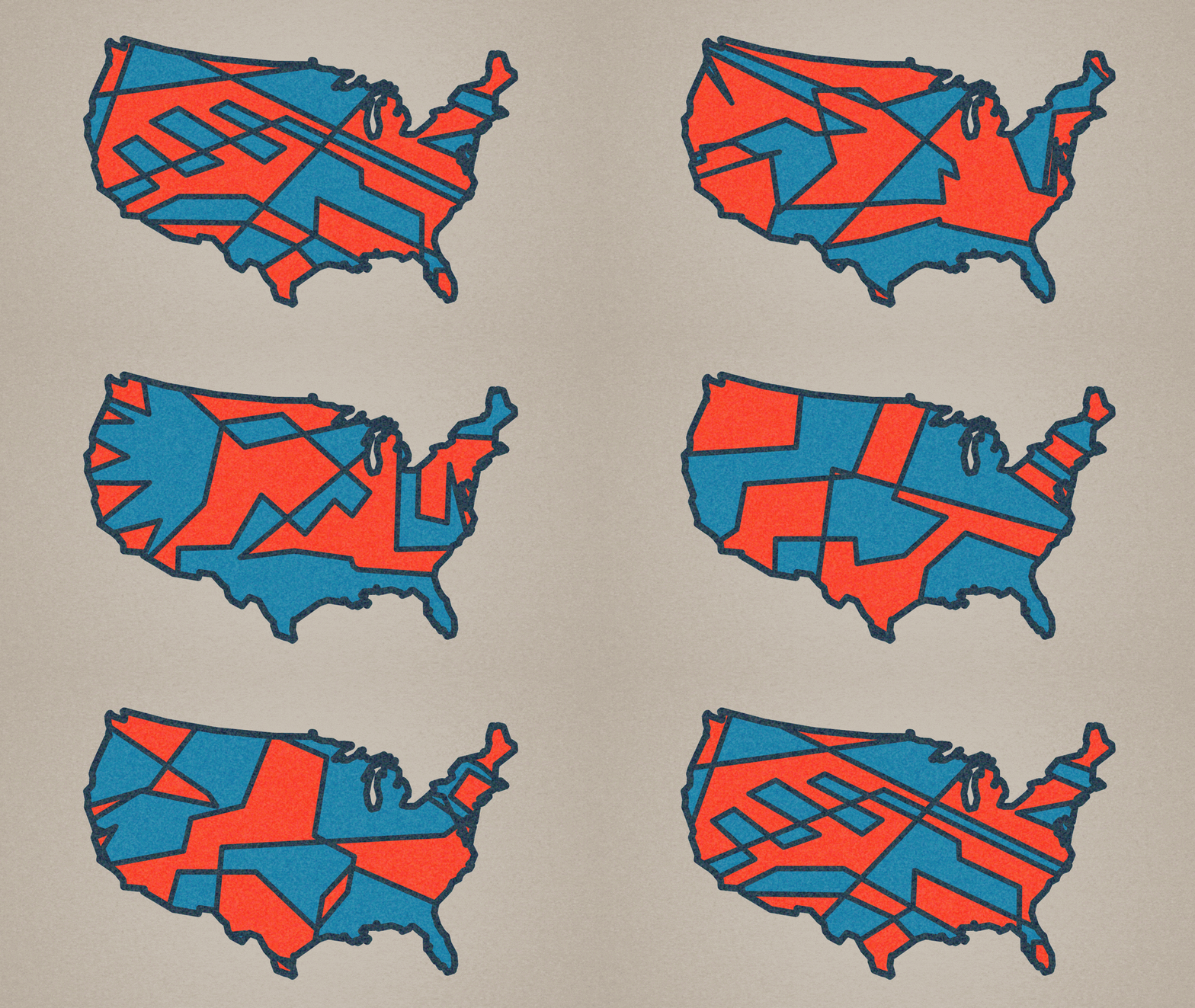
This is not conventional campaign strategy. It is cartographic warfare — and Democrats are entering it late, reactive, and still catching up to a Republican redistricting operation that has already changed the rules of the game.
The conventional wisdom about 2026 focuses on the U.S. House and Senate, on approval ratings and national mood. That frame misses where the structural contest is actually being decided. Congressional maps are drawn by state legislatures, and state legislatures are controlled by parties that most voters ignore in the rush toward federal offices. The result is a compounding asymmetry: national political attention pools around races that matter less, while the races that shape the electoral environment for a decade go underfunded and undercovered.
Republicans grasped this arithmetic earlier and exploited it more aggressively. In Texas this year, the GOP did not wait for the 2030 census to redraw congressional lines — they pushed through a mid-cycle redistricting designed to net five new Republican House seats. The move was legally aggressive, constitutionally contested, and strategically decisive. Democrats responded with a California redraw of their own, but a state Supreme Court decision blocked Virginia's attempted Democratic remap, demonstrating that mid-cycle redistricting cuts both ways — and that control of state courts is now part of the same contest. As Tinsel News has covered, Virginia's Supreme Court erased four Democratic House seats in a ruling that fit a decade-long pattern of Republican judicial appointments reshaping who gets to vote.
The Supreme Court's Callais ruling compounded the problem for Democrats. By weakening Section 2 of the Voting Rights Act, the Court removed a legal constraint that had previously limited the most aggressive partisan map-drawing. Both parties now have more room to pursue maps that maximize their own advantage — but that freedom benefits whichever party controls more state chambers, and Republicans currently control more of them. The playing field was already tilted before the starting gun fired. Louisiana's recent experience is instructive: as Tinsel News reported, Louisiana Republicans gutted a majority-Black congressional district after the Supreme Court already told them they could.
Forward Majority's response is to go granular. The organization uses an in-house modeling system called "Tipping Points" — a precinct-level demographic and political data tool designed to identify the highest-return opportunities with the available resources. Leslie Martes, the group's CEO, describes the environment with unusual candor: "We're in the Wild West now," she told Axios. "There are 7,000 legislative districts across the country. Not all of them are up this year, but you've got to make sure that you're playing in the right places with the resources that you have."
The specific targets tell the story of where the margins are tightest. Arizona's State Senate 17th District is currently held by a Republican — but Kamala Harris carried it in 2024, even as she lost Arizona statewide. That's the kind of district where presidential-level Democratic performance has not translated into statehouse control, and where the gap between presidential voting and legislative representation represents both a structural failure and a correctable opportunity. Arizona and Michigan use independent commissions to redraw congressional maps, which means statehouse control there matters differently — but the downstream effects on legislative power, redistricting culture, and state-level policy remain significant.
In most states, congressional district lines are drawn by the state legislature and signed by the governor. A party that controls the state House, state Senate, and governor's mansion can draw maps that entrench their congressional advantage for ten years — until the next census. The 2030 census will trigger a full redraw in all 50 states. Statehouse races won or lost in 2026 will shape who holds that power.
Forward Majority predicts that one to two seats in Wisconsin, one to three in Pennsylvania, and at least one in Minnesota could collectively determine control of legislative chambers representing roughly 42 million Americans. These are not hypothetical stakes. Wisconsin's state legislative maps have been among the most aggressively gerrymandered in the country, producing Republican supermajorities in a purple state for years. Pennsylvania's legislature has been the site of sustained redistricting litigation. Minnesota's chamber margins are thin enough that a single seat shifts the balance of power over everything from congressional maps to Medicaid expansion.
The deeper argument Forward Majority is making — implicitly, through its spending decisions — is that the 2028 congressional map is being negotiated right now, in races that will receive a fraction of the media coverage and donor attention of federal contests. House Minority Leader Hakeem Jeffries is simultaneously preparing a parallel strategy: squeezing more Democratic-friendly seats from blue states where Democrats control the process. Republicans plan to pad their numbers in Georgia and Mississippi. Both parties understand that trifecta control — state House, state Senate, governor — is the prerequisite for creative cartography. The fight for those trifectas is happening in the same overlooked statehouse contests that Forward Majority is targeting.
There is a structural irony embedded in this dynamic that deserves naming. The Democratic Party has spent years arguing that gerrymandering is a threat to democratic representation — and it is. But the response to gerrymandering, in the absence of federal reform, is counter-gerrymandering. Forward Majority is not funding these races to produce fair maps. It is funding them to produce Democratic maps, or at minimum to prevent Republican maps. The goal is power, not reform. That tension is not a reason to avoid the fight — Republicans have never hesitated — but it is a reason to be clear about what the fight is actually over. Independent redistricting commissions, where they exist, represent a genuine structural alternative, as Tinsel News has explored in its guide to how gerrymandering works.
What Forward Majority's $30 million bet actually represents is a belated acknowledgment that Democrats spent years ceding the infrastructure of electoral power while competing for its outputs. Republicans built their statehouse advantage through sustained investment in legislative races across multiple cycles — an effort that paid dividends in 2011 and again in 2021, when census-triggered redistricting locked in congressional maps that held even in wave elections. The lesson took Democrats a decade to fully absorb. The 2026 investment is an attempt to apply it before the 2030 redistricting cycle sets the table for another generation.
The margin for error is sixty-four votes. That number is not rhetorical flourish — it is the operational reality of statehouse races that get a fraction of the funding, coverage, and turnout of their federal counterparts. In that gap between attention and consequence, the next decade of congressional power is being decided.