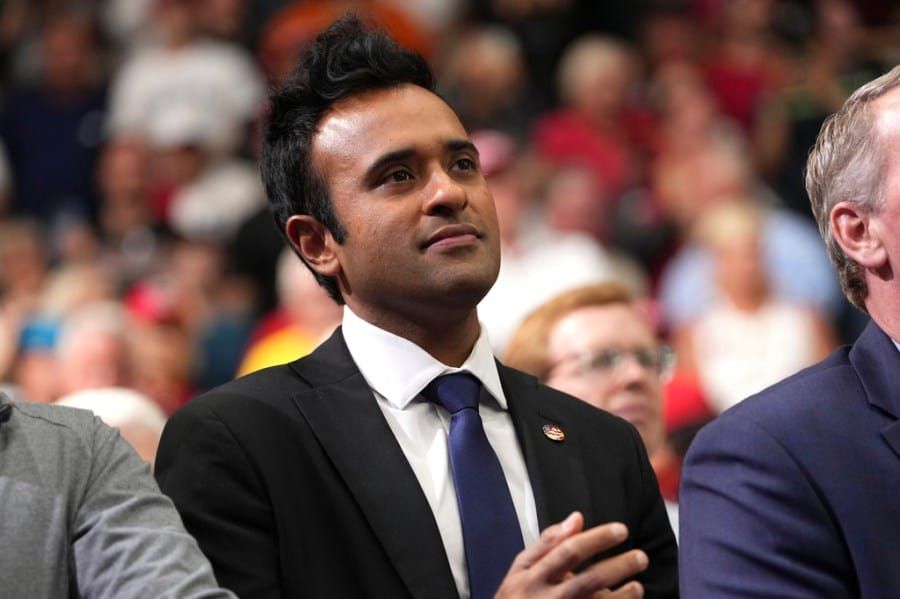
The ad did not attack Dr. Amy Acton's record as Ohio's former public health director. It did not challenge her policy positions. It did not question her qualifications. Instead, Vivek Ramaswamy's campaign went looking for the most intimate wound a person can carry — the fracture between a child and a parent — and put it on television.
The advertisement, which drew widespread condemnation from The Hill and across the political spectrum, features Acton's mother speaking against her own daughter's candidacy. Critics reached immediately for the McCarthy comparison — and the parallel is not imprecise. Joseph McCarthy's signature move was not the lie itself but the weaponization of personal vulnerability: the implication that something private and shameful was also something disqualifying. Ramaswamy is doing something structurally similar, but with a 21st-century update. He is not accusing Acton of disloyalty to country. He is accusing her of disloyalty to family — and using her own mother to make the charge.
What the McCarthy comparison misses, though, is this: Ramaswamy's ad is not primarily about destroying Amy Acton. It is about the Republican Party's evolving theory of how to win.
Dr. Amy Acton served as Ohio's Director of Health during the COVID-19 pandemic, becoming a prominent public figure for her daily briefings. She became a target of right-wing protests and harassment before resigning in 2020. She is now the Democratic candidate for governor of Ohio.
The accountability question here is not complicated: Ramaswamy made this choice. His campaign made this choice. Whatever estrangement exists between Acton and her mother is a private matter that became a public instrument the moment his team decided to film it and buy airtime. The decision chain runs directly to the candidate. When he faces questions about it, the question is not whether the ad is distasteful — it clearly is, including to members of his own party — but why his campaign calculated it was worth making anyway.
The answer to that question is more revealing than the ad itself.
Republican campaign strategy has spent the last decade systematically expanding the definition of what is acceptable to weaponize. The arc runs from opposition research on financial records to opposition research on personal relationships, from attacks on voting records to attacks on family dynamics, from challenging a candidate's competence to challenging a candidate's character as a daughter. Each escalation gets condemned. Each condemnation fades. The next cycle begins slightly further along the same axis. Ramaswamy's ad is not an aberration — it is the logical endpoint of a progression that the party has consistently failed to stop, in part because stopping it would require acknowledging that the escalation was strategic rather than accidental.
Follow the money and the incentives, and the ad looks less like a miscalculation. Ramaswamy is a first-time candidate for governor who spent 2023 running for president on a platform of radical candor and anti-establishment disruption. His political brand depends on doing things that generate attention — on proving that he will go further than other candidates, that no norm constrains him, that shock is a strategy. The attack ad is, in this light, not a miscalculation. It is a product launch. The condemnation from fellow Republicans is, for Ramaswamy's purposes, arguably useful: it positions him as someone willing to fight in ways that more cautious Republicans won't. The cruelty is not incidental to the message. The cruelty is the message.
The cost of this calculus falls entirely on Acton. Whatever the nature of her relationship with her mother — and estrangements between parents and adult children are among the most common and most private of human experiences — that relationship has now been converted into campaign content without her consent. It has been broadcast to Ohio voters as evidence of something disqualifying. The implicit argument is that a woman who is not in good standing with her mother cannot be trusted to lead a state. This is not a policy argument. It is a character assassination that uses a family wound as its blade.
Precision matters about what makes this different from standard opposition research. Opposition research on voting records, financial disclosures, business dealings, and public statements operates in the domain of voluntary public action — things a candidate chose to do and can be held accountable for. What Ramaswamy's campaign did is categorically different: it located a relationship that Acton did not choose, that involves another person's autonomous decision to participate, and that has no bearing on her fitness for office. There is no policy argument embedded in the ad. There is only the implication that something is wrong with her — privately, humanly, in ways that voters should find troubling.
The McCarthy parallel, invoked by critics on both sides of the aisle, is instructive for a specific reason. McCarthy's eventual undoing came when attorney Joseph Welch asked, on live television, "Have you no sense of decency?" The question worked because it named something that had been present all along but had not been stated plainly. The naming of it — the public articulation that a line had been crossed — created the conditions for accountability. The pattern of using institutional power to destroy political opponents has a long history in American politics, but it requires someone to name it clearly each time it recurs.
What is less certain is whether the question still carries the same weight. McCarthy's downfall required a political culture that still had shared standards about what was off-limits. The Republican Party of 2025 has spent years methodically dismantling those shared standards — not accidentally, but as a strategy. The condemnation Ramaswamy received from fellow Republicans is real, but it is also worth examining what form that condemnation takes. Republicans who criticized the ad did not, by and large, say that this kind of attack is categorically unacceptable and that campaigns that produce it should face consequences. They said it was a bad look. They said it went too far. They maintained the fiction that there is a line, without specifying where the line is or what enforces it.
That ambiguity is the point. As campaign money flows with fewer constraints and accountability structures weaken, the space for this kind of attack expands. There is no FEC rule against using a candidate's estranged parent in an advertisement. There is no campaign finance mechanism that penalizes cruelty. The only enforcement mechanism is political — which means it depends on voters finding the tactic disqualifying, and on the political culture maintaining enough shared norms to make that judgment stick.
This pattern extends beyond Ohio and beyond Ramaswamy. Women candidates face a specific vulnerability to this type of attack — the implicit judgment that their personal relationships, their family standing, their roles as daughters and mothers, are legitimate subjects of political scrutiny in ways that male candidates' family lives typically are not. The Acton ad fits into a broader pattern of attacks on women in public life that treat their private relationships as evidence of public unfitness. The gender dimension of the attack is not incidental.
What Ramaswamy has done is test whether a new category of attack — one that reaches into the most private domain of a candidate's life and converts it into ammunition — will be absorbed into the normal operating range of American politics. If the condemnation fades, as it typically does, the answer will be yes. The ad will become a data point in the ongoing calculation of what works. Someone will do it again, and do it more effectively, and the debate will be about whether this particular version went too far rather than about whether the category of attack should exist at all.
The question Joseph Welch asked in 1954 was not rhetorical. It was a demand for an answer. The answer Ramaswamy's campaign has provided — through the existence of the ad itself — is that decency, in this political environment, is a constraint that applies only when it is enforced. And right now, no one is enforcing it.