Twenty percent of the world's oil supply passes through a waterway narrower than the English Channel. It is 21 miles wide at its tightest point. The shipping lanes that tankers actually use are four miles across, divided by a two-mile buffer zone. At any given time before the 2026 crisis, roughly 100 commercial vessels were transiting this passage every day, carrying approximately 20 million barrels of crude oil and a fifth of the world's liquefied natural gas.
The Strait of Hormuz is the most important chokepoint in the global energy system. It is also, as of April 12, 2026, the most dangerous.
Where Is the Strait of Hormuz?
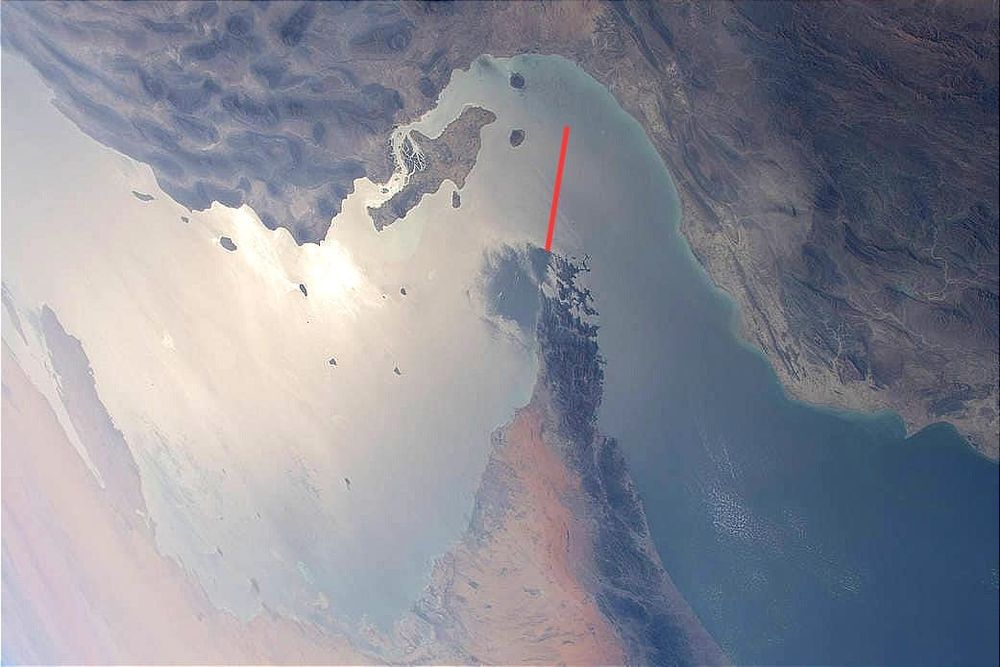
The Strait of Hormuz is the narrow passage connecting the Persian Gulf to the Gulf of Oman and, beyond it, the open waters of the Arabian Sea and the Indian Ocean. It sits between Iran to the north and the Musandam Peninsula of Oman (and the United Arab Emirates) to the south.
The strait is roughly 104 miles long and varies in width from about 60 miles at its widest to just 21 miles at the narrowest point between Iran and Oman. The water depth ranges from 200 to 330 feet — deep enough for the largest oil tankers afloat, which is precisely why it matters so much.
Ships moving through the strait follow a traffic separation scheme: inbound vessels use one lane, outbound vessels another, each lane two miles wide, with a two-mile buffer zone between them. These shipping lanes run primarily through Omani territorial waters, though they also cross into Iranian waters — a geographic fact that gives Iran a legal and physical claim over a portion of the route that every tanker must travel.
The shipping lanes run partially through Iranian territorial waters. Every tanker passing through the strait transits space that Iran has a legal claim to control.
The Strait of Hormuz
Why Does It Matter for Global Oil?
The Strait of Hormuz is the exit valve for the world's most productive oil region. Nearly every barrel of crude produced by Saudi Arabia, Iraq, the UAE, Kuwait, and Qatar — collectively responsible for roughly a third of global oil output — must pass through this single passage to reach international markets.
The dependence is not equal. Saudi Arabia and the UAE have built pipeline bypass infrastructure — the East-West Crude Oil Pipeline to the Red Sea port of Yanbu for the Saudis, and the Abu Dhabi Crude Oil Pipeline to the port of Fujairah on the Arabian Sea for the Emiratis. These pipelines can reroute a portion of their output around the strait. But they cannot handle full production capacity, and the rerouting adds cost, time, and complexity.
Iraq, Kuwait, Qatar, Bahrain, and Iran itself have no bypass at all. If the strait is closed, their exports stop.
But it is not just oil. Qatar is one of the world's largest exporters of liquefied natural gas. Nearly all of its LNG — along with roughly 20 percent of the global LNG trade — exits through the strait. The Gulf states also account for 30 to 35 percent of global urea exports, 20 to 30 percent of ammonia trade, and significant shares of aluminum, sulfur, and helium. The strait is not just an oil chokepoint. It is a chokepoint for the fertilizer that grows food, the gas that heats homes, and the industrial inputs that supply factories from Seoul to Stuttgart.
What Is Happening Now?
On February 28, 2026, the United States and Israel launched Operation Epic Fury — a massive joint air campaign against Iranian military infrastructure that killed Supreme Leader Ali Khamenei in one of its opening salvos. Within hours, Iran's Islamic Revolutionary Guard Corps issued VHF radio warnings forbidding all vessel passage through the Strait of Hormuz.
What followed was the largest disruption to global energy supply since the 1970s oil crisis.
As of today, 230 loaded oil tankers sit at anchor inside the Persian Gulf, unable to leave. Twelve seafarers have been killed or are missing. Six cruise ships carrying 15,000 passengers have been stranded. Iran has conducted at least 21 confirmed attacks on merchant vessels, laid naval mines throughout the passage, and deployed GNSS spoofing to disrupt navigation systems.
The IRGC has also established a toll system. Ships seeking passage through an alternative Iranian channel — north of Larak Island rather than the main southern route — are assessed fees exceeding $1 million per transit. According to Lloyd's List, the payments are being collected in Chinese yuan.
How the Blockade Affects Energy Prices
The market response has been the fastest and steepest price surge in the history of oil conflict.
Oil Price Surge Since the Crisis
Brent crude surged past $100 per barrel within days of the closure — the first time since Russia's 2022 invasion of Ukraine. By mid-March, Dubai crude hit $166, an all-time record. European natural gas prices nearly doubled in a single week, jumping from €30 to above €60 per megawatt-hour. In California, gasoline exceeded $5 a gallon by the second week of March.
The International Energy Agency released 400 million barrels from emergency reserves on March 11 — equivalent to roughly four days of global consumption. OPEC+ pledged a modest 206,000 barrel-per-day increase. The U.S. temporarily suspended its Russian oil embargo to allow 30 tankers (19 million barrels) to reach Asian markets. None of these measures have been sufficient to offset the scale of the disruption.
Wall Street analysts and U.S. government officials are now modeling scenarios in which oil reaches $200 a barrel.
It's Not Just Oil
The focus on crude prices obscures the breadth of what the Strait of Hormuz carries. The strait is a chokepoint for critical supply chains that have almost nothing to do with gasoline.
Fertilizer may be the least discussed and most consequential downstream impact. The Gulf states produce a third of the world's traded fertilizers — urea, ammonia, and diammonium phosphate. Urea prices rose 50 percent by late March. Unlike oil, there are no strategic fertilizer reserves. If the crisis extends through planting season in the northern hemisphere, the price of food — already elevated by the energy price surge — will rise further, hitting the world's poorest countries hardest.
Helium sounds trivial until you understand what it does. A third of the world's helium supply comes from Qatar. Helium is essential for cooling MRI magnets, manufacturing semiconductors, and testing aerospace components. By early April, hospitals and chip fabrication plants were reporting rationing.
Who Controls the Strait?
Legally, the Strait of Hormuz is governed by the United Nations Convention on the Law of the Sea (UNCLOS), which guarantees the right of “transit passage” through international straits. Under UNCLOS, all vessels — commercial and military — have the right to pass through the strait without interference, and coastal states cannot suspend transit passage.
Iran signed UNCLOS but has not ratified it, and has historically asserted broader sovereignty over the strait, including the right to regulate passage. Iran's position is that its territorial waters extend 12 nautical miles from its coast, encompassing portions of the shipping lanes. This creates a legal gray zone: international law says Iran cannot close the strait; Iran says it can regulate traffic in its own territorial waters.
In practice, control of the strait is determined not by legal instruments but by geography and military capability. Iran's coastline runs along the entire northern edge of the strait. Its military assets — fast-attack boats, anti-ship missiles, mines, drones, and coastal artillery — are positioned in hardened sites along the Iranian shore and on islands within the strait, including the Greater and Lesser Tunbs and Abu Musa. The 2026 war has demonstrated that Iran can effectively close the strait despite having a fraction of the U.S. Navy's overall firepower, because the geography favors the defender in asymmetric warfare.
The U.S. Fifth Fleet, headquartered in Bahrain, is the primary naval presence in the Persian Gulf. Before the crisis, it maintained a carrier strike group in the region. Since April 12, the U.S. has declared a naval blockade — the most aggressive American posture in the strait since the 1988 Operation Praying Mantis, when U.S. and Iranian naval forces fought a one-day battle that destroyed half of Iran's operational navy.
What Happens Next?
As of April 12, the situation has escalated to its most dangerous point since the war began.
Vice President Vance announced that negotiations with Iran — held in Islamabad, Pakistan — have failed. The U.S. was unable to reach an agreement on reopening the strait. In response, President Trump declared a naval blockade: the U.S. Navy will prevent ships from entering or exiting the strait and intercept any vessel that has paid tolls to Iran.
This creates a paradox. Iran blocked the strait to punish the U.S. for the war. Now the U.S. is blocking the strait to punish Iran for blocking the strait. The countries most affected by both blockades — Iraq, Kuwait, Qatar, Bahrain, and the smaller Gulf states — are allies of the United States who had no say in the decision to go to war and no leverage over either party's decision to close the waterway their economies depend on.
Now America is blocking the strait
to punish Iran for blocking the strait.
The countries caught in between had no say in either decision.
The scenarios ahead range from bad to catastrophic:
If the naval blockade holds and Iran does not escalate further, oil prices stabilize near $100 but do not fall — because oil is not moving. The 230 stranded tankers represent billions of dollars in cargo with no path to market. Gulf states bleed revenue. Asian economies that depend on Gulf oil — China receives a third of its oil through the strait, Japan and India rely on it for 70 percent of their Middle East imports — are forced to draw down reserves or source from more expensive alternatives.
If Iran retaliates against the naval blockade, the war enters a new phase. Naval engagements in the strait would shut down all commercial traffic indefinitely, send oil past $150, and risk drawing in additional military forces from China, India, and European navies that have deployed assets to protect their own shipping.
If diplomacy produces a genuine reopening, the recovery will still be slow. Iran reportedly lost track of some of the mines it planted, meaning the strait cannot be safely transited even if both sides agree to open it. Mine clearance operations, already underway by U.S. Central Command, take weeks to months in a waterway this size. Insurance premiums — which have increased four to six times since February — will remain elevated long after the political crisis resolves.
The Strait of Hormuz has always been a single point of failure in the global energy system. Strategists have warned about its vulnerability for decades. The world built no alternative. No diversified routing. No surplus capacity that could absorb a full closure. The assumption was always that no rational actor would close a waterway that its own economy depends on.
The 2026 crisis has retired that assumption. The strait is closed, the alternative does not exist, and the consequences are being measured in food prices, fuel shortages, stranded ships, and a global economy that built itself on the faith that a 21-mile passage between two hostile shores would always remain open.
This is a living article. It will be updated as the crisis develops. Last updated: April 12, 2026.
Related Tinsel News coverage:
- Trump Says U.S. Will Keep Bombing Iran Until It Gets ‘Better Terms.’ Civilians Are Paying the Price.
- Energy Prices Soar 40% After Pentagon’s Iran Strikes Shut Down Global Oil Routes
- Gas Hits $5.80 as Iran War Disrupts Global Oil Supply. Working Families Bear the Cost.
- Oil Markets Defy Presidential Threats as Iran’s Stranglehold on Global Energy Tightens
- The Iran War Has Cost $12 Billion. Congress Never Authorized a Cent of It.