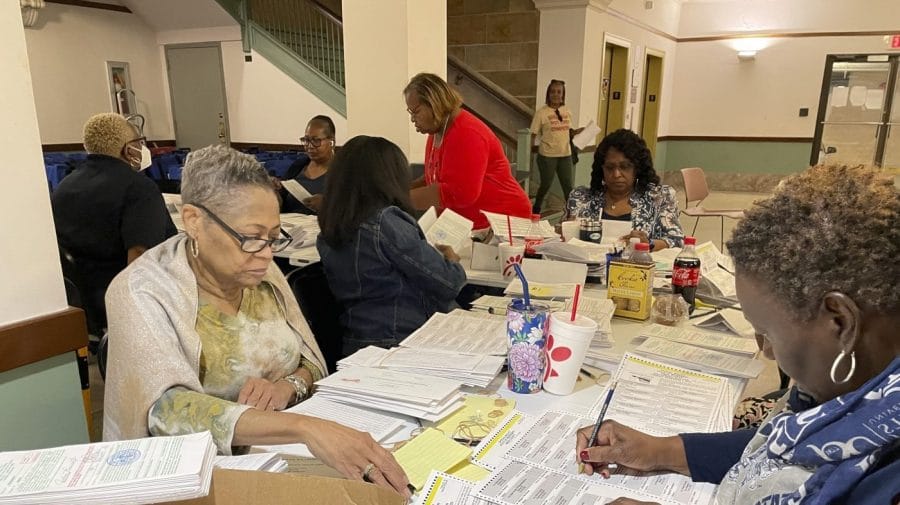
The Supreme Court on Monday heard arguments that could eliminate a voting protection used by 3.2 million Americans in the 2020 election — the ability to have their ballot counted if postmarked by Election Day but received days later. The case, challenging a Mississippi law that allows ballots to arrive up to five business days after Election Day, threatens similar provisions in 19 states and could reshape how millions of Americans vote.
At stake is not just a technical question about postal delivery times but a fundamental issue of voting access. Grace periods for mail ballots exist because the U.S. Postal Service cannot guarantee next-day delivery, particularly in rural areas. Military families overseas, Native American voters on reservations, and elderly citizens who rely on mail voting would bear the immediate cost of eliminating these protections.
The Republican National Committee and allied groups brought the Mississippi challenge, arguing that federal law requires all votes to be cast by Election Day. Their interpretation would invalidate decades of state laws designed to ensure that voters aren't disenfranchised by postal delays beyond their control. The Hill reports that more than a dozen states currently allow some form of post-Election Day receipt for properly postmarked ballots.
The timing amplifies the stakes. States are already drafting contingency plans for the 2026 midterms, knowing that a Supreme Court decision could come as late as June 2025 — leaving minimal time to retrain poll workers, update voter education materials, and modify ballot-counting systems. Election administrators warn that rushed implementation of new rules historically leads to voter confusion and increased rejection rates for legitimate ballots.
Mississippi's five-day grace period isn't an outlier. Alaska allows 10 days for ballots to arrive after Election Day. Illinois gives 14 days. These laws recognize a simple reality: postal delivery times vary dramatically by geography and infrastructure. A ballot mailed from downtown Jackson might arrive overnight. A ballot from rural Issaquena County might take a week.
The plaintiffs frame their argument around election integrity, claiming that counting ballots after Election Day creates opportunities for fraud. Yet they've presented no evidence of systematic fraud related to grace periods. What the data does show is that eliminating grace periods would disproportionately affect specific populations. In 2020, military and overseas ballots accounted for nearly 20% of all ballots received after Election Day but properly postmarked. Native American voters, who often rely on postal routes that visit reservations only weekly, used grace periods at three times the rate of other voters.
The administrative burden of eliminating grace periods would transform into voter suppression through bureaucracy. States would need to implement earlier mail ballot deadlines, forcing voters to return ballots a week or more before Election Day to ensure arrival. This compresses the window for voters to receive, complete, and return their ballots — particularly problematic in states where ballots aren't mailed until 30 days before the election.
Election officials across party lines have opposed eliminating grace periods, citing the chaos it would create. Local election offices would need to process a massive surge of last-minute ballots in the days before Election Day, rather than spreading the workload across a longer period. The compressed timeline increases the risk of processing errors and gives election workers less time to contact voters about fixable problems like missing signatures.
The financial cost alone could reach hundreds of millions. States would need to upgrade ballot tracking systems, hire additional temporary workers for pre-Election Day processing, and launch extensive voter education campaigns about new deadlines. These costs would fall on the same local governments that have seen election funding cut in recent years. As surveillance infrastructure expands, voting infrastructure crumbles.
International comparison reveals how extreme the proposed change would be. Most democracies that use mail voting allow ballots postmarked by Election Day to be counted if received within a reasonable period. Canada allows mail ballots to arrive up to 14 days after polls close. Australia counts postal votes received up to 13 days later. The U.S. would join a small group of nations that prioritize arbitrary deadlines over voter participation.
The Supreme Court's conservative majority has shown increasing willingness to override state election laws in ways that restrict voting access. This case fits a pattern: federal courts intervening to eliminate voting methods that state legislatures — including Republican-controlled ones — implemented to increase participation. Mississippi's Republican legislature passed the grace period law. Republican secretaries of state in Alaska, Iowa, and North Dakota defend similar provisions.
Behind the legal arguments lies a political calculation. Mail voting patterns shifted dramatically in 2020, with Democratic voters using mail ballots at higher rates due to pandemic concerns. But historical data shows no consistent partisan advantage to mail voting or grace periods. Military voters, who lean Republican, benefit significantly from grace periods. Rural voters across party lines depend on them. The push to eliminate grace periods appears driven less by partisan advantage than by a broader project to make voting harder.
The plaintiffs' argument rests on an interpretation of federal law that would overturn not just grace periods but potentially any state law that facilitates voting access beyond the bare minimum. If the Court accepts their reasoning that federal law prohibits counting any ballot not physically received by Election Day, it could open challenges to early voting, ballot drop boxes, and other methods states use to make voting accessible.
State election directors are preparing for the worst. Draft policies circulating among election administrators include recommendations to move mail ballot deadlines two weeks before Election Day, essentially eliminating mail voting for anyone who decides to vote by mail in the final weeks of a campaign. As money floods into elections, access to the ballot shrinks.
The human cost would be immediate and measurable. In 2020, over 65,000 military and overseas ballots arrived after Election Day but were counted under grace period laws. Another 180,000 ballots from elderly voters in assisted living facilities followed the same pattern. These aren't abstract numbers — they represent Americans who followed the law, mailed their ballot on time, and trusted the system to count their vote.
Native American tribes have filed briefs warning the Court about the devastating impact on reservation voters. Many reservations lack home mail delivery, requiring voters to travel to distant post offices. Postal routes to some reservations run only once or twice per week. Without grace periods, these communities would face a choice: vote in person at polling places often 50 or more miles away, or accept that their mailed ballot might not count.
The case also illuminates the fiction that election administration is politically neutral. The challenge to Mississippi's law came from groups that simultaneously push for voter ID laws, restrictions on early voting, and limits on voter registration drives. The infrastructure for restricting voting rights operates through coordinated legal challenges designed to look like discrete cases about technical issues.
If the Court eliminates grace periods, the 2026 midterms would unfold under radically different rules. States would need to educate millions of voters about new deadlines. Election offices would face unprecedented pressure to process mail ballots quickly. And inevitably, thousands of voters who followed the same procedures they've used for years would see their ballots rejected.
The justices' questions during oral arguments suggested awareness of these practical consequences but skepticism about whether such concerns should override their interpretation of federal law. This framing — that clear statutory text must be followed regardless of real-world impact — ignores that Congress passed federal election law against the backdrop of existing state practices. States have allowed post-Election Day receipt of military ballots since World War II.
What makes this case particularly troubling is its timing within a broader assault on voting access. As states implement new voter ID requirements, reduce polling locations, and purge voter rolls, eliminating grace periods adds another barrier. Each restriction might seem minor in isolation. Together, they create an obstacle course that inevitably reduces turnout among the most vulnerable voters.
The administrative burden would become voter suppression by design. When systems make it harder to vote — requiring earlier deadlines, providing less flexibility, creating more opportunities for technical rejection — fewer people vote. This isn't speculation. Academic research consistently shows that each additional step in the voting process reduces participation, with the effects concentrated among elderly, disabled, rural, and lower-income voters.
The Supreme Court's decision will determine whether millions of Americans can continue to vote by mail with confidence their ballot will count if mailed on time. But the broader question is whether the Court will continue to enable a coordinated campaign to make voting harder under the guise of election integrity. The integrity of elections depends not on arbitrary deadlines but on counting every legal vote cast by eligible citizens who follow the rules.
As states await the Court's decision, election administrators are budgeting for two scenarios: maintaining current systems or implementing the most significant change to mail voting in decades. The uncertainty itself imposes costs, forcing states to prepare for multiple possibilities while voters remain unsure whether the rules they've followed for years will still apply. This manufactured chaos serves no legitimate purpose. It does, however, advantage those who benefit when fewer Americans vote.