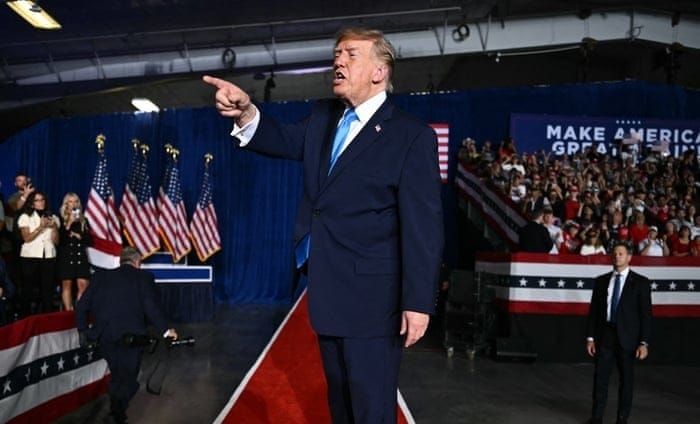
Jim Desmond is not a household name. He is a Republican candidate running for Congress in San Diego — a city whose residents, according to the president of his own party, could plausibly be killed by an Iranian strike. Desmond's response to that suggestion, reported by The Guardian US, was direct: he had "served to protect Americans, not write off American cities." He is, as far as the public record shows, nearly alone among Republicans in saying so.
That asymmetry — one candidate in a competitive district speaks, an entire party stays quiet — is not a political curiosity. It is the story. What Donald Trump said at a rally in Nebraska on Monday night was not a gaffe, not a slip, not an off-script moment that aides would spend Tuesday walking back. It was a president, conducting an active military campaign against Iran, speculating aloud that the adversary he is fighting could successfully strike two of the largest cities in the United States. The silence that followed from his party tells you more about the current condition of American political accountability than the comment itself.
That Trump said something reckless is established. The deeper problem is that the Republican Party's non-response to a president openly musing about the vulnerability of American cities to enemy attack represents a structural collapse of the oversight function that parties are supposed to perform. When a president can suggest that an adversary could "take out" Los Angeles or San Diego and face no meaningful pushback from legislators of his own party, the institutional check is gone. What remains is a single congressional candidate calculating that a competitive district in a city the president just described as a potential target might require him to say something.
San Diego is home to Naval Base San Diego, the largest naval surface fleet base on the U.S. West Coast, and Marine Corps Air Station Miramar. Los Angeles hosts the Port of Los Angeles, one of the busiest in the world. When a president speculates that Iran could strike these cities, he is not describing abstract political targets — he is describing military and economic infrastructure that millions of Americans depend on.
The power dynamic here deserves naming precisely. This is not a situation where the president made a provocative foreign policy argument that reasonable people might dispute. He was not describing a strategic vulnerability in classified terms, or issuing a warning through proper channels. He was at a campaign-style rally, speculating to a crowd about the capacity of an enemy his administration is actively bombing to destroy American cities. The audience for that comment was domestic. The effect — normalizing the idea that Iranian retaliation against civilians is a conceivable outcome of current policy — is not.
Democrats in California condemned the remarks, as The Guardian US reported. That condemnation is predictable and, in the current environment, largely without consequence. The meaningful accountability mechanism in a one-party-dominant executive environment is not the opposition — it is the governing party's own members. When Republican legislators in states adjacent to the cities Trump named said nothing, they were not staying neutral. They were making a choice. Silence, in this context, is a position.
Tinsel News has previously covered how Senate Republicans reversed their own war powers resolution under administration pressure — a pattern that shows the governing party's willingness to abandon institutional prerogatives when the president applies political cost. The same pattern operates here. The calculation is not complicated: speaking out against Trump carries primary risk; staying silent carries none. The result is a party that has functionally outsourced its oversight function to competitive-district candidates like Desmond, who have electoral reasons to differentiate themselves that safe-seat incumbents do not.
There is also a specific human geography to this story that the political framing tends to erase. Los Angeles County has a population of roughly 10 million people. San Diego County has approximately 3.3 million. These are not abstractions in a geopolitical argument. They are the places where people live — including, in Los Angeles, the largest Iranian diaspora community outside Iran itself. The ICE raids that have reshaped those communities in recent months are one dimension of that reality. The aftermath of those operations is another. A president who speculates casually about Iranian strikes on those same cities, at a rally in a different state, is not speaking about them — he is speaking about them to someone else, for someone else's purposes.
The military dimension compounds this. San Diego is one of the most significant naval installations in the United States. Any serious Iranian strike capability directed at the city would be directed, in part, at U.S. military assets — which means Trump was not only speculating about civilian casualties but about military vulnerability. That is a remarkable thing for a commander in chief to say publicly, at a rally, with no evident strategic purpose. The question of whether it constitutes a security breach is for others to adjudicate. The question of whether it required a response from Republican defense hawks is easier: it did, and they did not provide one.
The broader pattern this fits is documented and specific. Tinsel News has tracked how the Iran war has proceeded for months without congressional authorization or a formal budget, with Republican legislators either supporting or declining to challenge executive action at each stage. The rally comment is not an outlier in that sequence — it is a continuation of it. A party that will not vote to authorize or end a war will not, it turns out, object when the president describes its potential consequences in terms that should alarm the cities in question.
Desmond's statement is worth taking seriously precisely because it is so isolated. He said he served to protect Americans, not write off American cities. That is a sentence that should be unremarkable — a baseline of what any elected official would say if a president of their party suggested an adversary could destroy a city in their district. The fact that it stands out means the baseline has moved. What was once the floor of acceptable political response has become a differentiating position. That is the story the rally comment produced, and it is not primarily about Trump.
The midterm cycle is now close enough that candidates in competitive districts are doing the political math on when to break with the president. Desmond is doing that math in San Diego. The Republicans who represent safe seats — those with no electoral incentive to say anything — are doing a different calculation. The outcome of that second calculation is what will determine whether this moment produces any accountability at all. So far, the answer is visible in the silence: it will not.