The most dangerous decision of Donald Trump's presidency was made on a gut feeling.
That is the conclusion of a sweeping investigation by New York Times reporters Maggie Haberman and Jonathan Swan, who spent two years conducting roughly 1,000 interviews for their forthcoming book, Regime Change: Inside the Imperial Presidency of Donald Trump. The 4,500-word account, published this week, reconstructs in granular detail how the president overruled his own intelligence community, dismissed the explicit warnings of his vice president, and launched the most consequential American military operation in two decades based on a pitch his CIA director called “farcical.”
Of every person in Trump's national security apparatus — the intelligence chiefs, the diplomats, the generals — the president himself was the most hawkish voice in the room on Iran.
An Hour in the Situation Room
The sequence that led to war began on February 11, when Israeli Prime Minister Benjamin Netanyahu arrived at the White House and was escorted to the Situation Room. Mossad Director David Barnea joined by videoconference.
For one hour, Netanyahu laid out a four-step plan for what he framed as a decisive joint U.S.-Israeli operation against Iran:
- Eliminate Supreme Leader Ali Khamenei — a targeted strike on Iran's most senior political and religious authority.
- Cripple Iran's military capabilities — a sustained campaign to destroy missile systems, air defenses, and nuclear infrastructure.
- Spark a popular uprising — Netanyahu predicted the regime would weaken within weeks and Iranians would revolt.
- Install secular leadership — the presentation included a video featuring potential post-regime leaders, among them Reza Pahlavi, the exiled son of Iran's last shah.
Netanyahu assured Trump that Iran's ballistic missile program could be destroyed in a matter of weeks, that Tehran would be too weakened to close the Strait of Hormuz, and that Iran would be unable to retaliate against American assets in neighboring countries.
Trump's response, according to Haberman and Swan: “Sounds good to me.”
Israeli officials in the room interpreted the remark as a green light for coordinated action.
The Intelligence Community's Verdict
What happened next may be the most consequential detail in the entire investigation.
Overnight, U.S. intelligence analysts went to work evaluating every claim Netanyahu had made. The assessment came back fast, and it was devastating.
CIA Director John Ratcliffe used a single word to describe the agency's evaluation of Netanyahu's regime change scenarios: “farcical.”
Secretary of State Marco Rubio, upon hearing the CIA's assessment, translated it into plainer English: “In other words, it's bullshit.”
General Dan Caine, Chairman of the Joint Chiefs of Staff, was more measured but equally skeptical. According to the Times, he told the room: “Sir, this is, in my experience, standard operating procedure for the Israelis. They oversell, and their plans are not always well-developed.” Caine specifically warned about the strain on U.S. weapons stockpiles and the near-certainty that Iran would block the Strait of Hormuz — through which 20 percent of the world's oil supply transits daily.
Vice President J.D. Vance, who was traveling in Azerbaijan at the time, expressed what Haberman and Swan describe as “strong skepticism” during a call with senior officials on February 12.
In short: the CIA, the State Department, the Joint Chiefs, and the vice president all had serious reservations. Netanyahu's plan had been evaluated and found wanting by every major analytical body in the U.S. national security establishment.
It didn't matter.
17 Days to War
How Trump Decided to Strike Iran — Feb. 11–28, 2026
A Divided Administration
Over the next two weeks, a series of discussions took place inside the White House. There was no consensus. The Haberman-Swan investigation reveals just how fractured the administration's positions were:
Secretary of Defense Pete Hegseth was the strongest advocate for military action. He believed confrontation with Iran was inevitable and argued the United States should act from a position of strength rather than wait. Hegseth's posture was consistent with the reason Trump chose him for the role: he is an ideological believer in the aggressive projection of American military power. He pushed for strikes throughout the deliberation period.
Secretary of State Marco Rubio occupied a more complicated position. He was skeptical of a full-scale war and would have preferred continuing the maximum pressure sanctions campaign. But he was also skeptical that Iran would ever agree to a negotiated deal, which left him in a kind of strategic limbo — opposed to the war in its broadest conception, but unable to articulate a clear alternative. As Haberman and Swan report, he was “ambivalent.”
Vice President J.D. Vance was the most actively opposed. He laid out a detailed case against military action: the strain on U.S. munitions, the vulnerable position it would leave American forces in, the near-certainty of regional chaos, and — critically — the political consequences. Vance warned Trump that many of his own voters would see a full-scale war as a betrayal of his campaign promises, and that it risked fracturing the MAGA coalition that had delivered him a second term. According to the Times, Vance was “for no strikes at all” initially, but “knowing that Mr. Trump was likely to intervene in some fashion, he tried to steer toward more limited action.”
Chief of Staff Susie Wiles raised a different set of concerns. She warned that a war would cause gas price spikes that would damage Republicans in the 2026 midterm elections — a political calculation rather than a strategic one, but no less relevant inside a White House that treats electoral positioning as a core policy input.
Communications Director Steven Cheung noted that striking Iran would “violate the president's campaign trail rhetoric about keeping the United States out of new wars abroad” — a concern that appears to have been logged and then ignored.
The Go/No-Go Meeting
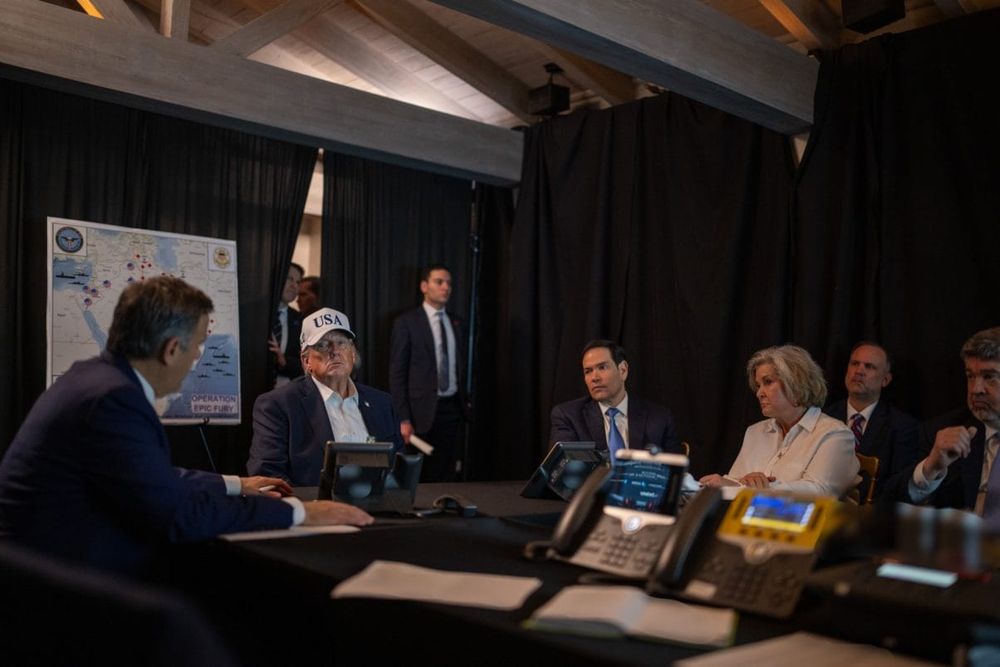
On February 26, Trump convened a final decision meeting in the Situation Room. It lasted one hour. The group was deliberately small: the president, Vice President Vance, Secretary of State Rubio, Secretary of Defense Hegseth, Chief of Staff Wiles, CIA Director Ratcliffe, White House Counsel David Warrington, Communications Director Cheung, and Press Secretary Karoline Leavitt.
Trump went around the table and asked each person what they thought.
Vance spoke first. “You know I think it's a bad idea,” he said, according to the Times. “But if you want to do it, I'll support you.”
Hegseth held firm. Iran was going to have to be dealt with eventually, he argued. Might as well do it now.
Rubio framed the decision in narrower terms: “If the goal is regime change, we shouldn't do it. But if the goal is to degrade Iran's capabilities to wage war — their missile program — that's a goal that we can achieve.”
General Caine laid out the operational risks — the strain on weapons stockpiles, the challenges of sustaining a prolonged campaign — but stopped short of offering a direct recommendation.
Trump made his decision. “I think we have to do it,” he said.
The Deference
What the Haberman-Swan investigation captures most clearly is not the decision itself but the moment of capitulation that followed it.
When the president made clear he intended to proceed, almost everyone in the room fell in line. Not because the intelligence supported the decision. Not because the strategic logic had been resolved. But because they had watched Trump survive indictment, conviction, and an assassination attempt. They had seen him defy conventional political logic so many times that it had reshaped how they evaluated what was possible.
His gut had been right before — or at least right enough — and that track record made it psychologically harder for advisers to hold the line on a decision that, by every traditional foreign policy metric, carried enormous risk.
As Haberman and Swan write, Trump's advisers “had seen him so many times that it affects how they look at things and what might be doable.”
The Order
At 3:38 p.m. on February 27, aboard Air Force One, Donald Trump sent a message to General Dan Caine authorizing the start of the war:
“Operation Epic Fury is approved. It is not aborted. Good luck.”
Joint U.S.-Israeli strikes began within hours. Iranian Supreme Leader Ali Khamenei was killed at his palace compound in one of the opening salvos. Over the following weeks, more than 13,000 targets were struck across more than 10,000 combat flights.
The war that followed — still unresolved in critical respects — has cost American taxpayers more than $12 billion. It produced a 40 percent spike in global energy prices, sent gas prices above $5.80 a gallon, and left the Strait of Hormuz effectively closed to commercial traffic. The regime has not fallen. The uprising never came. Iran shot down a U.S. fighter jet. The Pentagon turned to algorithmic targeting to sustain the campaign's pace.
The CIA's one-word assessment of Netanyahu's plan — farcical — has proven to be among the most accurate predictions of the entire conflict.
Regime Change: Inside the Imperial Presidency of Donald Trump, by Maggie Haberman and Jonathan Swan, will be published June 23, 2026 by Simon & Schuster.