The eight states targeted by the NAACP's new "Out of Bounds" campaign — Tennessee, Louisiana, Alabama, Florida, Mississippi, South Carolina, Texas, and Georgia — share two things. Their flagship public universities collectively generate more than $100 million annually from athletic programs built substantially on the labor of Black athletes. And their legislatures have spent the past year redrawing voter maps specifically designed to reduce Black political representation, a project accelerated by the Supreme Court's ruling in Louisiana v. Callais, which severely weakened the Voting Rights Act.
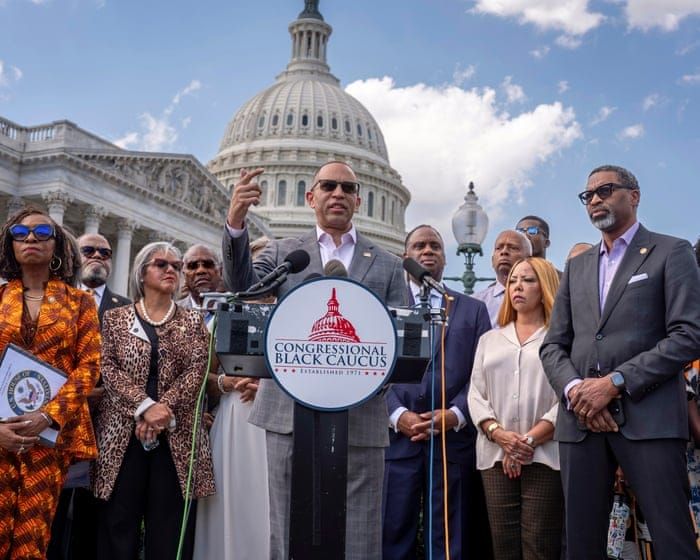
The campaign, launched Tuesday with the backing of House Minority Leader Hakeem Jeffries, asks Black athletes to consider whether they want to enroll in universities whose host states are actively working to make their votes count less. Jeffries called it an "unprecedented moment, featuring an unprecedented attack on Black political representation" requiring an "unprecedented response." He invoked Jackie Robinson. The framing is deliberate and the stakes are real — but the argument the NAACP and Jeffries are making in public understates the structural contradiction at the center of this story.
This isn't primarily a story about athletes as political actors. It's a story about an economic arrangement that has always extracted value from Black athletes while insulating the institutions — and the states that house them — from political accountability to Black communities. The boycott campaign is significant not because it is a new tactic, but because it names, for the first time at this scale and with this level of political backing, the connection between athletic revenue extraction and political disenfranchisement. Those two phenomena have the same geography, the same beneficiaries, and — the NAACP is now arguing — the same remedy.
The mechanism here is worth being precise about. The Louisiana v. Callais decision, handed down by a Supreme Court whose current composition was shaped by years of dark-money investment in the federal judiciary, gave states significant new latitude to redraw congressional maps in ways that dilute Black voting power. Virginia's Supreme Court erased four Democratic House seats through redistricting earlier this year; Florida executed a similar map that makes four Democratic seats disappear, as Tinsel News has reported. The pattern is not incidental. It is a coordinated, multi-state effort to lock in legislative majorities that are structurally insulated from the demographic changes that would otherwise threaten them.
The universities in these states are not passive bystanders. They are anchor institutions — major employers, major donors to state political infrastructure, and major recipients of state funding. Their athletic programs, many of which rank among the most profitable enterprises in American amateur sports, depend on recruiting Black athletes at rates that far exceed Black enrollment in the broader student population. The SEC schools are not outliers here; they are the center of the model. And their silence in the face of voter suppression legislation in their own states is a form of complicity that the NAACP is now asking athletes to price into their recruitment decisions.
The Supreme Court's ruling in Louisiana v. Callais significantly weakened the Voting Rights Act, giving states new authority to redraw congressional maps in ways that reduce Black political representation. All eight states targeted by the NAACP's "Out of Bounds" campaign have moved to draw new voter maps in the ruling's wake.
Jeffries's decision to amplify the campaign is itself analytically interesting. Democrats have spent years searching for ways to apply pressure in states where electoral politics has been structurally foreclosed — where gerrymandering, voter ID laws, and now Callais-enabled redistricting have made conventional political organizing insufficient to change outcomes. The boycott framework offers something that voting drives and litigation cannot: it applies economic pressure at the point where these states are most exposed. College football and basketball are not peripheral to the economies and identities of Alabama, Georgia, Mississippi, and Tennessee. They are central to them. A credible threat to the recruiting pipelines that sustain those programs is a different kind of political pressure than anything the Democratic Party has deployed in these states in decades.
The Jackie Robinson comparison is worth examining rather than simply accepting. Robinson's integration of Major League Baseball was a profound act, but it was also an act of inclusion into an existing economic structure — one that Black athletes were asked to enter on terms they did not set. The boycott logic inverts that dynamic. It asks Black athletes not to integrate but to withhold — to treat their labor as a bargaining position rather than as a gift to institutions that have not earned it. That is a materially different argument, and a more structurally sophisticated one than the Robinson framing suggests.
There are real questions about whether a boycott of this scope is achievable. Recruiting decisions involve scholarships, coaching relationships, family finances, and career trajectories. Asking an 18-year-old to forgo a scholarship to the University of Alabama because the Alabama legislature redrew its congressional maps is asking that athlete to absorb a cost that the legislature, the university president, and the head football coach will not share. The campaign's architects know this. The goal of the announcement phase is not mass immediate compliance — it is to make the connection visible, to put it on the table during every recruiting visit in every targeted state, and to force university administrators to either defend their silence or break it.
The silence of SEC athletic programs is the campaign's sharpest target. According to The Guardian's reporting, Jeffries specifically called out SEC schools for their failure to speak up as their states moved to limit Black voting rights. That silence has a cost-benefit logic: the universities profit from the current arrangement and have no material incentive to antagonize the state legislators who control their budgets. The NAACP's campaign is an attempt to change that calculus — to make silence more expensive than it currently is.
Whether the campaign achieves its immediate goal of influencing recruiting decisions matters less than what it establishes as a framework. The argument that athletic labor and political rights exist in the same moral universe — that you cannot extract one while suppressing the other without someone eventually naming the contradiction — is not going away. Gerrymandering and redistricting have accelerated since Dobbs and Callais, and the communities most affected are the same communities whose athletic talent fills these rosters and funds these programs. The NAACP has given that connection a name and a campaign structure. The universities that stay silent are now making a legible choice, not just an institutional default.
The deeper question the "Out of Bounds" campaign forces is one that neither the NAACP nor Jeffries has fully answered: what do these universities owe the communities whose labor built them? Not just in athletics — in the broader history of Southern public universities, many of which were explicitly built to exclude Black students and have spent the decades since integration extracting Black athletic and academic talent without proportionate political investment in the communities those students come from. The voter map fight is the latest chapter in that history. The boycott campaign is the first time the economic power created by that history has been named as a political tool. That is what makes it significant — not the Jackie Robinson metaphor, but the structural argument underneath it.
The eight targeted states will hold legislative sessions and draw more maps regardless of what happens this recruiting cycle. But the universities in those states now face a choice their administrators have not had to make publicly before: defend the political environment their silence enables, or use the institutional weight that $100 million in annual athletic revenue gives them to push back against it. Every head coach who recruits in Alabama, Georgia, or Florida this fall will be asked, by athletes and their families, where the program stands. That question did not exist at this scale before Tuesday. It does now.