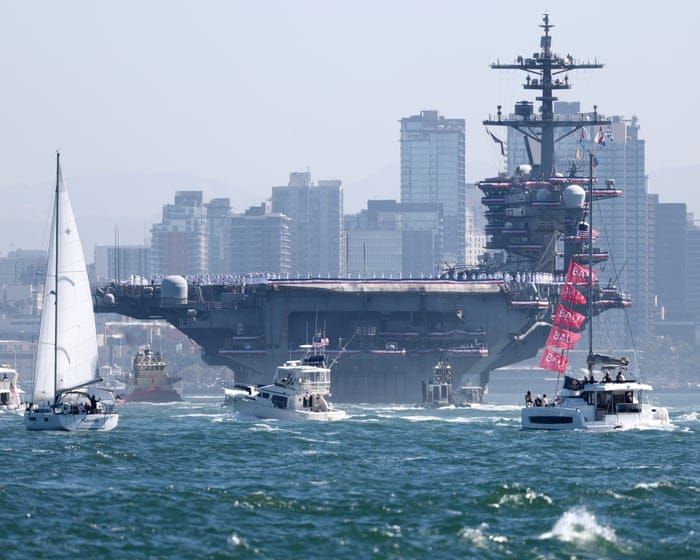
Eight sailors attempted to take their own lives aboard the USS Abraham Lincoln during its deployment to the Persian Gulf. When the carrier returned to San Diego and the crowds came out to welcome it home, the ship's commanding officer, Captain Dan Keeler, addressed the attempts by telling reporters there were "no lost lives on board" — and that the deployment had been the "first experience with combat" for most of the crew. Those two facts are not in tension. They are the same fact, seen from different angles.
The Guardian US reported Keeler's remarks as the Lincoln docked following what military officials described as a record-length deployment. What the Pentagon's language consistently does with events like this — "lengthy tour," "no lost lives" — is convert a human emergency into an administrative data point. Eight people in a confined, high-pressure environment, many experiencing combat for the first time, attempted to end their lives. The institution's public response was to note that none of them succeeded.
Extended carrier deployments — those running significantly beyond the standard 6-7 month rotation — are associated with elevated rates of psychological distress, relationship breakdown, and suicidal ideation. The USS Abraham Lincoln's deployment to the Persian Gulf came amid active U.S. military operations against Iran, meaning crew members faced both the duration stress of a prolonged tour and the acute psychological weight of combat exposure, often for the first time.
What the Pentagon's framing obscures is this: the military does not have a mental health crisis despite its operational demands — it has a mental health crisis because of decisions made at the top of the chain of command about how long to deploy people, into what conditions, with what preparation, and with what support structures in place. Eight suicide attempts on a single vessel during a single deployment is not a tragic anomaly. It is the measurable human cost of policy choices that will never appear in a Pentagon budget line.
Captain Keeler's framing — "no lost lives on board" — is worth examining as a rhetorical act. It redefines success as the absence of death, rather than the presence of wellbeing. By that standard, a crew of thousands returning with eight people who tried to die but didn't is a success. The eight people who tried are a rounding error. This is how institutions absorb evidence of their own failure: by setting the bar low enough that they clear it, then calling it a record.
The question is not whether Captain Keeler is a callous man — there is no evidence of that. The question is what system produced a situation in which a commanding officer, facing reporters after a deployment with eight suicide attempts, reached for the phrase "no lost lives" as his headline. That language did not come from nowhere. It came from a military culture that has spent decades developing sophisticated vocabulary for minimizing the psychological cost of service, because acknowledging that cost in full would require confronting the decisions that produce it.
Those decisions include: how long to sustain a deployment, how to rotate crews under operational pressure, what mental health infrastructure to embed in a carrier strike group, and whether the missions being assigned are proportionate to the human cost of carrying them out. The Lincoln's deployment coincided with active U.S. military operations against Iran — operations that Tinsel News has documented were launched without congressional authorization and at a cost that Congress has never formally approved. The sailors who attempted suicide were not abstractions in that debate. They were the people closest to its consequences.
The Pentagon has cycled through this pattern for twenty years. After Iraq and Afghanistan, the military acknowledged a mental health crisis among veterans and active-duty personnel. It funded studies, launched programs, trained chaplains, and embedded counselors. The suicide rate among active-duty service members has remained persistently elevated. The reason is not that the programs failed to help individuals — some did. The reason is that the programs addressed symptoms while the institution continued to generate the conditions: extended deployments, repeated combat exposure, inadequate transition support, a culture in which seeking help remains career-penalizing despite official messaging to the contrary.
The "first experience with combat" detail in Keeler's remarks deserves particular attention. Most of the Lincoln's crew encountered combat for the first time during this deployment. That is not a footnote — it is a description of a psychological event that military research consistently identifies as a major risk factor for acute mental health crises. The military knows this. The research is not obscure. What it means in practice is that the Pentagon sent thousands of people into their first combat experience on a record-length deployment, and when eight of them attempted suicide, the commanding officer's public framing was that no one died.
Follow the money, and it runs through the Pentagon budget. Pete Hegseth has sought a 44 percent increase in Pentagon spending — a budget that funds weapons systems, contractor relationships, and force projection. Mental health infrastructure for enlisted personnel is not a line item that generates the same political returns as a carrier strike group. The Lincoln itself costs roughly $13 billion to build and billions more to operate annually. The investment in the psychological wellbeing of the people who operate it is not proportionate, and the disproportion is a choice.
There is also a question about what "thousands turned out to welcome weary sailors" means when placed next to eight suicide attempts. The homecoming ceremony is real, the gratitude is real, and the sailors who returned deserve both. But the ceremony also functions as a closing bracket — it marks the deployment as complete, the sailors as returned, the chapter as closed. It does not ask what happened inside that chapter, or who is responsible for the conditions that produced it, or what changes before the next deployment begins.
The sailors who attempted suicide on the USS Abraham Lincoln are not, in the end, a story about individual fragility or the inevitable cost of service. They are a story about what happens when an institution treats human beings as a deployable resource, extends that deployment past its documented psychological limits, sends those people into combat for the first time without adequate preparation or support, and then — when the predictable crisis arrives — measures success by the absence of death rather than the presence of care. Eight people tried to die. The Pentagon called it a lengthy tour. Those two sentences are the same sentence, translated into different languages.
The Lincoln will deploy again. The next crew will face the same calculus — the same extended rotations, the same operational pressure, the same gap between official messaging about mental health and the actual culture aboard a combat vessel. Until the Pentagon is required to account for psychological casualties with the same rigor it accounts for material losses, the eight suicide attempts on the Lincoln will be absorbed into the institution as a data point rather than a verdict. The families of those eight sailors already know which one it is.