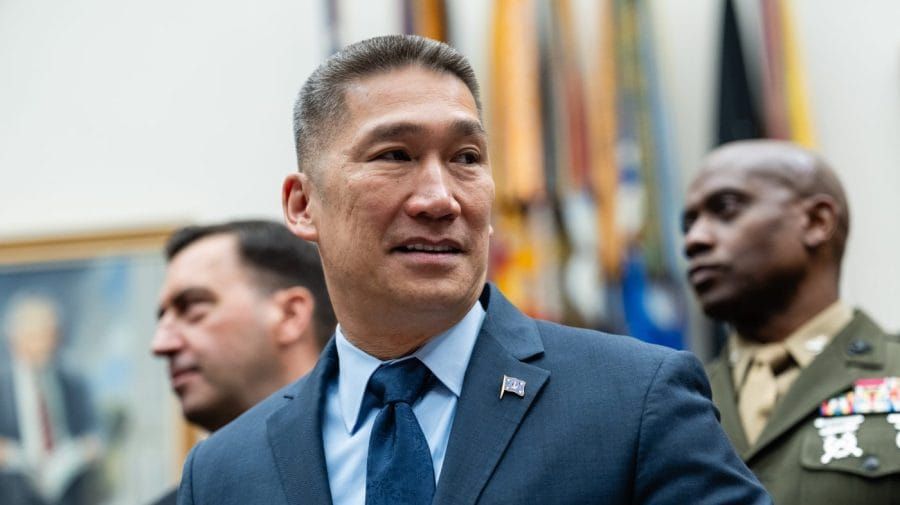
Eight sailors attempted to end their lives during a single deployment. That is the number Acting Navy Secretary Hung Cao disclosed to a Senate Democrat this week, according to The Hill, which reported the figure came in a letter — not testimony, not a press briefing, not a public statement. A letter. The USS Abraham Lincoln carrier strike group had been at sea for months, conducting military operations against Iran in a war Congress never formally authorized. Eight people, on one ship group, tried to die.
The number is not a data point. It is a measure of what prolonged, unauthorized, politically driven military deployment does to the people who have to execute it. And the fact that it arrived via correspondence to a single senator — not in a congressional hearing, not in a Defense Department press release — tells you nearly as much as the number itself.
The USS Abraham Lincoln's deployment has been one of the longest in recent carrier history. The strike group, which includes not just the carrier but its air wing and accompanying vessels, was extended as the administration escalated its military campaign against Iran. Sailors who had expected to come home kept waiting. Families kept waiting. The ship kept moving.
The military has a documented mental health crisis that long predates this deployment. Suicide rates among active-duty service members have exceeded combat death rates in nearly every year since 2012. The Department of Defense publishes an annual suicide report. Researchers have identified extended deployments, operational tempo, and lack of mental health access as primary risk factors. None of this is new information. What is new is that eight attempts happened on one strike group during one deployment — and the public learned about it only because a senator asked and a cabinet official put the answer in writing.
That disclosure pattern deserves scrutiny on its own terms. The Pentagon under Pete Hegseth has prioritized budget expansion and operational aggression while systematically cutting the civilian oversight infrastructure that would normally surface this kind of information. The acting Navy secretary's letter was not a proactive disclosure. It was a response to a direct inquiry. Without the senator's question, the eight attempts may not have become public at all.
This is how the human cost of the Iran war gets managed: not denied, not addressed, but administratively contained. The number exists in a letter. The letter went to one senator. The senator is a Democrat with no committee power to compel further testimony. The cycle ends there unless someone forces it open.
The Iran war, as Tinsel News has documented across multiple reporting cycles, has cost at least $12 billion and has proceeded without a formal congressional authorization. The White House has claimed executive authority to conduct operations. Congress has passed resolutions challenging that authority and watched them ignored. The sailors on the Abraham Lincoln were deployed into that legal and political vacuum — extended at sea, conducting combat operations, with no clear exit timeline and no democratic mandate underpinning the mission they were executing.
That context is not incidental to the eight suicide attempts. It is structural. Research on military mental health consistently identifies mission clarity, command legitimacy, and deployment predictability as protective factors. When troops do not know why they are fighting, when deployments stretch beyond their announced endpoints, when the political authority for their mission is contested at home — those are not abstract policy concerns. They are conditions that erode psychological resilience in documented, measurable ways.
The military campaign against Iran has proceeded without a formal Authorization for Use of Military Force (AUMF). Congress has passed multiple resolutions challenging executive authority to conduct operations, all of which the White House has ignored. Sailors on the USS Abraham Lincoln were deployed into — and extended within — this legally contested mission. The Senate has held no dedicated hearing on the mental health consequences of the deployment's length.
The administration has not called the situation on the Abraham Lincoln a crisis. It has not announced a review of deployment length policy. It has not committed to a hearing. The acting Navy secretary disclosed the number because he was asked. That is the full extent of the institutional response so far.
What accountability looks like here is not complicated: a public hearing, under oath, in which military leadership explains the deployment extension timeline, the mental health support available to sailors during extended operations, and what protocols exist for identifying and intervening when sailors are in crisis at sea. Those hearings could happen. The Senate Armed Services Committee has the authority to call them. The question is whether the political will exists to treat eight suicide attempts as a consequence that demands examination rather than a statistic that can be absorbed into a letter and filed.
The sailors on the Abraham Lincoln are not the only ones bearing this cost. The full accounting of the Iran war's human toll includes the Iranian civilians killed in strikes, the regional populations living under the economic consequences of a closed Strait of Hormuz, and the American service members sent to execute a mission whose legal foundation remains, at best, contested. Eight of those service members tried to die. The people with the power to ask why are in the Senate. Most of them have not asked.
A deployment that produces eight suicide attempts on one strike group is not a personnel management problem. It is a policy consequence. The policy is a war. The war has no authorization, no exit strategy, and — until a senator sent a letter — no public accounting of what it is costing the people fighting it.