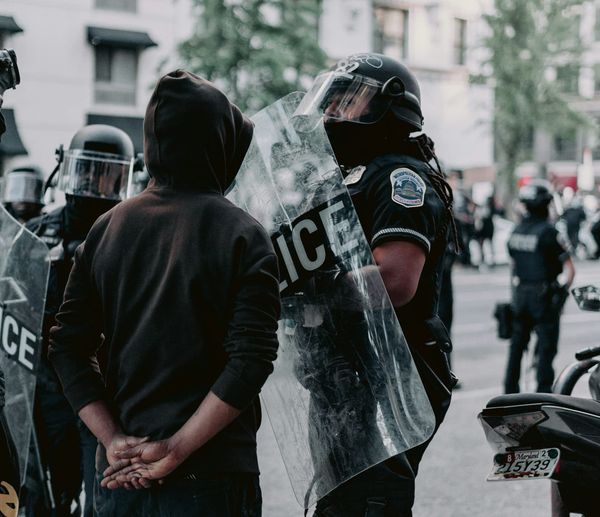
In March 2025, the New York Police Department's Twitter account posted a video of officers playing basketball with children in Brooklyn. The clip went viral — 4.3 million views, thousands of shares, comments praising the NYPD for "community engagement." What the video didn't mention: the precinct that filmed it had the second-highest rate of stop-and-frisk complaints in the city that quarter, according to data from the New York Civil Liberties Union.
This is copaganda. Not misinformation, exactly — the officers really did play basketball with kids. But the framing, the omission, the platform amplification, and the emotional register all work together to construct a version of policing that erases accountability, normalizes surveillance, and makes criticism feel like ingratitude.
Copaganda is the systematic use of media — news coverage, entertainment, social platforms, and public relations — to shape public perception of police in ways that obscure violence, preempt accountability, and manufacture consent for expanded law enforcement power. It is not a conspiracy. It is a structure. And it has been embedded in American media for over a century.
What is copaganda?
The term "copaganda" — a portmanteau of "cop" and "propaganda" — describes media content that promotes a positive image of law enforcement while downplaying or erasing systemic problems like excessive force, racial profiling, and lack of accountability. It operates across multiple platforms: local news crime coverage, scripted television dramas, social media accounts run by police departments, and even reality shows that embed journalists with law enforcement.
Copaganda is not defined by intent. A local news reporter covering a police press conference is not necessarily trying to run PR for the department. But when that reporter uncritically repeats the police version of events, uses police-provided footage, and centers the department's framing without seeking comment from affected communities, the structural effect is the same: the police control the narrative.
The term gained mainstream traction after the 2020 protests following George Floyd's murder, when media critics and activists began documenting how news outlets and entertainment companies consistently framed policing from the perspective of law enforcement. But the practice is far older. The Federal Bureau of Investigation has maintained a dedicated public relations apparatus since the 1930s, when Director J. Edgar Hoover cultivated relationships with Hollywood studios and radio producers to shape the bureau's image.
Content qualifies as copaganda when it does one or more of the following:
- Frames police as the primary or sole credible source in a story about policing
- Uses passive voice or euphemism to obscure who committed violence ("officer-involved shooting" instead of "police shot")
- Highlights individual acts of kindness while ignoring systemic accountability failures
- Treats police press releases as neutral fact without independent verification
- Excludes or marginalizes the perspectives of people harmed by police
Copaganda is effective because it does not feel like propaganda. A news segment about a police officer buying groceries for a family in need is not overtly political. A procedural drama where detectives solve crimes and protect victims is not explicitly pro-police in the way a campaign ad would be. But the cumulative effect — thousands of hours of media content that consistently centers police perspectives, valorizes law enforcement labor, and treats police violence as an exception rather than a pattern — shapes how millions of people understand what police do and whether they should be trusted.
The history of police image management
American police departments did not always have public relations strategies. For much of the 19th and early 20th centuries, police were understood as a blunt instrument of municipal power — corrupt, violent, and accountable primarily to political machines. The transformation of police into a profession with a carefully managed public image began in earnest in the 1920s and 1930s, when Progressive Era reformers sought to professionalize law enforcement and distance it from machine politics.
J. Edgar Hoover, who became FBI director in 1924, pioneered the use of mass media to construct a heroic image of federal law enforcement. Hoover cultivated relationships with journalists, fed them stories about FBI successes, and worked directly with Hollywood studios to shape how the bureau appeared on screen. Films like "G Men" (1935) portrayed FBI agents as incorruptible defenders of the public — a stark contrast to the reality of an agency that systematically surveilled and disrupted civil rights organizations under Hoover's leadership.
Local police departments followed suit. By the 1950s, many large urban police forces had dedicated public information officers whose job was to manage media relationships and control the flow of information about police activity. The Los Angeles Police Department under Chief William Parker became a model for this approach. Parker worked closely with the creators of "Dragnet," a radio and television series that depicted LAPD officers as professional, restrained, and effective. The show's famous tagline — "Just the facts, ma'am" — became synonymous with a vision of policing as objective and apolitical.
This was copaganda in its formative stage: not crude propaganda, but a sophisticated effort to align entertainment narratives with institutional interests. And it worked. By the 1960s, public approval of police was at historic highs — even as departments like the LAPD were surveilling civil rights activists and using violent tactics to suppress protests.
The 1980s and 1990s saw the rise of "tough on crime" politics, and copaganda evolved to match. Shows like "COPS," which premiered in 1989, embedded cameras with police officers and framed arrests from law enforcement's perspective. The show disproportionately depicted Black and Latino people as suspects, reinforcing racial stereotypes about crime. A 1998 study published by the National Institute of Justice found that viewers of "COPS" were more likely to overestimate crime rates and support punitive policies.
How copaganda works in media
Copaganda is not a single tactic. It is a system of practices embedded across news, entertainment, and public relations. Understanding how it works requires looking at the specific mechanisms that shape coverage — from sourcing routines to narrative framing to the economic incentives that govern media production.
Sourcing imbalance. The most fundamental mechanism of copaganda is who gets to speak. In crime reporting, police are almost always the primary source. Reporters attend police press conferences, quote police spokespeople, and use police-provided statistics. This is partly a function of access: police departments have public information officers whose job is to provide information to journalists. Community members affected by police violence rarely have equivalent institutional resources.
The result is structural bias. When a police shooting occurs, the first version of events the public hears is almost always the police version. By the time independent witnesses come forward or video evidence emerges, the initial narrative has already shaped public perception. A 2021 analysis by The Marshall Project found that in the immediate aftermath of police shootings, 80 percent of news stories relied exclusively on police accounts.
Passive voice and euphemism. Language shapes perception. Copaganda often relies on passive constructions that obscure agency. "Officer-involved shooting" is the most notorious example — a phrase that makes it sound like the officer was present when a shooting occurred, rather than the person who did the shooting. "Suspect died in custody" erases the question of how. "Force was used" does not specify who used it or why.
These are not neutral editorial choices. They are choices that protect police from accountability by making violence sound procedural and inevitable. When a headline reads "Man Dies After Encounter With Police," the framing suggests the death was incidental to the encounter, not caused by it. When the headline reads "Police Killed a Man During a Traffic Stop," the responsibility is clear.
Embedded journalism and ride-alongs. Shows like "COPS" and "Live PD" pioneered a model where journalists or camera crews accompany police on patrol. This creates an inherent identification with law enforcement. The viewer sees the world from the officer's perspective — literally, in the case of body camera footage aired without context. The people being arrested are framed as threats, problems to be solved. Their perspective is absent.
Even in traditional print and broadcast journalism, ride-alongs create relationships that shape coverage. A reporter who spends hours with officers, hears their frustrations, and witnesses their daily routines is more likely to frame stories from their perspective. This is not necessarily conscious bias — it is the predictable result of access and proximity.
Entertainment as normalization. Scripted television has been one of the most powerful vectors for copaganda. Procedural dramas like "Law & Order," "Blue Bloods," and "Chicago P.D." depict police as flawed but ultimately heroic figures who solve crimes, protect victims, and navigate a justice system that is too lenient on criminals. These shows rarely depict wrongful arrests, police brutality, or the ways the criminal legal system disproportionately harms Black and brown communities.
The cumulative effect is normalization. Millions of Americans have watched thousands of hours of television in which police are the protagonists, their authority is legitimate, and their violence is justified. When real-world police violence occurs, viewers interpret it through the lens of these narratives. The officer must have had a reason. The victim must have done something. The system must work, because we have seen it work on television.
Social media copaganda
The rise of social media gave police departments a direct channel to the public, bypassing traditional media gatekeepers. By 2025, nearly every major police department in the United States has a Twitter account, a Facebook page, and often an Instagram presence. These accounts post feel-good stories, highlight community engagement, and frame police work as service.
This is copaganda optimized for the attention economy. A video of an officer dancing with a child at a community event will get far more engagement than a press release about use-of-force statistics. Police departments know this. They produce content designed to go viral — and it works.
The NYPD's basketball video is a textbook example. The department's social media team knew the video would perform well. It features children, physical activity, and officers smiling. It costs nothing to produce. And it generates goodwill that insulates the department from criticism when accountability issues arise. When activists point out that the same precinct has a pattern of constitutional violations, the response is predictable: "But we saw them playing basketball with kids. They can't be that bad."
Social media copaganda also takes more aggressive forms. Police departments use platforms to shape narratives in real time during protests or high-profile incidents. They post their version of events immediately, often before journalists can verify facts. By the time corrections or alternative accounts emerge, the police narrative has already been shared thousands of times.
During the 2020 protests, police departments across the country used social media to post images of property damage, frame protesters as violent, and justify crackdowns. A 2021 report by the Brennan Center for Justice documented how police used social media not just for PR, but for surveillance — monitoring activist accounts, tracking protest organizers, and building dossiers on people who criticized law enforcement. The same dynamics that make government agencies deploy cultural propaganda to shape public opinion apply here: the medium changes, but the strategy of manufacturing consent through emotionally resonant content does not.
How to recognize it
Copaganda is everywhere, which makes it easy to miss. But once you know the patterns, they become impossible to ignore. Here are the most common signs:
Police are the only sources. If a story about policing quotes only police officials, it is copaganda. Journalism requires multiple perspectives. A story about a police shooting that does not include comment from the family, witnesses, or community advocates is incomplete by design.
Passive voice obscures responsibility. Watch for phrases like "officer-involved shooting," "suspect died in custody," or "force was used." These constructions erase the actor. Ask: who shot? Who killed? Who used force?
Heroic framing of routine work. A story about an officer helping someone is not inherently copaganda. But when these stories are used to deflect from accountability issues — or when they are amplified by police departments as PR — they become part of the system. Context matters.
Crime statistics without context. Police departments often release crime statistics to justify budget increases or expanded powers. But those statistics rarely include context about how crime is measured, what gets counted, or how enforcement patterns shape the data. A rise in arrests does not necessarily mean a rise in crime — it can mean a rise in policing.
Protesters framed as the problem. Coverage of protests that focuses on property damage, traffic disruption, or "clashes with police" rather than the reasons people are protesting is copaganda. It centers the perspective of authorities and treats dissent as disorder.
- Who is quoted? Are community members, witnesses, or affected families included, or only police?
- Whose perspective does the headline center? Does it frame the story from law enforcement's point of view?
- Is passive voice used to describe police actions? Does the language obscure who did what?
- Are police claims presented as fact, or are they attributed and verified?
- Does the story provide context about patterns of police behavior, or treat this incident as isolated?
Entertainment that never questions police authority. Procedural dramas are not required to be anti-police. But when a show consistently depicts police as heroes, never shows wrongful arrests or brutality, and frames the justice system as fundamentally fair, it is shaping perception in ways that benefit law enforcement. The absence of accountability narratives is itself a form of copaganda.
Why it matters for accountability
Copaganda is not just a media criticism issue. It has material consequences for accountability, policy, and the distribution of power. When the public consistently receives information about policing from the perspective of police, it becomes harder to build support for reforms that limit police power.
Consider qualified immunity, the legal doctrine that shields police officers from civil liability for constitutional violations. Efforts to reform or eliminate qualified immunity have faced significant public opposition, in part because many Americans believe that police need these protections to do their jobs. That belief is shaped by decades of media narratives that depict policing as dangerous, difficult work performed by people who make split-second decisions under pressure. Those narratives are not false, but they are incomplete. They erase the perspective of people harmed by police, the systemic nature of police violence, and the ways legal protections enable abuse.
Copaganda also shapes how the public interprets high-profile cases of police violence. When George Floyd was killed in 2020, the initial police statement described a "medical incident" during an arrest. That framing — passive, clinical, obscuring responsibility — is copaganda. It took bystander video to force a reckoning with what actually happened. But in the vast majority of cases, there is no video. The police version becomes the official version, and accountability never arrives. The same pattern emerges when major news outlets amplify false narratives without independent verification, allowing a single source's framing to harden into accepted fact before corrections can catch up.
The economic stakes are also significant. Police departments compete for public resources. When departments successfully cultivate positive media images, they are more likely to secure budget increases, resist cuts, and win public support for expanded powers. Copaganda is not just about perception — it is about money and institutional power.
Finally, copaganda shapes who gets to participate in debates about public safety. When media consistently center police perspectives and marginalize the voices of people most affected by policing — particularly Black and brown communities — it narrows the range of acceptable policy options. Abolition, divestment, and community-based safety models are framed as radical or unrealistic, while increased police funding and expanded enforcement are treated as common sense. This is not a neutral editorial judgment. It is a political choice shaped by decades of copaganda.
Breaking the cycle requires structural change: newsrooms that diversify their sources, entertainment industries that tell more complex stories about policing, social media platforms that do not algorithmically reward police PR, and a public that demands accountability over reassurance. The first step is recognizing the system for what it is. Copaganda is not a series of individual failures. It is the way the machine is designed to work.