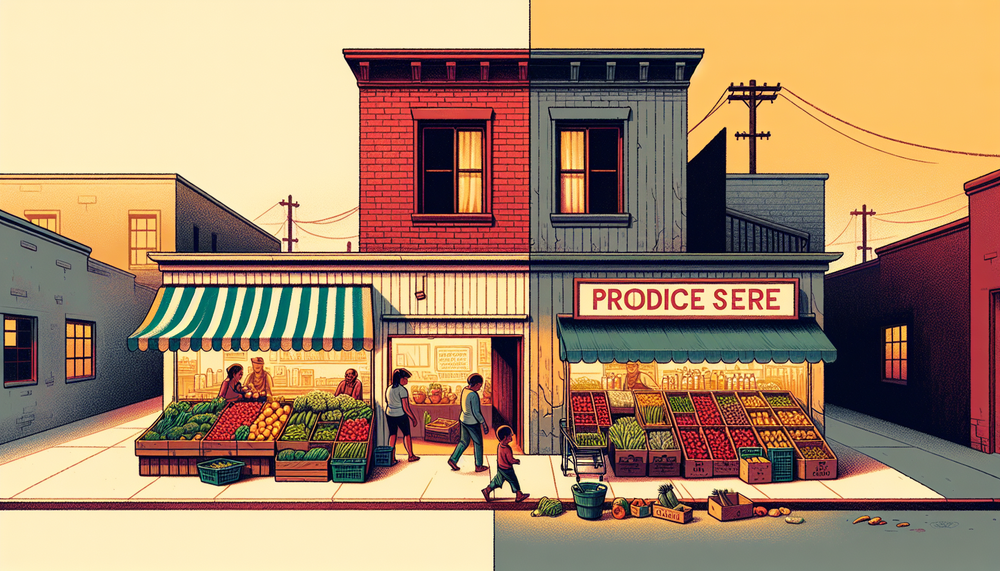
In 2018, Karen Washington stood before an audience in New York and said what many in the food justice movement had been thinking for years: "Food desert" was the wrong term. The phrase suggested a natural phenomenon, an empty landscape where nothing could grow. But Washington, a Bronx-based farmer and activist, knew better. The absence of fresh food in her neighborhood wasn't an accident of geography. It was a policy choice.
"I think we need to say food apartheid," Washington told the crowd. "Because food desert makes it seem like this is natural, like it just happened. But it didn't just happen. It was created."
The term she offered — food apartheid — reframes the entire conversation. It names a system of segregation that determines who eats well and who doesn't based on race and class. And it identifies the actors responsible: governments that disinvest, corporations that redline, and a real estate market that treats grocery access as a luxury good.
Food apartheid is a system of segregation that restricts access to healthy, affordable food based on race, class, and geography. Unlike "food desert," which suggests a natural void, food apartheid identifies the structural forces — redlining, disinvestment, corporate consolidation — that actively create and maintain unequal food access.
What is food apartheid?
Food apartheid describes the structural barriers that prevent communities — overwhelmingly Black, Latino, and low-income — from accessing fresh, nutritious, affordable food. The term was popularized by Karen Washington and other food justice organizers who argued that "food desert" obscured the human decisions behind food inequality.
The framework identifies three interlocking systems:
Economic segregation. Grocery chains use algorithms that factor in median income, car ownership, and credit scores to determine store locations. Neighborhoods below certain thresholds don't get stores — regardless of population density or demand. A 2021 study by the Johns Hopkins Center for a Livable Future found that majority-Black census tracts have 50 percent fewer supermarkets per capita than majority-white tracts, even when controlling for income.
Geographic isolation. Zoning laws and highway construction physically separate low-income communities from commercial districts. In Detroit, the construction of Interstate 375 in the 1960s demolished Black Bottom, a thriving Black neighborhood with its own commercial corridor. The highway remains. The grocery stores never returned. Today, Detroit has one supermarket for every 13,000 residents — compared to one per 3,800 in suburban Oakland County.
Corporate extraction. When grocery stores do operate in low-income neighborhoods, they often charge higher prices for lower-quality products. A 2019 investigation by The Guardian found that residents of food apartheid zones in Chicago paid up to 40 percent more for the same items available in wealthier neighborhoods three miles away. The price gap exists even within the same grocery chain.
Why not 'food desert'?
The term "food desert" entered policy vocabulary in the 1990s through British public health research. By the 2000s, the U.S. Department of Agriculture had formalized the definition: a census tract where at least 33 percent of the population lives more than one mile from a supermarket in urban areas, or more than ten miles in rural areas.
The language caught on because it sounded neutral. It described a problem without naming who created it. That neutrality is precisely what food justice advocates reject.
The passive framing — "food deserts exist" — erases agency. It suggests that grocery stores simply failed to materialize, rather than acknowledging that corporations made calculated decisions not to serve certain populations. It ignores the history of redlining, urban renewal, and white flight that created the conditions for food inequality.
The USDA's definition also centers distance rather than access. A neighborhood can have a supermarket within one mile and still experience food apartheid if residents lack cars, if public transit is inadequate, if the store's prices are prohibitively high, or if the produce section stocks wilted lettuce while the suburban location three miles away offers organic kale.
Food apartheid names what food desert obscures: this is a system, not a gap. It was built. It is maintained. And it serves specific interests.
How food apartheid works
Food apartheid operates through a combination of historical policy decisions and contemporary corporate practices. The system didn't emerge overnight — it was constructed over decades through deliberate choices about where to invest and where to abandon.
Redlining created the foundation. Beginning in the 1930s, the Home Owners' Loan Corporation drew maps of American cities, color-coding neighborhoods by perceived investment risk. Black neighborhoods were marked red — "hazardous" — and denied access to federally backed mortgages. Banks and insurers followed suit. The result: systematic disinvestment in Black communities that lasted generations.
When grocery chains expanded in the postwar era, they used the same maps. Stores followed white residents to the suburbs. Urban neighborhoods lost their commercial infrastructure. By the 1970s, major chains had largely exited inner cities. The few stores that remained were often smaller, more expensive, and stocked with lower-quality goods.
Corporate consolidation accelerated the problem. In 1990, the four largest grocery chains controlled 15 percent of the market. By 2020, that figure had risen to 40 percent, according to the U.S. Department of Agriculture Economic Research Service. Consolidation gave chains more power to choose where they operated — and where they didn't.
The decision-making process is algorithmic. Chains analyze demographics, income levels, car ownership rates, and competition. Neighborhoods that don't meet profitability thresholds are excluded. The algorithms don't explicitly reference race, but they don't need to — they use proxies that correlate tightly with racial demographics, a dynamic that mirrors how algorithmic tools sort workers into economic classes across other industries.
Zoning laws reinforce segregation. Many low-income neighborhoods are zoned for industrial use, making it difficult to open grocery stores even when demand exists. In South Los Angeles, a 2016 analysis by the Los Angeles Food Policy Council found that 40 percent of parcels suitable for grocery stores were zoned for manufacturing. Changing the zoning requires navigating a bureaucratic process that can take years and cost hundreds of thousands of dollars.
Meanwhile, dollar stores — which stock primarily processed foods with long shelf lives — face no such barriers. Between 2010 and 2020, dollar stores opened more than 10,000 new locations, many in neighborhoods that lost supermarkets. A 2021 study published in the journal Health Affairs found that each new dollar store in a census tract corresponded with a 2.4 percent increase in obesity rates.
The racial geography of grocery access
The distribution of grocery stores in America maps almost perfectly onto the country's history of racial segregation. This is not coincidence. It is cause and effect.
A 2022 study by researchers at the University of Illinois at Chicago analyzed grocery store locations in 100 U.S. metropolitan areas. The findings: majority-Black neighborhoods had 52 percent fewer supermarkets per capita than majority-white neighborhoods. Majority-Latino neighborhoods had 32 percent fewer. The disparities held even when researchers controlled for income, population density, and car ownership.
The health consequences are measurable. According to the Centers for Disease Control and Prevention, Black Americans are 60 percent more likely to be diagnosed with diabetes than white Americans. Latino Americans are 70 percent more likely. While genetics and healthcare access play roles, diet is a primary driver — and diet is shaped by what's available.
In neighborhoods experiencing food apartheid, corner stores and fast food restaurants outnumber supermarkets by ratios as high as 10 to 1. A 2020 study published in the American Journal of Public Health found that residents of these neighborhoods consume 30 percent fewer fruits and vegetables than the national average, not because of preference but because of access.
The economic impact extends beyond health. Families in food apartheid zones spend a larger share of their income on food — up to 25 percent compared to the national average of 10 percent, according to the U.S. Department of Agriculture. They also spend more time traveling to obtain it. A 2019 survey by Feeding America found that low-income households without cars spent an average of 3.5 hours per week traveling to and from grocery stores, often using multiple bus routes.
The pattern is national, but the severity varies by region. The South has the highest concentration of food apartheid zones, a legacy of Jim Crow-era segregation that was never dismantled. In Mississippi, 35 percent of the population lives in areas classified as food deserts by the USDA — the highest rate in the country. Nearly 70 percent of those residents are Black.
Karen Washington and the origins of the term
Karen Washington didn't set out to rename a national problem. She was trying to describe what she saw in the Bronx.
Washington grew up in New York City and became involved in urban agriculture in the 1980s, co-founding La Familia Verde Community Garden in the South Bronx. Over decades of organizing, she watched as supermarkets closed, corner stores raised prices, and her neighbors developed diet-related illnesses at rates far higher than the rest of the city.
The term "food desert" never sat right with her. It suggested passivity — as if healthy food had simply evaporated. But Washington knew the history. She knew about redlining. She knew that grocery chains had made deliberate decisions to exit her neighborhood. She knew that the same chains operated profitable stores in whiter, wealthier parts of the city.
In 2018, during a panel discussion at the James Beard Foundation, Washington offered an alternative: food apartheid. The term was borrowed from South Africa's history of institutionalized racial segregation, but Washington argued it fit the American food system just as well.
"Apartheid was a system designed to keep people separate and unequal," Washington said in a 2019 interview with Guernica magazine. "That's exactly what we have with food. It's not an accident. It's a structure."
The response was immediate. Some food justice organizers embraced the term, arguing it finally named the problem accurately. Others worried it was too confrontational, that it would alienate potential allies in government and philanthropy. Washington was unbothered by the discomfort.
"If the term makes you uncomfortable, good," she told Civil Eats in 2020. "It should make you uncomfortable. Because what's happening in these communities should make everyone uncomfortable."
Washington's framing has since been adopted by food justice organizations across the country, including the Detroit Black Community Food Security Network, the Los Angeles Food Policy Council, and the National Black Food and Justice Alliance. Academic researchers have begun using the term in peer-reviewed studies. In 2021, the American Public Health Association published a policy statement endorsing the shift from "food desert" to "food apartheid" in public health discourse.
The linguistic shift matters because it changes who is responsible. "Food desert" suggests the solution is to fill a void — bring in a grocery store, problem solved. "Food apartheid" suggests the solution requires dismantling a system — which means confronting the policies, corporate practices, and power structures that created the problem in the first place.
What food justice looks like
If food apartheid is a system, ending it requires more than opening a few grocery stores. It requires transferring power.
Food justice organizers have spent decades building alternatives: community gardens, food co-ops, urban farms, and mutual aid networks that operate outside the corporate food system. These projects don't just provide food — they challenge the assumption that communities experiencing food apartheid need to wait for corporations or governments to solve their problems.
Community ownership is the foundation. In Newark, New Jersey, the Newark Community Street Team operates a network of community fridges stocked by local residents and mutual aid groups. The fridges are free, accessible 24/7, and located in neighborhoods where the nearest supermarket is more than two miles away. Similar networks have emerged in Philadelphia, Los Angeles, and Chicago.
In Detroit, the Detroit Black Community Food Security Network runs D-Town Farm, a seven-acre urban farm that grows food for the community and trains residents in sustainable agriculture. The organization also operates the Detroit People's Food Co-op, a member-owned grocery store that prioritizes local, Black-owned suppliers.
Policy change targets the root causes. In 2018, Tulsa, Oklahoma, passed a zoning reform that restricted new dollar store construction in neighborhoods with limited grocery access. The ordinance was a direct response to advocacy by local food justice groups who argued that dollar stores were displacing potential supermarkets. Similar policies have since been adopted in cities including Birmingham, Alabama, and Cleveland, Ohio.
In California, the state legislature passed AB 1447 in 2021, which provides grants to community-based organizations to operate grocery stores in food apartheid zones. The program prioritizes worker cooperatives and nonprofit models over corporate chains. As of 2024, the program has funded 12 new stores, all community-owned.
Reparative investment acknowledges historical harm. In 2023, the city of Evanston, Illinois, launched a pilot program that provides $25,000 grants to Black residents to offset the cost of accessing healthy food. The program is funded by cannabis tax revenue and is explicitly framed as reparations for the city's history of redlining and discriminatory zoning.
Asheville, North Carolina, has committed $2.1 million in reparations funding specifically for food justice initiatives in historically Black neighborhoods. The funds support community gardens, farmers markets, and a mobile grocery service operated by a Black-owned cooperative.
The solutions emerging from food justice movements share a common thread: they center the communities experiencing food apartheid rather than treating them as passive recipients of aid. They recognize that people in these neighborhoods don't lack knowledge about nutrition or desire for healthy food — they lack power over the systems that determine what food is available and at what cost.
Karen Washington, now in her seventies, continues organizing in the Bronx. She's watched the term she popularized spread through academic journals, policy papers, and organizing spaces. But she's also clear that language alone doesn't change material conditions. The same structural inequities that shape who profits from Black and Latino communities building new industries apply equally to who controls the food those communities can access.
"Calling it food apartheid is a start," Washington said in a 2023 interview with The Counter. "But the real work is dismantling the system. And that means taking power away from the people who built it."