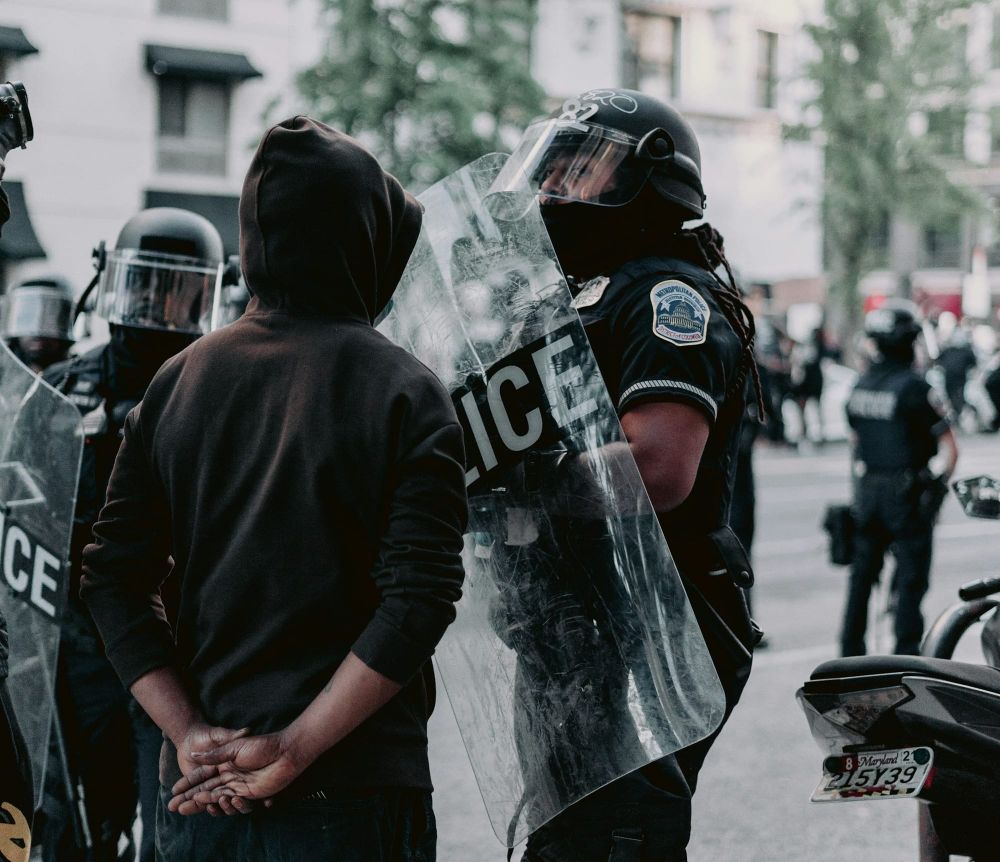
When police officers violate someone's constitutional rights — shooting an unarmed person, conducting an illegal search, using excessive force — the victim can file a civil lawsuit seeking damages. In theory. In practice, a legal doctrine called qualified immunity blocks most of those lawsuits before they reach a jury.
Qualified immunity is not in the Constitution. Congress never passed a law creating it. The Supreme Court invented it in 1967, then spent the next five decades expanding it into one of the most effective shields against police accountability in American law.
The doctrine works like this: even if an officer violated your rights, you cannot sue unless you can find a previous court case with nearly identical facts where a court ruled the conduct unconstitutional. If no such case exists — if the violation is novel, or the circumstances are slightly different — the officer is immune from liability. The right was violated. The officer faces no consequences.
What is qualified immunity?
Qualified immunity is a legal defense available to government officials — most commonly police officers — that shields them from civil liability for constitutional violations unless the victim can prove the right that was violated was "clearly established" at the time of the incident.
The phrase "clearly established" has a specific legal meaning. It does not mean the Constitution prohibits the conduct. It means a court has previously ruled that the specific conduct, under nearly identical circumstances, violated the Constitution. If no such ruling exists, the officer is immune — even if what they did was obviously unconstitutional.
The doctrine applies only to civil lawsuits seeking monetary damages under 42 U.S.C. § 1983, the federal law that allows people to sue government officials for constitutional violations. It does not prevent criminal prosecution, though criminal charges against police officers are rare. According to a 2019 analysis by The Washington Post, fewer than 1 percent of fatal police shootings since 2005 resulted in an officer being charged with a crime.
Qualified immunity also does not apply to injunctions — court orders requiring police departments to change their policies. But injunctions do not compensate victims. They do not hold individual officers financially accountable. And they require proving a pattern of misconduct, not just a single violation.
What qualified immunity does is ensure that in the vast majority of cases where police violate constitutional rights, the officer pays nothing. The victim gets nothing. And the violation creates no legal precedent that might prevent the same conduct in the future, because the case is dismissed before a court rules on the merits.
How qualified immunity works
The mechanics of qualified immunity are where the doctrine becomes a nearly insurmountable barrier. Courts apply a two-step test, though in practice they often skip straight to step two.
Step one: Did the officer violate a constitutional right? This is the question most people think lawsuits are about. Did the search violate the Fourth Amendment? Did the use of force violate the Eighth Amendment prohibition on cruel and unusual punishment?
Step two: Was the right "clearly established" at the time of the violation? This is where most cases die. To meet this standard, the victim must point to a previous case — ideally from the same federal circuit, though Supreme Court precedent also counts — where a court ruled that the specific conduct, under nearly identical facts, was unconstitutional.
The similarity requirement is extreme. In Jessop v. City of Fresno, police officers were accused of stealing $225,000 while executing a search warrant. The Ninth Circuit Court of Appeals acknowledged that theft is obviously illegal, but granted qualified immunity anyway because no previous case had established that stealing property during a search violated the Fourth Amendment. The fact that theft itself is a crime was not enough.
In Baxter v. Bracey, a police officer released a dog on a suspect who had surrendered and was sitting on the ground with his hands up. The Sixth Circuit granted qualified immunity because the prior case law involved a suspect who was lying down, not sitting. The difference in posture was enough to make the right not "clearly established."
Qualified immunity creates a logical paradox: victims cannot sue unless prior case law clearly establishes their right was violated. But if courts keep granting immunity because no prior case exists, no new precedent is ever created. The doctrine becomes self-reinforcing — the absence of precedent justifies immunity, and immunity prevents the creation of precedent.
Courts are not required to rule on whether a constitutional violation occurred before granting immunity. A 2009 Supreme Court decision, Pearson v. Callahan, gave judges permission to skip the constitutional question entirely and proceed straight to qualified immunity. This means an officer can win their case without a court ever deciding whether what they did was legal.
The result: police departments receive no guidance on what conduct is prohibited. Officers face no consequences for conduct that may be unconstitutional. And victims are left without remedy or precedent.
Where did qualified immunity come from?
Qualified immunity has no basis in the text of Section 1983, the Reconstruction-era civil rights law it purports to interpret. The statute, passed in 1871 to combat Ku Klux Klan violence and state complicity in racial terror, states that any person who violates constitutional rights "under color of" state law "shall be liable to the party injured." It contains no immunity provision. It contains no exception for government officials.
The Supreme Court created qualified immunity in 1967 in Pierson v. Ray, a case involving police officers who arrested Freedom Riders in Mississippi. The Court ruled that police officers should receive the same common-law immunities that existed when Section 1983 was passed — even though the historical record shows Congress specifically rejected immunity for government officials when it drafted the law.
Legal historians have documented this extensively. University of Chicago law professor William Baude published a comprehensive analysis in 2018 showing that the common-law defenses the Pierson Court relied on did not actually exist in 1871, and that the doctrine has "no legal justification."
The doctrine expanded significantly in 1982 with Harlow v. Fitzgerald, when the Court replaced the original "good faith" standard with the "clearly established law" test. The new standard was supposed to make immunity easier to resolve at early stages of litigation, sparing officers from the burden of trial. In practice, it made immunity nearly automatic.
By the 2000s, the doctrine had become so expansive that Justice Sonia Sotomayor wrote in a 2018 dissent that it "sends an alarming signal to law enforcement officers and the public. It tells officers that they can shoot first and think later."
Case studies: when qualified immunity blocks justice
The abstract legal standard becomes concrete in the cases where qualified immunity prevents accountability for documented constitutional violations.
Theft during a search warrant. In Jessop v. City of Fresno, police officers executing a search warrant at a suspect's home allegedly stole $225,000 in cash and rare coins. The Ninth Circuit acknowledged that "the City does not dispute that the theft of property is unconstitutional," but granted immunity because no case had specifically established that theft during the execution of a warrant violated the Fourth Amendment. The distinction: the officers were acting under color of law when they stole, which somehow made it different from ordinary theft.
Shooting a 10-year-old. In Corbitt v. Vickers, an Alabama police officer shot a 10-year-old boy who was lying on the ground after the officer had already shot and killed the boy's father. The boy survived. The Eleventh Circuit granted the officer immunity, ruling that while shooting the father might have been unconstitutional, no case law clearly established that shooting a non-threatening child in the immediate aftermath was also unconstitutional. The two acts were legally distinct.
Siccing a dog on a surrendered suspect. In Baxter v. Bracey, an officer released a police dog on a suspect who was sitting on the ground with his hands raised in surrender. The Sixth Circuit found prior case law involving a suspect who was lying down when a dog was released, but ruled that the difference between sitting and lying down meant the right was not clearly established. The Supreme Court declined to hear the case.
Tasing a non-resisting person. In Kelsay v. Ernst, officers tased a woman who was standing still, not fleeing, and posed no threat. She was seven months pregnant. The Eighth Circuit granted immunity because prior cases involved suspects who were fleeing or resisting — the fact that this woman was doing neither made her case legally novel.
These are not outliers. A 2020 Reuters investigation analyzed thousands of qualified immunity cases and found that courts granted immunity in the majority of cases, even when the constitutional violation was obvious to any reasonable observer.
The movement to end qualified immunity
Opposition to qualified immunity has become one of the few truly bipartisan criminal justice reform issues, uniting libertarian conservatives, progressive Democrats, and civil rights organizations.
The doctrine gained national attention after George Floyd's murder in 2020, when activists and legal scholars pointed out that qualified immunity would likely prevent Floyd's family from successfully suing the officers involved — even though Derek Chauvin was convicted of murder. Civil liability and criminal prosecution are separate legal tracks, and qualified immunity applies only to the former.
Legislative efforts have emerged at both federal and state levels. In Congress, Representative Justin Amash (then a Republican, later an independent) and Representative Ayanna Pressley (Democrat) introduced the Ending Qualified Immunity Act in 2020. The bill would eliminate the doctrine entirely, allowing victims to sue officers who violate constitutional rights without having to find prior case law with identical facts. The bill has been reintroduced in subsequent sessions but has not advanced to a floor vote.
At the state level, Colorado, Connecticut, New Mexico, and New York City have passed laws limiting or eliminating qualified immunity for state law claims. Colorado's law, passed in 2020, allows victims to sue officers directly under state law and caps damages at $25,000 per officer — though departments remain liable for the full amount. New Mexico's law eliminates immunity for all government officials in civil rights cases brought under state law.
Within the Supreme Court itself, the doctrine has faced unprecedented criticism from justices across the ideological spectrum. Justice Clarence Thomas, the Court's most conservative member, wrote in 2017 that qualified immunity has "no basis in the statutory text" and that the Court should reconsider it. Justice Sotomayor has called it a tool that "sends an alarming signal to law enforcement."
Despite this, the Court has repeatedly declined to hear cases that would allow it to revisit the doctrine. Between 2019 and 2023, the Court denied certiorari in more than 40 qualified immunity cases, including several where lower courts granted immunity in circumstances that appeared obviously unconstitutional.
Civil rights organizations have mounted sustained campaigns. The ACLU, the Institute for Justice, and the Cato Institute (a libertarian think tank) have all called for eliminating the doctrine. The Institute for Justice maintains a public database of qualified immunity cases, documenting the breadth of conduct the doctrine shields.
Where reform stands now
As of 2025, qualified immunity remains federal law. Congressional reform efforts have stalled despite bipartisan support in principle. The George Floyd Justice in Policing Act, which included qualified immunity reform, passed the House in 2021 but died in the Senate after negotiations collapsed.
The state-level reforms that have passed apply only to state law claims. Because Section 1983 is a federal statute, states cannot eliminate qualified immunity for federal civil rights lawsuits — only Congress or the Supreme Court can do that. This means that even in states that have eliminated immunity under state law, officers can still invoke qualified immunity in federal court.
The practical impact of state reforms has been mixed. In Colorado, the first state to pass comprehensive reform, early data showed a modest increase in civil rights lawsuits but no flood of litigation. Insurance costs for police departments rose slightly. Some departments reported that the law made it harder to recruit officers, though statewide hiring data did not show a significant decline.
The Supreme Court's refusal to revisit the doctrine is perhaps the most significant obstacle. The Court has the power to eliminate qualified immunity without congressional action — it created the doctrine through case law, and it can end it the same way. But the Court's repeated denials of certiorari suggest that a majority of justices, despite individual criticisms, are not prepared to take that step.
What makes qualified immunity particularly difficult to challenge is that it operates in the space between criminal and civil law. Criminal prosecution of police officers is rare and requires proving intent beyond a reasonable doubt. Civil lawsuits require only a preponderance of evidence but are blocked by qualified immunity. The result is a system where police officers who violate constitutional rights face neither criminal penalties nor civil liability.
The doctrine also creates perverse incentives. Because courts grant immunity when no prior case clearly establishes the conduct is unconstitutional, police departments have no legal obligation to train officers to avoid that conduct. An officer who shoots a fleeing suspect in the back might be immune if no prior case in their circuit involved that exact scenario — and the department that employed them has no legal duty to train officers not to do it, because the law was not "clearly established."
For victims, the practical effect is that constitutional rights exist in theory but not in practice. The Fourth Amendment prohibits unreasonable searches and seizures. The Eighth Amendment prohibits cruel and unusual punishment. The Fourteenth Amendment guarantees due process. But if an officer violates those rights in a way that is novel — or even just slightly different from prior cases — qualified immunity ensures there is no remedy.
The movement to end qualified immunity is not a movement to make it easier to sue police officers. It is a movement to make it possible to sue police officers when they violate constitutional rights. The question is not whether officers should face liability for good-faith mistakes made in split-second decisions. The question is whether they should face liability for anything at all. Right now, the answer is: almost never.