Opinion — Tinsel News Editorial
The oldest trick in the privatization playbook is the pilot program. Start small. Pick something that sounds bureaucratic — a quarter-mile parcel on the edge of a national park, a boundary adjustment, a land transfer for administrative purposes. Do not call it what it is. If the public absorbs it without resistance, the next transfer is larger. The one after that larger still. By the time anyone notices the pattern, the pattern has become policy.
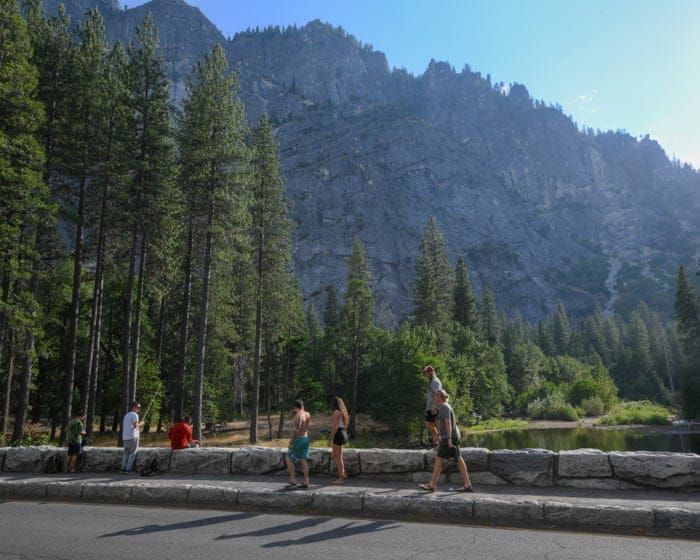
That is what is happening at Yosemite. As The Guardian US has reported, the administration is advancing a proposal to sell off a portion of Yosemite National Park — described as a quarter-mile parcel on the park's edge, which is to say, a quarter-mile parcel of land that belongs to every American who has ever existed and every one who ever will. The story is framed as a boundary technicality. It is not a technicality. It is a transfer of public wealth to private hands, and it belongs to a much longer list of transfers that are happening simultaneously, to the same beneficiaries, for the same reasons.
Rebecca Solnit, writing in The Guardian, reaches for the right frame: the United States is being sold for parts. Not metaphorically. The military, the universities, the research institutions, the public lands — each one is being dismantled or handed over in ways that are individually defensible and collectively catastrophic. The Yosemite parcel is a quarter-mile. The 45 million acres of protected forest now one rule change away from commercial logging is not a quarter-mile. The coal plant bailouts, the EPA rollbacks, the offshore drilling expansions — these are not boundary adjustments. They are a systematic transfer of public assets to the class of people who fund the campaigns of the people doing the transferring.
The argument for selling the Yosemite parcel will be made in the language of efficiency. Perhaps the parcel is administratively awkward. Perhaps there is a private use case that sounds reasonable in isolation. This is always how it goes. Public lands are never sold with a press release that says: we are giving this to wealthy people because wealthy people want it and wealthy people are paying for our political survival. They are sold with language about streamlining, about reducing federal footprint, about unlocking economic potential. The language is designed to make the transfer sound boring. Boring is the point. Boring things do not generate resistance.
But the underlying principle is not boring. Public lands exist because the United States made a decision, over more than a century, that some things should not be owned. Not because private ownership is always wrong, but because some goods — clean air, wild spaces, the experience of standing in a valley that has existed for millions of years and will exist for millions more — cannot be adequately protected by profit motive. A private owner of Yosemite's edge has an incentive to develop it. The public has an incentive to preserve it. These incentives are not reconcilable through market mechanisms. This is not a libertarian thought experiment. It is why the national park system exists.
Yosemite was protected by an act of Congress signed by Abraham Lincoln in 1864, making it the first land set aside by the federal government for public use and preservation. The modern National Park Service was established in 1916. The legal doctrine underlying public lands holds that the government manages these resources as a trustee for all citizens — present and future. A sale does not just transfer land. It extinguishes the trust.
The strongest counter-argument is that this is one parcel, that the administration has not proposed selling Yosemite itself, that critics are catastrophizing a minor administrative action. This is a reasonable-sounding objection. It is also the objection that has been made at every previous stage of public-land privatization — at every lease, every drilling permit, every boundary revision — and it has been wrong every time. The pattern is not catastrophizing. The pattern is documented. The current administration has, in the same period it has floated the Yosemite sale, advanced rollbacks of the Roadless Rule, expanded offshore drilling, weakened protections for national monuments, and handed management authority for federal lands to state governments and private entities whose financial interests run directly against preservation. A quarter-mile parcel does not exist outside this context. It exists inside it.
There is also a class argument that rarely gets made explicitly but is visible in every detail of how these transfers happen. Public lands are one of the few remaining institutions in American life that are genuinely universal. Yosemite does not cost more to visit if you are poor. The air above a national forest is not rationed by income. The wolf that roams a protected wilderness is not available for purchase. These are not small things. They are the remaining infrastructure of a commons — the shared inheritance that belongs to the child of a farmworker in the Central Valley with the same legal weight as it belongs to a hedge fund manager in Manhattan. When that commons is transferred to private hands, it does not become available to everyone who can afford it. It becomes available to whoever the new owner decides to admit, at whatever price they choose to charge, under whatever conditions serve their interests. The universal becomes the exclusive. This is not a side effect of privatization. It is the product.
The question worth asking is not whether the Yosemite parcel is large enough to matter in isolation. It is whether the public has decided that public lands are worth defending — not as a policy preference, but as a principle. Because the administration has been consistent about one thing: it is testing that principle systematically, across every domain, at every scale. The $3.8 billion in taxpayer money funneled to coal plants that were already closing is a test. The 53 percent of Project 2025 now encoded into federal law is a test. The Yosemite parcel is a test. The tests are graded on a curve: if the resistance is insufficient, the next test is harder.
What oligarchy looks like, in practice, is not a villain buying a national park in a single dramatic transaction. It looks like a quarter-mile here, a rule rollback there, a lease extension somewhere else, each one defended as too small to fight about, each one making the next one easier. The accumulation is the strategy. The boredom is the weapon. The public lands that belong to all of us are not going to be taken in one move. They are going to be transferred, parcel by parcel, in language designed to make the transfer sound like maintenance — until the day someone looks up and realizes that the commons they inherited is gone, and the people who took it are already charging admission.