The scene at the end of Donald Trump's Beijing summit told the story more plainly than any communiqué. Chinese children waved flags and chanted farewell as the American president walked back to Air Force One, claiming he had secured a cluster of deals to sell U.S. oil, jets, and soya beans to China. Xi Jinping, according to The Guardian's Jonathan Watts, smiled but confirmed nothing. What the summit actually crystallized, behind the handshakes and the flag-waving children, was a structural reality that no trade deal can paper over: one of these two countries is building the energy system that will power the 21st century. The other is trying to sell more of what the 21st century is replacing.
This is not primarily a story about Donald Trump. It is a story about what happens when a petrostate mistakes its current dominance for permanent advantage — and what it costs when the mistake becomes policy. The United States has spent decades allowing fossil fuel interests to define its energy posture. The bill for that arrangement is now being presented in the form of lost manufacturing capacity, lost export markets, and a deteriorating geopolitical position against a rival that made different choices.
China's dominance in the energy transition is not a future projection. It is a present fact. As The Guardian's analysis documents, China has achieved manufacturing scale in solar panels, electric vehicles, and battery storage that no Western country is currently positioned to challenge. It produces the majority of the world's solar panels. It leads global EV sales by a margin that is widening, not narrowing. Its domestic grid investment dwarfs what the United States has deployed. These are not the outputs of a country that got lucky — they are the outputs of a deliberate industrial strategy sustained across multiple administrations over two decades.
The United States, during that same period, ran a different strategy. Fossil fuel companies spent hundreds of millions of dollars lobbying against climate regulation, funding think tanks that manufactured doubt about clean energy economics, and backing candidates who treated energy transition as a culture war threat rather than an industrial opportunity. That spending did not prevent the energy transition globally. It prevented the United States from leading it. The original thesis here is not that America chose fossil fuels over renewables. It is that the fossil fuel industry purchased America's absence from the race — and the bill for that purchase is now denominated in geopolitical terms, not just atmospheric ones.
The Power & Money lens makes this legible. The five largest U.S. oil and gas companies reported combined profits exceeding $150 billion in 2022 and 2023, years when they simultaneously lobbied against clean energy incentives and backed legislation to open new federal drilling leases. Their financial interest in slowing the transition was direct and quantifiable. The political infrastructure they funded — the campaign donations, the revolving-door appointments, the think tank networks — produced policy outcomes that served their short-term balance sheets. What it did not produce was a competitive U.S. position in the industries that will define the next fifty years of global trade.
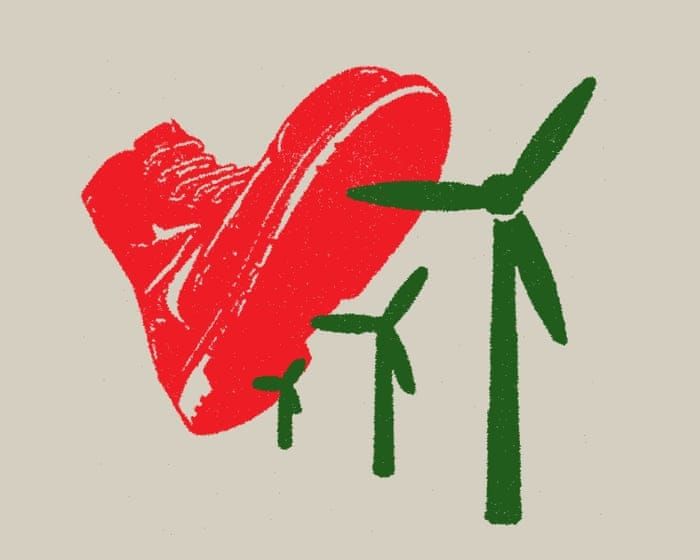
The Guardian's Jonathan Watts frames the current global energy competition as a shift from petrostate to electrostate dominance — from economies that derive geopolitical power from controlling fossil fuel extraction to economies that derive power from manufacturing the hardware of electrification. China has positioned itself as the world's dominant electrostate. The United States, under current policy, is doubling down on its petrostate identity at the moment when that identity is depreciating fastest.
The consequences are not abstract. Consider what Trump's Beijing summit actually produced. The American president arrived claiming the United States held the upper hand — energy supplier, jet manufacturer, agricultural exporter. China, the buyer. That framing is revealing precisely because of what it omits: who is selling the solar panels, the batteries, and the EV drivetrains that the rest of the world is purchasing. The answer is not the United States. When developing economies in Southeast Asia, Africa, and Latin America build out their energy infrastructure over the next two decades, they will largely be buying Chinese equipment, using Chinese financing, and operating within Chinese technical standards. That is not a climate story. It is a trade story, an influence story, and a story about which country's engineers and diplomats are in the room when the contracts get signed.
The Systemic Pattern lens connects this to a broader failure of American industrial policy. As we've documented in other sectors, the United States has a consistent pattern of allowing incumbent industries to use regulatory and political capture to slow the adoption of competitive alternatives — until the window for domestic leadership closes. The story of U.S. solar manufacturing is instructive: American researchers pioneered photovoltaic technology. American companies held early market positions. Then a combination of insufficient domestic policy support, fossil fuel lobbying against clean energy mandates, and failure to match China's state-backed manufacturing subsidies resulted in the near-total collapse of U.S. solar panel production. The technology was invented here. The industry is not.
The same pattern is now playing out in EVs and battery storage, with the added wrinkle that the current administration has actively dismantled the policy scaffolding — the Inflation Reduction Act's clean energy provisions — that had begun to reverse the trend. Some IRA funding continues to flow, but the political signal sent by attempting to gut the law has already affected investment decisions. Automakers and battery manufacturers weighing factory locations are watching whether the United States is a reliable policy environment for clean energy investment. The answer, increasingly, is no.
There is a counter-argument worth taking seriously: that American fossil fuel exports give Washington real geopolitical power, that energy independence built on domestic oil and gas production reduces vulnerability to foreign supply disruptions, and that the energy transition will take longer than climate advocates project. The power argument has some merit — U.S. LNG exports to Europe did matter after Russia's invasion of Ukraine. But influence derived from selling a commodity that your customers are actively trying to stop buying has a diminishing half-life. Europe's accelerated renewable buildout after 2022 was driven partly by the desire to never again be in the position of depending on any fossil fuel supplier. The United States is selling into a market that is structurally motivated to reduce its own demand.
The deeper problem is what the current policy posture costs in terms of the competition that actually matters. China entered Trump's second term having studied the first, with a clear-eyed understanding that American energy policy would be shaped by fossil fuel interests and that this created an opportunity. While Washington treats clean energy as a domestic culture war issue, Beijing treats it as an export strategy, a diplomatic tool, and a military logistics advantage. Chinese military planners have noted for years that electrifying supply chains reduces dependence on the fuel logistics that make conventional military operations vulnerable. The energy transition is not just an economic competition. It is a strategic one.
The Human Impact dimension of this story is mostly invisible in American political coverage, which tends to frame the energy transition as a debate between environmentalists and workers. That framing serves the fossil fuel industry by obscuring who actually bears the cost of the current policy trajectory. The workers in communities dependent on coal and oil extraction are not the primary beneficiaries of policies that delay the transition — the executives and shareholders of fossil fuel companies are. Workers in those communities would benefit more from the kind of sustained industrial investment in new energy manufacturing that Germany and China have deployed than from policies that extend the life of industries whose long-term decline is not reversible by any administration.
Outside the United States, the stakes of American energy policy are experienced more directly. Countries in the Global South that are most exposed to climate impacts — and that had the least role in producing them — are watching the world's largest historical emitter double down on fossil fuel production while withdrawing from the international frameworks designed to manage the transition. Their perspective is largely absent from the American domestic debate, which treats energy policy as a question of jobs and prices rather than a question of who bears the cost of decisions made in Washington and Houston.
What Trump's Beijing summit actually demonstrated is the asymmetry of the current moment. The American president arrived to sell commodities. The Chinese host was selling the infrastructure of the future. One of those positions compounds in value as the energy transition accelerates. The other depreciates. The flag-waving children at the airport were not performing diplomacy. They were marking a transition that American policy, for two decades, spent billions of dollars trying to delay — and that is now arriving anyway, with the United States watching from the wrong side of it.