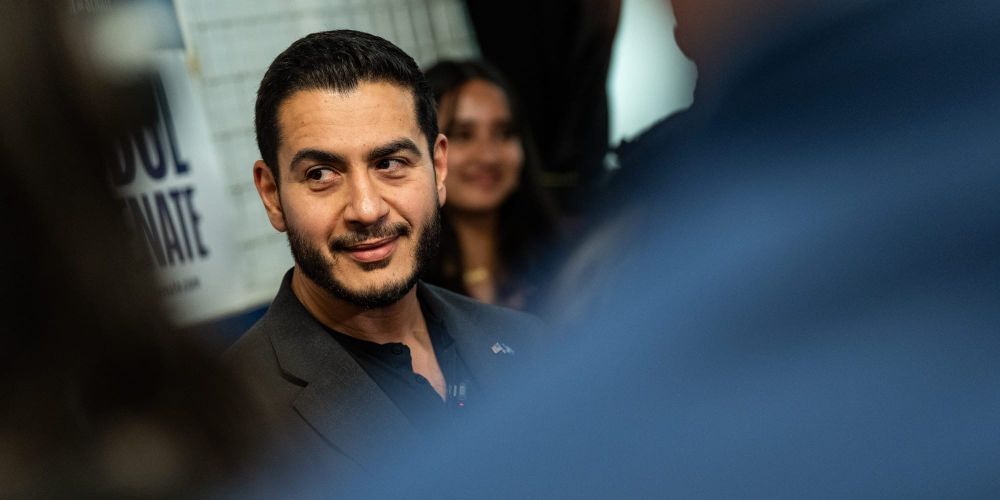
The conventional wisdom held for years that Palestine was the third rail of Democratic politics — a position you whispered, qualified, or abandoned the moment a primary got competitive. Abdul El-Sayed just ran a Senate campaign in Michigan on explicit solidarity with Palestinians under bombardment, won, and is now headed to Washington with something most incoming senators do not carry: a mandate on foreign policy from the people who sent him there.
That mandate did not emerge from a vacuum. It was built in Dearborn, in Hamtramck, in the Arab American communities of southeast Michigan that watched their families in Gaza buried under rubble while their own government signed the arms transfers. It was built by the "uncommitted" movement that cost Democrats Michigan's electoral votes in 2024 and forced a reckoning the party spent the following two years trying to minimize. El-Sayed's victory, reported by The Intercept, is the electoral consequence of that reckoning finally arriving at the Senate door.
The question now is not whether El-Sayed's win means something. It does. The question is whether the institution he just entered is capable of being changed by it — and whether the tools available to a single senator from Michigan are adequate to the scale of what his constituents are asking him to do.
Michigan is home to the largest Arab American population of any U.S. state, concentrated in Wayne County communities including Dearborn and Hamtramck. The "uncommitted" primary movement in February 2024 drew over 100,000 votes in Michigan alone — more than President Biden's margin of defeat in the state in the November general election. El-Sayed's Senate campaign was built in part on organizing infrastructure developed during that protest movement.
The structural reality El-Sayed walks into is this: the United States Senate is perhaps the most change-resistant legislative body in the democratic world. A single senator can place holds on nominations, can force floor votes through procedural maneuvering, can use committee assignments — if he gets useful ones — to compel testimony and generate a public record. What a single senator cannot do is unilaterally rewrite the $3.8 billion annual military aid relationship between Washington and Tel Aviv, override a presidential veto, or force a chamber of one hundred people to hold a vote it does not want to hold.
This is not a counsel of despair. It is a description of the terrain. And El-Sayed, a physician who ran for Michigan governor in 2018 on Medicare for All before that position was considered safe, has demonstrated before that he understands the difference between what is politically possible today and what becomes possible when you shift the ground beneath it.
The immediate pressure points are real, if limited. Senate rules give individual members the ability to place holds on arms sales pending congressional notification — a procedural tool that has been used rarely on Israel-related transfers but is available. The Arms Export Control Act requires the executive branch to certify that U.S. weapons are not being used in violation of international humanitarian law; El-Sayed will have standing to demand that certification publicly and to challenge it when the evidence contradicts it. He can use the Senate floor as a platform in a way that no House member, activist, or protest movement can replicate — every speech is entered into the congressional record, every procedural move generates coverage, every "no" vote on a supplemental military package becomes a documented dissent that future candidates will have to answer for.
That last point matters more than it might appear. One of the most important things The Intercept's reporting on El-Sayed's win makes clear is that the political cost of solidarity with Palestinians has been recalculated. AIPAC spent heavily in this race — as it has in nearly every competitive Democratic primary in the 2026 cycle, deploying over $30 million against a single candidate in Michigan alone. El-Sayed won anyway. That result is data. It will be read by every Democratic strategist, every future candidate in a district with a significant Muslim or Arab American population, every senator up for reelection in 2028 who has been quietly calculating whether their Gaza vote is a liability.
The trajectory of Senate Democratic opinion on Israel is already moving, and El-Sayed's arrival accelerates it. Forty Senate Democrats voted to block arms transfers to Israel in the most recent floor vote on the question — a number that would have been unthinkable five years ago, when the comparable vote drew fifteen. El-Sayed does not arrive as a lone dissident. He arrives as the most visible member of a growing bloc, with a constituent base that has demonstrated it will punish Democratic politicians who ignore them, and with a biography — Arab American, Muslim, the son of Egyptian immigrants — that makes the usual dismissals harder to sustain.

The dismissals will come anyway. They always do. The foreign policy establishment has a well-worn playbook for managing senators who arrive with inconvenient mandates: committee assignments that keep them away from the relevant levers, collegial pressure to "be realistic," the slow bureaucratic grind of an institution that rewards patience and punishes urgency. El-Sayed will be told, by people who mean it sincerely, that the way to change U.S. policy toward Israel is to build relationships, earn trust, wait for the right moment. The people who have been saying this for thirty years have not changed U.S. policy toward Israel.
What El-Sayed brings that those senators did not is a different theory of change — one that is less about persuading colleagues in private and more about making the political cost of inaction visible to voters. His campaign was built on exactly this logic: that the path to a different U.S. foreign policy runs through electoral accountability, not through the Foreign Relations Committee's markup process. The uncommitted movement understood this before most Democratic strategists did. El-Sayed is its most direct institutional expression.
The people most affected by what El-Sayed does or does not accomplish are not in Michigan. They are in Gaza, where the death toll documented by the UN exceeded 20,000 children before the end of 2025, and where the reconstruction of a functioning society depends in part on whether the United States eventually conditions, restricts, or ends the military relationship that has enabled the destruction. A UN inquiry last year documented deliberate targeting of civilian infrastructure and called for accountability proceedings — proceedings the United States has blocked at every institutional turn. El-Sayed's constituents know this. They watched it happen. They voted in part to send someone to Washington who would say so out loud.
The gap between what his constituents need and what the Senate can deliver is real. No single senator ends a war. No single senator rewrites a bilateral defense relationship that has been institutionalized across decades of legislation, executive agreements, and military-to-military ties that Congress has been actively deepening even as public opinion has shifted. The structural forces arrayed against the kind of change El-Sayed's campaign promised are enormous, well-funded, and deeply embedded in both parties.
But the argument that nothing can change because everything is hard is also a choice — and it is a choice that has served the people who benefit from the status quo. El-Sayed's win does not guarantee a different U.S. policy on Palestine. What it does, concretely and measurably, is change the political calculus for every senator who has to decide whether to vote for the next arms package, the next supplemental, the next waiver of human rights conditions. It puts a face and a constituency on the dissent that was previously easy to dismiss as the noise of activists without electoral consequence.
His arrival also coincides with a Democratic Party that is, for the first time in a generation, genuinely divided on this question at the leadership level. House Democratic leaders split visibly on the last Israel aid vote, a fracture that senior party figures spent months trying to paper over. The DNC's own internal assessment of why Michigan was lost in 2024 — an assessment that was produced and then withheld from party leadership — reportedly named Gaza as a primary driver of Arab American and young voter defection. El-Sayed is the living version of that autopsy walking into the Senate chamber.
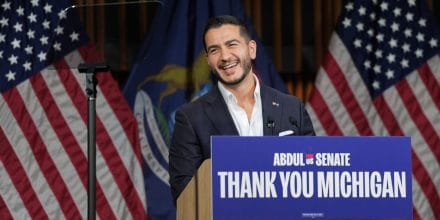
What he does with that position will depend on choices he has not yet had to make: whether to work primarily through institutional channels or through public pressure, whether to prioritize symbolic votes that build a record or procedural maneuvers that generate real friction, whether to caucus closely with the small group of senators who share his position or to spend his capital trying to move those who are persuadable. These are not easy choices. They are also not choices that can be made in the abstract, before he has seen the specific legislation, the specific nominations, the specific moments when the question of U.S. complicity in Gaza is on the table and a vote is required.
The voters who sent him to Washington did not send him with a detailed legislative strategy. They sent him with a moral position and a political mandate. The moral position — that the United States should not be funding the killing of civilians — is not complicated. The legislative strategy for translating that position into policy change, inside an institution designed to absorb and neutralize exactly this kind of pressure, is the work of the next six years.
The people of Gaza cannot vote in Michigan. But the people of Dearborn can — and did. That is not a small thing. It is, in fact, the only mechanism through which U.S. foreign policy has ever changed: not through the quiet persuasion of insiders, but through the accumulation of electoral pressure until the cost of the status quo exceeds the cost of change. El-Sayed's mandate is one data point in that accumulation. Whether it is enough depends on how many more follow, and on whether he uses the platform he has just won to make the next vote harder for the senators who would rather not cast it.