The United States has displaced Black and Indigenous communities from their land twice over: first through slavery, colonization, and the legal machinery of dispossession; then again through urban renewal, redlining, and gentrification. What is less often acknowledged is that both waves of displacement were not accidents of the market. They were outcomes of deliberate policy. The intentional community movement emerging across the country — from the redwood hills of Northern California to the rural South — is built on a counter-premise: that collective ownership, not individual property, is the structure that actually holds.
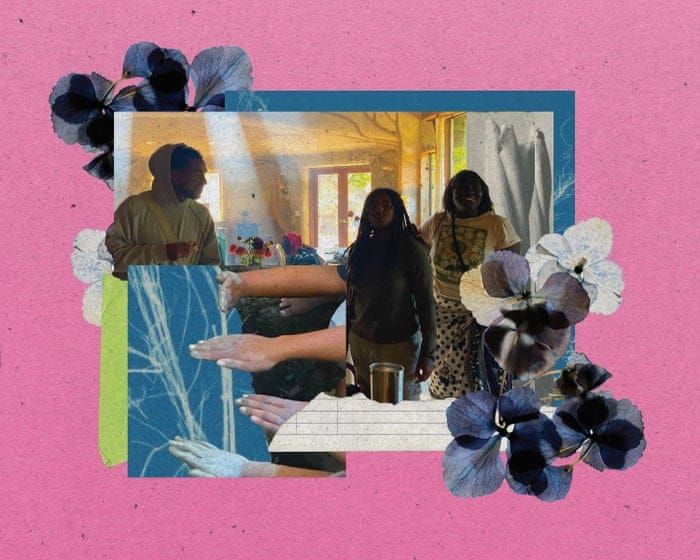
Zappa Montag lives that premise daily. According to The Guardian US, he steps outside his home at Black to the Land, an off-grid ecovillage in Boonville, California, into a thicket of redwoods, Pacific madrones, and oak trees. The community's 76 hectares — 189 acres — are dotted with fruit trees and a large garden growing squash, cucumbers, tomatoes, beans, corn, and peppers. A small stream runs through a valley below surrounding hills. Six Black residents steward the land together, running on well water and solar power, 115 miles north of San Francisco. Montag describes the project as an effort to "reverse-gentrify the country."
That phrase deserves more than a headline. Gentrification is typically framed as an economic process — capital flowing toward undervalued land, prices rising, lower-income residents displaced. But the communities building intentional spaces like Black to the Land are naming something the conventional framing obscures: gentrification is also a racial project, and its inverse requires not just affordability policy but a different theory of ownership altogether.
Key ContextWhat Is an Intentional Community?
Intentional communities are small groups of people who live in the same area based on shared values and a common vision. They take many forms — rural ecovillages, urban co-housing spaces where residents have private units but share communal areas, and collective land trusts. Black Americans and Indigenous peoples have long used these structures, drawing on traditions of mutual aid and communal stewardship that predate the modern property system.
The systemic pattern here is not new. Black land ownership in the United States peaked around 1910, when Black Americans owned roughly 16 to 19 million acres, according to the Federation of Southern Cooperatives. By 2001, that figure had fallen to less than 2 million acres — a collapse driven by tax sales, heir property vulnerabilities, USDA loan discrimination, and outright violence. Indigenous land loss is older and larger in scale: the dispossession of Native nations from hundreds of millions of acres is the foundational land transaction of American history, formalized through treaties broken as soon as they were signed. What the intentional community movement understands, and what mainstream housing policy rarely names, is that the land gap is not a market failure. It is a market outcome.
This is where the accountability lens becomes necessary. The policies that produced Black and Indigenous land loss had authors. The USDA systematically denied Black farmers loans for most of the twentieth century — a pattern documented in a 1999 consent decree in Pigford v. Glickman that resulted in a $1.25 billion settlement. Redlining was not the spontaneous preference of private banks; it was codified by the Home Owners' Loan Corporation, a federal agency, in the 1930s. Urban renewal programs that demolished Black neighborhoods in dozens of American cities during the 1950s and 1960s were federally funded. The land that was taken had takers with names and institutional affiliations. The intentional community movement is, among other things, a response to that specific history — not a retreat from it.
The structure of collective ownership that these communities use matters as much as the political intention behind them. Community land trusts, cooperative ownership models, and intentional community frameworks share a common logic: they remove land from the speculative market by placing it in collective stewardship, making it harder — sometimes impossible — to sell to outside buyers or developers. This is not merely symbolic. It is a legal architecture designed to resist the same mechanisms that produced the original dispossession. Where individual property ownership creates a single point of failure — one death, one debt, one legal dispute can dissolve a family's claim — collective ownership distributes that vulnerability across a community and across time. As Tinsel News has covered in examining how environmental harm maps onto race in America, the communities most exposed to extraction are precisely those with the least legal protection over their land. Collective ownership frameworks are a direct counter to that exposure.
The movement also carries an explicitly ecological dimension that the mainstream housing conversation consistently misses. Black to the Land is off-grid, solar-powered, and food-producing. The connection between land sovereignty and ecological stewardship is not incidental to these communities — it is structural. Indigenous land management practices across North America maintained biodiversity and ecological balance for millennia before European colonization. The forced removal of Indigenous peoples from their land was not only a human rights catastrophe; it was an ecological one. Rewilding and ecological restoration projects increasingly recognize this, with some conservation organizations now explicitly partnering with Indigenous communities to restore land governance rather than simply protecting land from human use. The intentional community movement sits at that intersection: it is simultaneously a housing strategy, a reparative land politics, and an environmental practice.
~16–19MAcres owned by Black Americans at peak in 1910. By 2001, that figure had fallen to under 2 million acres — a collapse driven by discriminatory federal loan policy, heir property vulnerabilities, and targeted dispossession.Source: Federation of Southern Cooperatives
The power and money lens is equally clarifying here. Land in the United States is not a neutral commodity. It is the primary vehicle through which generational wealth is built and transmitted — and the primary vehicle through which it has been denied to Black and Indigenous families. The racial wealth gap in America is, in large part, a land gap. Federal housing policy from the New Deal through the 1970s actively subsidized white homeownership while excluding Black families from the same programs. The FHA-backed suburban expansion that created the American middle class was, by deliberate design, a white middle class. The communities building intentional spaces are not opting out of the wealth-building logic of property. They are constructing an alternative to it — one that does not depend on an individual family's ability to navigate a system engineered to exclude them.
This distinguishes the movement from other back-to-land or intentional community projects that have flourished periodically in American history. The communes of the 1960s and 1970s were largely white, largely voluntary, and largely a rejection of mainstream culture by people who had full access to it. The Black and Indigenous intentional community movement is something different: it is a response to forced exclusion, built on traditions of mutual aid and collective stewardship that were never abandoned so much as suppressed. The distinction matters for how we understand what is being built. This is not nostalgia. It is infrastructure.
The challenges are real and should not be minimized. Collective land ownership requires legal structures — land trusts, cooperatives, LLCs — that are complex to establish and maintain. Rural communities face isolation, limited access to services, and the ongoing pressure of surrounding land markets. Urban co-housing projects face zoning restrictions, financing barriers, and the constant pressure of rising property values in gentrifying neighborhoods. Heir property — land passed down without a formal will, leaving multiple family members with undivided interests — remains a major vulnerability for Black landowners across the South, where a single dissenting heir can force a partition sale. The legal infrastructure that supports collective ownership is still being built, and it is being built against active resistance from property markets and, in some cases, local governments that benefit from the status quo. The concentration of wealth at the top of the property market makes that resistance structural, not incidental.
What Zappa Montag is doing in the hills above Boonville, and what communities from California to Alabama are doing in their own contexts, is not separatism. It is the construction of an alternative infrastructure of belonging — one that treats land not as an asset to be extracted from but as a commons to be stewarded. The question of whether that infrastructure can scale, connect, and survive the legal and financial pressures arrayed against it is not rhetorical. It is the central question of a movement that has correctly diagnosed the problem. The communities building it are not waiting for federal housing policy to catch up. They are building the answer themselves, on land they intend to keep. As the same displacement pressures play out globally — from the Bo-Kaap in Cape Town to neighborhoods across the American South — the legal and communal models being developed in these intentional communities may matter far beyond their immediate geography.
The original dispossession was policy. So is its reversal.