For decades, two of the most organized ethnic lobbying forces in American politics operated on a simple theory of power: back the candidate who gives you what you want, and keep backing them until the want becomes policy. The Cuban diaspora lobby, concentrated in South Florida, and the American Israel Public Affairs Committee built parallel machines around this theory. Both found their fullest expression in Donald Trump. Both got what they came for. Both are now watching the coalition they built develop cracks they did not anticipate.
This is the story that The Intercept has documented in a sweeping analysis of how the Cuban lobby and AIPAC came together under Trump — and are now dealing with the downstream consequences of the policies they demanded. But the story is larger than two interest groups experiencing buyer's remorse. It is an account of how transactional politics, when it succeeds completely, produces outcomes that even its architects cannot fully control.
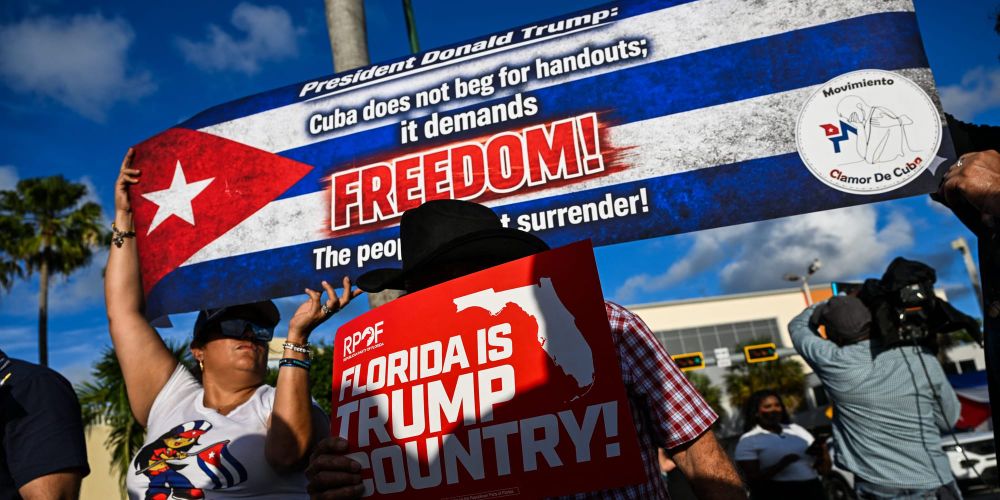
The Cuban diaspora lobby — centered in Miami-Dade County — and AIPAC both spent years cultivating Trump as their preferred vehicle for hardline foreign policy objectives. The Cuban lobby sought maximum pressure on Havana, including tightened sanctions and hostility toward any normalization effort. AIPAC sought unconditional U.S. backing for Israeli military operations, the relocation of the U.S. embassy to Jerusalem, and the isolation of Palestinian political institutions. Under Trump, both got their asks — and then some.
The Cuban American lobby's political history in Florida is one of the most effective ethnic interest group operations in modern American politics. It is not monolithic — the community has diversified across generations, and newer arrivals from Cuba often hold different political orientations than the older exile generation — but the institutional power built by the hardline wing has consistently punched above its demographic weight. Organizations like the Cuban American National Foundation helped build a political culture in South Florida that treated any diplomatic engagement with Havana as betrayal, and that culture translated into electoral influence that both parties have historically deferred to.
AIPAC's operation is different in structure but similar in logic. It does not formally endorse candidates, but its affiliated PACs have become among the most aggressive independent expenditure vehicles in American politics. In the 2024 cycle and into 2026 primaries, AIPAC-connected money has flowed into Democratic and Republican primaries alike, targeting candidates who expressed any skepticism about unconditional military support for Israel. As Tinsel News has reported, that spending has not always worked — but the scale of the investment, and the willingness to spend it in Democratic primaries, represents a significant escalation from AIPAC's traditional role.
What bound these two operations together under Trump was a shared preference for maximum pressure, minimum diplomacy, and a foreign policy framework that treated adversaries as entities to be punished rather than managed. The Cuban lobby wanted Cuba isolated. AIPAC wanted Iran sanctioned and Palestinian statehood kept off the table. Trump, for reasons mixing ideological sympathy and transactional calculation, delivered on both fronts — and the convergence of these interests helped cement Florida as a Republican stronghold and gave MAGA its most organized foreign policy constituency.
The fracturing, as The Intercept's analysis documents, is not a sudden break. It is the accumulated weight of consequences. For the Cuban diaspora community, the contradiction has become increasingly visible: a lobby that built its identity around opposition to authoritarian governance and the suffering of civilians under an unresponsive state is now aligned with an administration whose domestic policies — mass deportation, the erosion of due process, the targeting of Latino communities regardless of immigration status — are falling hardest on Latinos in the United States, including Cuban Americans who arrived more recently and do not share the old exile politics.
The deportation machine does not sort carefully by national origin or political affiliation. As Tinsel News has reported, 93 percent of ICE street arrests have targeted Latinos — a profile that does not distinguish between the Cuban American voter who backed Trump and the Venezuelan asylum seeker who did not. The political logic that led older Cuban exile organizations to support hardline immigration enforcement as a proxy for anti-communism has collided with the lived reality that the enforcement machinery operates on racial and ethnic lines, not ideological ones.
Cuba itself has become a pressure point that the lobby's own demands helped create. The maximum pressure campaign — tightened sanctions, Cuba kept on the State Sponsors of Terrorism list, remittance restrictions — has produced the humanitarian collapse that critics predicted. Cuba has run out of fuel. The power grid has failed for extended periods. Ordinary Cubans — not the government — are bearing the cost of the policy the lobby demanded. For a diaspora community whose political identity was always framed around solidarity with the Cuban people, this creates a moral tension that is difficult to sustain.

The AIPAC fracture runs along different fault lines but shares the same structural logic: an organization that shaped policy now owns the consequences of that policy. The Gaza war, now past its twentieth month, has killed more than 45,000 Palestinians according to Gaza health ministry figures — a toll documented and cited by the United Nations. The political environment that AIPAC's spending helped create, one in which any Democratic politician who questioned Israeli military operations faced a well-funded primary challenge, also helped suppress the internal party debate that might have produced earlier and more substantive U.S. pressure for a ceasefire.
The result is that AIPAC now operates in a Democratic Party that is moving against it faster than its spending can compensate. As Tinsel News has reported, 40 Senate Democrats voted to block arms to Israel — a figure that was 15 just four years ago. The 2028 presidential field is already running against AIPAC's model openly, with candidates denouncing the organization in public even as the Democratic Party's donor infrastructure remains entangled with it. The organization's political power was always a function of making the cost of opposition prohibitive. That calculation is changing.
There is a deeper structural argument embedded in this story that the transactional frame tends to obscure. Both the Cuban diaspora lobby and AIPAC built their power on the premise that their communities' security interests were best served by maximum American belligerence toward their adversaries. The Cuban lobby believed that a sufficiently punishing sanctions regime would eventually collapse the Castro government and its successors. AIPAC believed that unconditional American military and diplomatic support for Israel would produce security for Israelis and stability for the region.
Neither premise has been validated. Cuba's government has survived six decades of U.S. sanctions, and the current maximum pressure campaign has produced mass emigration — including from the very community that the exile lobby claims to represent. Cubans are leaving the island in record numbers, not toward liberation but toward the United States, where many of them arrive as the very undocumented immigrants that the political coalition the lobby helped build is now trying to deport. The irony is structural, not incidental.
For AIPAC, the security argument has become harder to sustain in the face of a war that has isolated Israel diplomatically, strained its relationship with every major European ally, and produced a humanitarian catastrophe that the United Nations has documented in detail. The argument that unconditional support produces Israeli security requires a definition of security that excludes the political and moral costs of the current moment — and that exclusion is becoming increasingly difficult to maintain as those costs accumulate.
What both lobbies are experiencing is not simply political backlash. It is the moment when a transactional strategy reaches its logical endpoint. You get the policy. The policy produces consequences. The consequences cannot be entirely attributed to your opponents. The question then becomes whether the organization was ever really about the stated goal — the welfare of the Cuban people, the security of Israelis — or whether it was primarily about the maintenance of its own power and the preservation of a particular political identity.
That question is being asked inside both communities with new urgency. Younger Cuban Americans, many of them children or grandchildren of the original exile generation, have different relationships to the island, different relationships to the Democratic Party, and different assessments of whether the maximum pressure strategy has served the people it claims to protect. Younger Jewish Americans, including many who identify as pro-Israel in the sense of caring about Israeli society and democratic institutions, have broken sharply with AIPAC's model — a break documented in polling data showing generational collapse in support for unconditional U.S. military backing.
The political consequences of these fractures are not yet fully legible. Florida's Cuban American vote has not collapsed for Republicans — the 2024 results showed continued strong support in Miami-Dade among older Cuban American voters. AIPAC's spending capacity remains enormous, and its ability to shape Democratic primaries has not disappeared. But the trend lines are moving in one direction, and the organizations' own policy successes are accelerating that movement.
There is something clarifying about a moment when powerful institutions must account for the outcomes they produced. The Cuban lobby wanted Cuba isolated and got it. AIPAC wanted unconditional American support for Israeli military operations and got it. The consequences of those policies — mass Cuban emigration into a hostile immigration system, a Gaza war that has killed tens of thousands of civilians and produced global isolation for Israel — are not abstractions. They are the direct results of the policy environment these organizations built and maintained.
The lobbies that built MAGA's foreign policy consensus are now navigating a world their own demands helped create. The Cuban people are still not free. Israelis are not more secure. The organizations that claimed to speak for both communities are smaller, more contested, and more defensive than they were four years ago. That is not a coincidence. It is the most predictable consequence of a political strategy that confused maximalism with effectiveness — and mistook the acquisition of policy wins for the achievement of the goals those policies were supposed to serve.