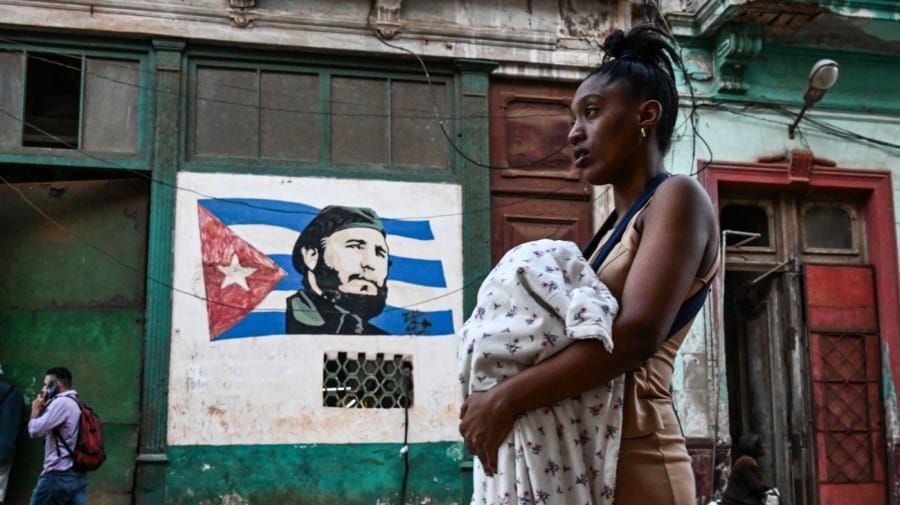
Cuba announced last Friday that it has run out of oil and diesel. Not that supplies are critically low, or that rationing has intensified, or that the energy situation has deteriorated — but that the fuel is gone. Hospitals are running on backup generators. Families are cooking over wood fires. Rolling blackouts now stretch past twelve hours a day in some provinces. According to The Hill, Cuban officials confirmed the shortage as the Trump administration simultaneously escalated its demands that Havana change its political system or face the prospect of military action.
This is the part that tends to get buried: the people bearing the weight of this crisis are not the Cuban government. They are the eleven million Cubans who did not design the political system they were born into, who cannot unilaterally dismantle it, and who are now losing power for half the day while Washington frames their suffering as a lever of diplomatic pressure.
The U.S. embargo against Cuba — in place in various forms since 1962 — has always rested on a theory of political change that has never been validated by evidence. The theory holds that enough economic pain will eventually produce a popular uprising or elite defection that dismantles the Cuban government. After six decades, the Cuban government remains. What the embargo has reliably produced is deprivation: shortages of food, medicine, fuel, and spare parts that fall hardest on people with the least ability to insulate themselves. The Trump administration has not updated this theory. It has intensified it.
The current crisis did not materialize overnight. Cuba's energy infrastructure has been deteriorating for years, sustained in part by subsidized Venezuelan oil that itself became unreliable as Caracas faced its own economic collapse. The island's Soviet-era power plants are aging, poorly maintained for lack of parts, and increasingly dependent on fuel imports that the sanctions regime makes expensive and logistically complicated. When Venezuela's supply faltered, Cuba had no fallback. The sanctions do not merely restrict trade — they create a chilling effect on third-country companies and financial institutions that might otherwise engage with Cuba, for fear of secondary penalties from the U.S. Treasury Department. The result is an island that cannot easily buy fuel on the open market, cannot access international credit to finance imports, and cannot attract the foreign investment that might modernize its energy infrastructure.
The Trump administration's position, as reported by The Hill, is that Cuba must change its ways under U.S. terms — or face escalating consequences, up to and including potential military action. The framing treats the Cuban government as the audience for this pressure. But governments under sanctions rarely collapse cleanly. They adapt, consolidate, and — critically — they distribute the costs of adaptation downward. Cuban officials are not cooking over wood fires. The families in Havana's working-class neighborhoods are.
The U.S. embargo bars American companies from trading with Cuba and imposes secondary penalties on foreign firms that engage with Cuban entities. This effectively cuts Cuba off from international credit markets, complicates fuel purchases from third-country suppliers, and prevents the foreign investment needed to modernize Soviet-era power infrastructure. Cuba's reliance on subsidized Venezuelan oil — itself a product of limited alternatives — collapsed as Venezuela's own economy deteriorated, leaving no viable substitute.
This is the original accountability failure that the standard coverage of Cuba's energy crisis consistently avoids: the U.S. government has designed and enforced a sanctions architecture specifically intended to produce civilian suffering, on the stated theory that civilian suffering will produce political change, despite six decades of evidence that this theory does not work. The policy has never been evaluated on humanitarian grounds because its architects have never been required to justify it on humanitarian grounds. Congress has not held serious oversight hearings on the civilian impact of Cuba sanctions in years. The State Department does not publish annual assessments of how sanctions affect Cuban households. The policy runs on autopilot, tightened periodically by administrations seeking to demonstrate resolve, and its costs are borne entirely by people who have no vote in U.S. elections and no lobby in Washington.
The Trump administration's escalation follows a pattern visible across its foreign policy posture — a belief that maximum pressure, applied without off-ramps or calibration, produces capitulation. The same logic animates its approach to Iran, Venezuela, and now Cuba. The emergency economic powers that enable these sanctions regimes were built for genuine national security emergencies, not as permanent tools of regime change. But once deployed, they are nearly impossible to roll back politically, because any reduction in pressure gets framed domestically as weakness.
What makes the Cuba case particularly stark is the disproportion between the stated goal and the documented reality. The stated goal is democratic reform. The documented reality, as confirmed by Cuban officials and corroborated by energy analysts tracking the island's grid, is that eleven million people are now living without reliable electricity, without adequate fuel for transportation or cooking, and without the hard currency to import what the sanctions regime restricts. Hospitals cannot reliably power surgical equipment. Students study by candlelight. Food spoils in homes without refrigeration. These are not abstract policy outcomes. They are the daily texture of life for people the U.S. government has decided are acceptable collateral in a geopolitical standoff.
There is also a specific hypocrisy worth naming directly. The U.S. Embassy in Havana requires diesel to run its generators — and has, according to prior Tinsel News reporting, secured fuel access even as the blockade restricts the same resource for Cuban civilians. The embassy operates as an island of American infrastructure inside a country the U.S. has deliberately deprived of the ability to maintain its own. The symbolism is not subtle.
The Trump administration's threat of military action adds a dimension that moves this beyond the familiar contours of sanctions politics. Military threats against Cuba invoke a history — the Bay of Pigs, the Missile Crisis, decades of covert operations — that shapes how any U.S. posture is received across Latin America. The administration's framing of its Cuba policy as a security matter, rather than a democracy promotion effort, opens the door to military options that previous administrations kept formally off the table. Whether this is genuine strategic intent or pressure theater is, from the perspective of Cuban civilians, irrelevant. The fuel is still gone.
The systemic pattern here is not unique to Cuba. It appears wherever the U.S. applies comprehensive sanctions against states with authoritarian governments: the government absorbs the pressure, the civilian population pays the cost, and the policy continues because the domestic political cost of changing it exceeds the domestic political cost of continuing it. Iranian civilians are living this same calculus right now, as sanctions and military pressure produce economic devastation that the Iranian government has survived while ordinary Iranians have not. The pattern is not a bug in the sanctions model. It is its operating condition.
None of this requires defending the Cuban government's record on political rights, press freedom, or treatment of dissidents — a record that is genuinely poor and that Tinsel News would apply the same scrutiny to as any other government. The question is not whether the Cuban government deserves pressure. The question is whether a policy that has failed for sixty years to produce its stated goal, while reliably producing humanitarian harm, should continue to run on autopilot — and whether the people who designed and maintain it should ever be asked to account for the gap between what they promised and what they delivered.
Cuba has run out of fuel. The policy that produced that outcome has not run out of political support in Washington. Until someone is required to explain why those two facts are acceptable together, the blackouts will continue — and the theory of change that caused them will remain, untested and unaccountable, exactly where it has been for six decades.