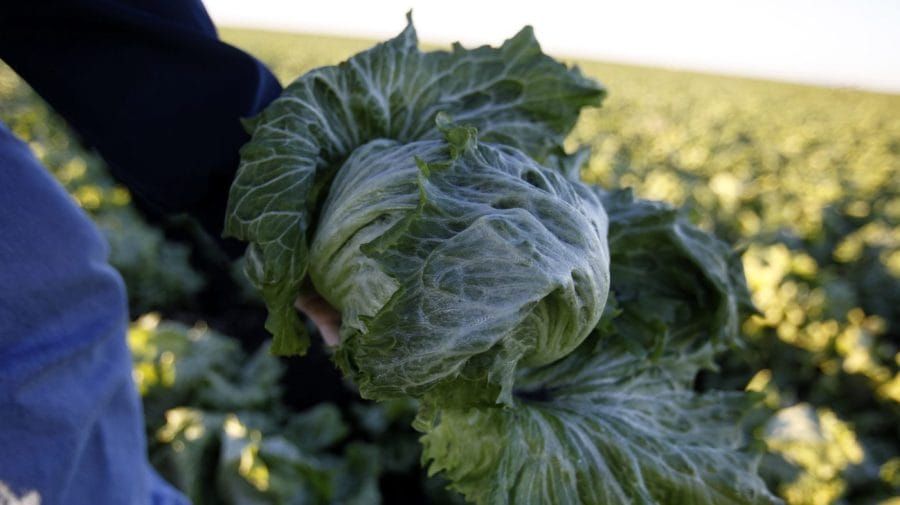
The lettuce was on store shelves across the Midwest before anyone knew it was making people sick. By the time federal health officials traced the cyclospora outbreak to iceberg lettuce sourced from central Mexico, according to The Hill, the pathogen had already reached nine states: Michigan, Ohio, Indiana, Kentucky, West Virginia, Illinois, Kansas, Oklahoma, and Pennsylvania. More than 11,500 cases have been confirmed, making this the largest known cyclosporiasis outbreak in U.S. history.
That word — known — is doing a lot of work. Because the story of how this outbreak spread is also the story of a food safety system that was specifically designed not to know, and the regulatory rule that could have changed that was quietly shelved after the produce industry spent years lobbying against it.
Cyclospora cayetanensis is a microscopic parasite. It causes prolonged, debilitating diarrhea — sometimes lasting weeks — along with fatigue, nausea, and cramping. It is not a pathogen that announces itself quickly. Symptoms can take up to two weeks to appear after ingestion. That delay means people across nine states ate contaminated lettuce, got sick, and recovered or sought care before the public health machinery could work backward through supply chains to find the source. That detective work is slow, expensive, and depends entirely on whether the supply chain can be traced at all.
Here is where the regulatory gap becomes a policy failure: the FDA's Food Safety Modernization Act, passed in 2011, authorized a rule that would have required detailed electronic traceability records for high-risk foods — including leafy greens. The rule, known as the Food Traceability Rule, was finalized in 2022. It required food companies to maintain records that could pinpoint the origin of contaminated produce within 24 hours of a request from federal investigators, rather than the days or weeks that current paper-based systems often require. The compliance deadline for that rule was January 2026.
The previous administration moved that deadline. Under pressure from food industry groups — including produce associations that argued the electronic recordkeeping requirements were burdensome and costly — federal regulators delayed the implementation date. As Tinsel News has reported, the company under suspicion in this outbreak contributed $2.2 million to Republican causes after the administration moved to delay the rule that would have required the recordkeeping that could have caught this outbreak faster.
The pattern is not new. Industry lobbying against food safety regulation has a long, well-documented history in Washington. What is different here is the scale of the human cost now attached to a specific, traceable regulatory decision. The question is not whether a faster traceability system would have prevented every one of the 11,500 confirmed cases. It would not have. The question is how many it would have prevented — and how many more are coming before the contaminated supply chain is fully cleared.
The FDA's Food Traceability Rule, finalized in 2022 under the Food Safety Modernization Act, required companies handling high-risk foods — including leafy greens — to maintain electronic records that could trace a product's origin within 24 hours. The compliance deadline was January 2026. The previous administration delayed implementation after food industry lobbying. Under current paper-based systems, tracing a contaminated product can take days or weeks — time during which contaminated food remains in distribution and on dinner tables.
The outbreak's geographic spread tells the story of how modern food distribution works. Iceberg lettuce grown in central Mexico enters a supply chain that moves product across the country within days. A single contaminated growing region or processing facility can seed outbreaks in a dozen states before the first case is diagnosed. This is not a failure of individual farms or individual consumers — it is a structural feature of a consolidated, high-velocity food system that was built without adequate public health infrastructure to match its speed.
The affected states are not random. Michigan, Ohio, Indiana, Kentucky, and West Virginia — the original five — are states where grocery distribution hubs serve large regional populations. The addition of Illinois, Kansas, Oklahoma, and Pennsylvania extends the reach into the central corridor and the mid-Atlantic. These are not states with robust alternative food networks for most residents. They are places where people eat what the supply chain delivers, and trust that what arrives is safe.
That trust is a policy choice. The Food Safety Modernization Act represented a bipartisan consensus, more than a decade ago, that the U.S. food system had grown too complex and too fast-moving for the regulatory infrastructure built in an earlier era. The law gave the FDA new authorities specifically designed to prevent outbreaks like this one — or, failing prevention, to stop them faster. The Food Traceability Rule was one of those authorities. Its delay was not a neutral administrative decision. It was a choice, made under industry pressure, with costs that are now being counted in cases.
The money trail here is not subtle. Food industry associations have spent years arguing that traceability requirements impose costs that would be passed to consumers. That argument treats the cost of compliance as certain and the cost of outbreaks as speculative. The 11,500 confirmed cases of cyclosporiasis — with their weeks of illness, their lost work, their medical bills, their hospitalizations among immunocompromised patients — are the speculative cost made concrete. They are also costs borne entirely by individuals, not by the companies whose lobbying delayed the rule designed to prevent them.
The global dimension of this outbreak matters too. The lettuce at the center of the outbreak was grown in central Mexico, where agricultural workers — many of them in low-wage, high-exposure conditions — tend the fields that supply the U.S. market. When contamination events occur, the investigative focus falls on the U.S. public health response. The conditions in growing regions that may have contributed to contamination, the labor and sanitation infrastructure available to workers in those regions, and the trade relationships that structure the supply chain receive far less scrutiny. The people most exposed to contamination risk at the source are rarely the people whose illness gets counted in the outbreak statistics.
This is also a story about what regulatory rollback actually looks like at human scale. Abstract debates about the burden of federal food safety rules become concrete when the rule that was delayed is the one that would have accelerated the traceback investigation for the country's largest-ever cyclosporiasis outbreak. The argument that traceability requirements are too costly to implement was always an argument about who bears the cost — a calculus that, as the White House's burial of a multi-year alcohol study made clear, the current administration has consistently resolved in industry's favor. The answer, as it turns out, is 11,500 people who ate a salad.
The Food Traceability Rule has not been repealed. It has been delayed. The compliance deadline has been pushed back, but the statutory authority remains. What happens next — whether the rule is ultimately implemented, further delayed, or quietly dismantled — will determine whether this outbreak becomes a turning point in food safety policy or a data point in a longer pattern of regulatory capture. The 11,500 confirmed cases will not be the last number in this story. The compliance deadline is still a decision that someone has to make.