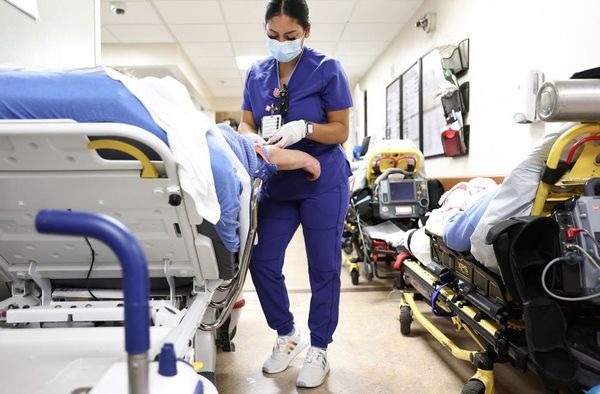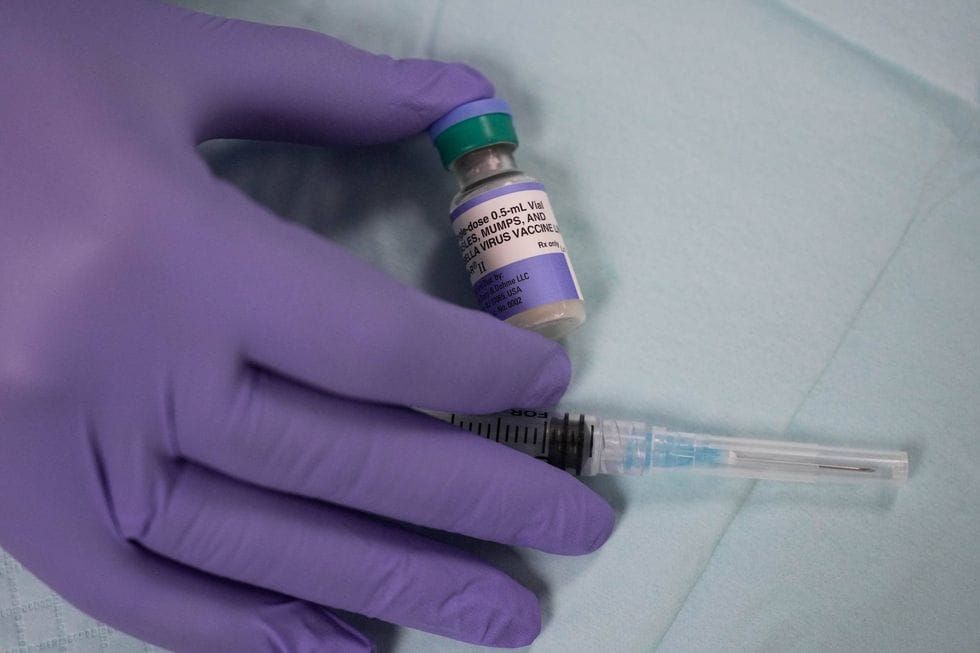
Pennsylvania's measles outbreak passed 1,000 confirmed cases on Monday — the largest in the state in three decades. At least 198 people have been hospitalized. Five have died. Officials say fewer than 1% of those infected had been appropriately vaccinated, according to Common Dreams, which first reported the full scope of both states' outbreaks. New York, watching the crisis spread across its border, declared a statewide measles emergency the same day.
These are not acts of God. They are the predictable consequence of a decade-long, well-funded campaign to erode public trust in one of the most effective medical interventions in human history — a campaign now operating from inside the federal government.
The scale of the reversal is worth sitting with. In 2024, the United States recorded 285 measles cases. This year, the Centers for Disease Control and Prevention has counted more than 3,900 — a fourteenfold increase, the worst outbreak since 1991, in a country that had functionally eliminated the disease. That kind of collapse in a vaccine-preventable illness does not happen by accident. It requires sustained, organized doubt-seeding over years, followed by the political elevation of the people who did the seeding.
Robert F. Kennedy Jr. has spent decades as the most prominent anti-vaccine voice in the United States. He co-founded Children's Health Defense, an organization dedicated to promoting vaccine skepticism, and spent years pushing the long-discredited claim that the measles-mumps-rubella vaccine is linked to autism — a claim the scientific community has refuted comprehensively and repeatedly. As recently as August, according to Common Dreams, Kennedy was still circulating that myth. He is now the Secretary of Health and Human Services, the official responsible for federal vaccination policy.
The contradiction at the center of Kennedy's tenure is not subtle. He has, at various points, urged Americans to receive the MMR vaccine. But in the same breath — often in the same public appearance — he has claimed, without evidence, that the vaccine causes deaths each year and that its benefits are "exaggerated." He has promoted unproven alternative treatments in place of vaccination. The effect of those simultaneous messages is not neutrality. It is paralysis. When the person running the federal health apparatus tells you a vaccine is both necessary and dangerous, the rational response for a hesitant parent is to wait. Millions have waited. Some are now sick. Some have died.
Two doses of the measles-mumps-rubella vaccine are approximately 97% effective at preventing measles. The disease was declared eliminated in the United States in 2000 after decades of routine childhood vaccination. Less than 1% of Pennsylvania's current outbreak cases involved people who had been appropriately vaccinated, state health officials said.
Pennsylvania Governor Josh Shapiro has been direct about where he places responsibility. He has publicly named Kennedy and the Trump administration's reversal of longstanding federal vaccination policy as factors amplifying the crisis. That is a Democratic governor of a swing state making a specific, named accountability claim about the federal government's role in his constituents' deaths. It is not a partisan talking point. It is a statement of documented sequence: federal vaccine communication eroded, community vaccination rates dropped, the disease returned.
The timeline of Kennedy's behavior during the outbreak is worth examining precisely. As measles spread through Pennsylvania this fall, Kennedy was not convening emergency public health briefings or issuing unambiguous federal guidance urging vaccination. On September 17, he traveled to Washington, D.C., to speak at a convention hosted by Children's Health Defense — the anti-vaccine organization he helped build — and told attendees, which included prominent anti-vaccine activists, that they had a "strong and steadfast" friend in his office. This is the conduct of a person who has not resolved the contradiction between his institutional role and his ideological commitments. It is the conduct of someone whose primary loyalty, in a moment of genuine public health emergency, ran toward the movement that created the emergency.
Here is what the outbreak coverage has largely avoided saying plainly: Kennedy is not a confused communicator who occasionally sends mixed messages. He is a movement leader who now controls the institution his movement was built to undermine. The measles crisis is not a failure of his tenure — it is the logical extension of his career. The outbreaks in Pennsylvania and New York are not occurring despite his presence at HHS. They are occurring in the conditions his decades of advocacy created, now accelerated by his institutional authority to shape — or decline to shape — federal public health messaging.
New York Governor Kathy Hochul's emergency declaration, the first issued by any U.S. state this year, offers a useful contrast in what functional public health governance looks like. The order, in effect through November 4, expands the number of health professionals authorized to administer the MMR vaccine, allows pharmacists to vaccinate children as young as two, and requires vaccination records to be reported to state immunization registries within 72 hours. "No one should get seriously ill or die from a vaccine-preventable disease," Hochul said. The statement is unremarkable as public health communication. Its unremarkability is the point. It is what federal leadership should sound like and does not.
As we noted in our earlier coverage of how the outbreak map traces directly to RFK Jr.'s policy footprint, the states experiencing the worst surges are those where vaccine confidence has been most systematically eroded. Pennsylvania's rural communities, where New York's 108 cases are also concentrated, are not random outbreak sites. They are communities where years of organized misinformation — amplified now by the credibility of federal office — have depressed vaccination rates below the threshold required for herd immunity. A Republican senator has already named this connection publicly, as Tinsel News reported earlier this year. The political cost of saying so plainly is apparently low enough that even members of Kennedy's own coalition are willing to say it.
The pattern here connects to something broader about how regulatory capture works in the United States. It does not always look like a lobbyist writing a rule. Sometimes it looks like appointing the movement's founder to run the agency the movement was targeting. The result is the same: the institution loses its capacity to perform its core function. HHS exists, in part, to protect Americans from vaccine-preventable illness. Its current secretary spent his career making Americans more afraid of vaccines. The measles numbers are not a policy failure in the ordinary sense. They are a measurement of what it costs when you hand an institution to the person most committed to its failure.
The HHS has been making vaccine policy from disputed and retracted research — a pattern that goes beyond messaging inconsistency into active institutional distortion of the evidence base. This is not the only arena where industry lobbying turned a preventable outbreak into a public health crisis by corrupting the regulatory process upstream of the emergency. When the scientific foundation of federal health guidance is compromised, the damage flows downstream into every clinic, every school immunization form, every pediatrician's office where a hesitant parent asks whether the shot is really necessary. The answer from the top of the federal health system has been: we're not sure either.
Five people are dead in Pennsylvania from a disease that a two-dose vaccine prevents with 97% efficacy. The country has recorded more measles cases this year than in any year since 1991. The person responsible for the federal government's response has spent decades ensuring that fewer people trust the vaccine that stops it. The emergency declarations from Albany are the sound of state governments trying to fill a void the federal government has chosen to leave open.