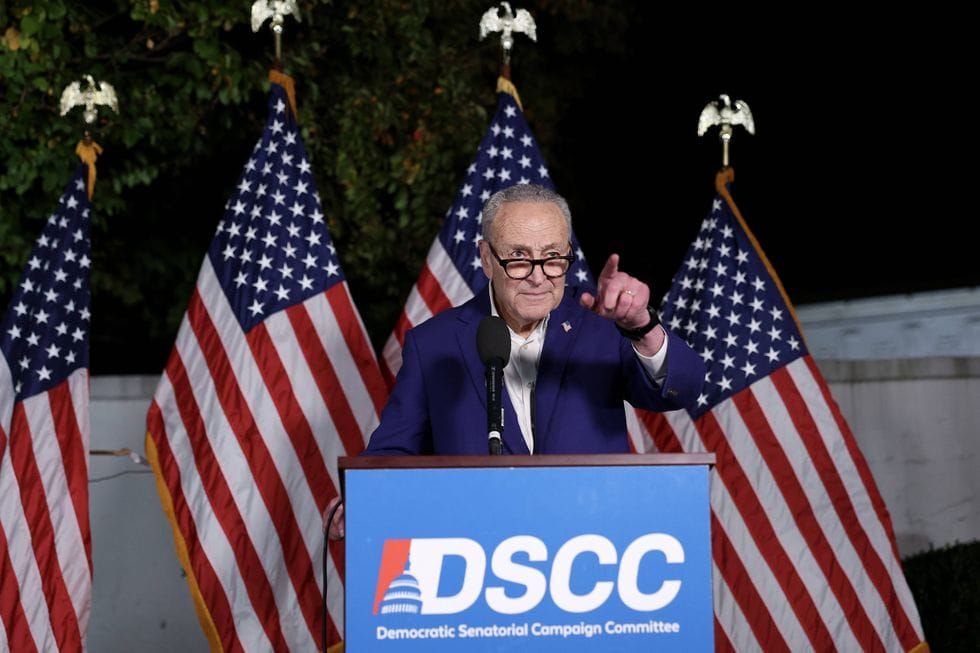
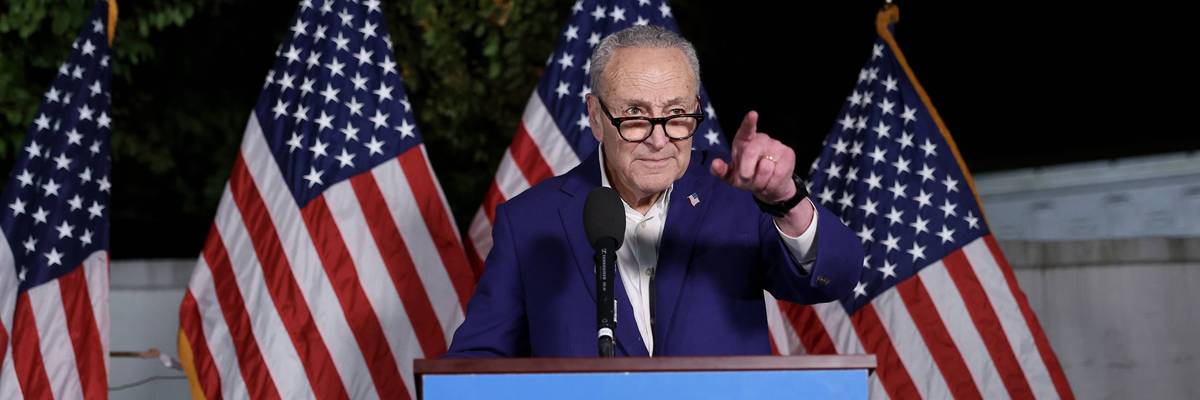
The morning after Democrats secured at least 54 Senate seats and a House majority, Senate Minority Leader Chuck Schumer stood before reporters and reached for the oldest tool in the congressional arsenal. "The Founding Fathers had the power of the purse as one of the ways of deterring a president who does war without the consent of the American people," Schumer told reporters on Wednesday. "We are going to end the war."
It was the clearest signal yet that the Democratic majority arriving in January intends to do something Congress has not done since the end of the Vietnam War: cut off funding for an active military conflict. The Iran War began in February without a declaration of war, without an Authorization for Use of Military Force, and — as Tinsel News has documented — without any credible legal basis under existing statute. The constitutional confrontation Schumer is previewing would be unprecedented in scope, and the outcome is far from guaranteed.
But the political conditions for it have never been more favorable. And the reason for that sits in a single social media post from the man who may run for president in 2028.
The Iran War began in February without congressional authorization. Earlier this year, four Republican senators — Rand Paul (R-Ky.), Susan Collins (R-Maine), Bill Cassidy (R-La.), and Lisa Murkowski (R-Alaska) — joined the vast majority of Democrats to pass a war powers resolution compelling the president to end the conflict. Trump ignored it. With a full majority in both chambers, Democrats can now move beyond symbolic resolutions and attach defunding conditions directly to defense appropriations.
On Tuesday night, Vice President JD Vance posted a statement that was remarkable for its candor and devastating for its implications. "The reason we lost is the war," Vance wrote. "The president himself said so last night. If you'd like to argue it was worth it, that losing the Senate for the next six years was worth it, then do so. Argue it was a worthwhile cost to pay. Agree or disagree, that's at least honest. But everyone knows why we lost." Donald Trump Jr. endorsed the post without, apparently, registering that it was an implicit indictment of his father's judgment.
Vance's statement is not just a political postmortem. It is an admission — from inside the administration — that the Iran War caused the Republican loss of the Senate. That matters constitutionally because it forecloses the argument that Congress should defer to executive wartime authority out of political solidarity. The president's own vice president has now said the war was a mistake. The question is whether that admission changes anything about the White House's willingness to end it.
Here is what the source material does not say, and what the coming months will force into the open: defunding a war is not the same as ending one. Congress can cut off appropriations. The executive branch can contest that cut, reroute existing funds, invoke emergency authorities, and dare the courts to intervene. The history of the War Powers Resolution — passed in 1973 and ignored by most presidents since — suggests that the constitutional tools Congress believes it has are less reliable than they appear on paper. Seven previous Senate votes to rein in the Iran War failed. A majority changes the arithmetic. It does not automatically change the outcome.
The specific mechanism Schumer described — the power of the purse — is the strongest constitutional lever available to Congress short of impeachment. Article I of the Constitution grants Congress exclusive authority to appropriate funds. No money can be spent without congressional authorization. In theory, Democrats could attach a provision to any defense spending bill that prohibits the use of funds for offensive military operations against Iran. In practice, the executive branch has developed decades of legal infrastructure for arguing that such restrictions infringe on the commander-in-chief's authority.
Two of those four Republicans — Susan Collins and Bill Cassidy — will not be in the Senate when the new majority is seated. Their departure removes two of the most reliable crossover votes on war powers. The remaining Republicans who might join Democrats — Rand Paul chief among them — come from a libertarian-inflected tradition that is skeptical of executive war-making, but that skepticism has not always survived direct pressure from a Republican White House. Whether Paul and Lisa Murkowski will hold when the defunding fight becomes a full constitutional confrontation, rather than a symbolic resolution, is the variable Schumer's math cannot yet account for.
There is also the question of Democratic unity. Senator John Fetterman of Pennsylvania was the lone Democrat to oppose the war powers resolution earlier this year. In a chamber where every vote will matter, his position on a defunding measure — which is a harder vote than a resolution — remains unclear. Fetterman has repeatedly demonstrated a willingness to break with his caucus on national security votes in ways that track with his donor relationships rather than his stated ideology. A 54-seat majority is comfortable. It is not bulletproof.
What makes this moment different from every previous war powers confrontation is the economic context. The closure of the Strait of Hormuz — a direct consequence of the Iran War — has driven energy prices to levels that voters felt in their daily lives. Vance's own statement names this as a cause of Republican defeat. The war's energy costs have functioned as a regressive tax, falling hardest on working families who spend a higher share of their income on fuel. That is not an abstract constitutional argument. It is a grocery bill and a gas receipt, and it moved enough voters in enough states to flip the Senate.
That economic pressure is what gives Schumer's threat teeth that previous war powers resolutions lacked. When Congress passed resolutions, the White House could dismiss them as partisan theater. When Congress moves to cut off funding for a war that the vice president has admitted cost Republicans the Senate, the political calculus shifts. Some Republicans facing 2028 primaries — or, more immediately, reelection in states where gas prices remain elevated — will have to calculate whether their loyalty to a lame-duck president is worth the cost.
The global dimension of this fight is already visible. The Strait of Hormuz closure has not only affected American consumers. It has disrupted oil supply chains across Asia, driven coal consumption in markets that were moving toward cleaner energy, and handed economic advantage to Russia, which has benefited from elevated oil prices while facing reduced pressure over Ukraine. A war that was sold domestically as a security necessity has functioned internationally as a subsidy to adversaries and a burden on allies. The countries most harmed by the Hormuz closure — Japan, South Korea, India — have been the least consulted about its continuation. Their interests are absent from Schumer's framing, and they will be absent from the defunding debate, even though they have more skin in this outcome than most American voters.
What the next three months will show is whether the constitutional confrontation Schumer is promising is a real effort to end an unauthorized war or a political positioning exercise designed to extract concessions without actually cutting off funds. The history of Democratic war powers politics does not inspire confidence. In 2007, Democrats won Congress on an antiwar mandate and spent two years passing non-binding resolutions before funding the Iraq War through the end of the Bush administration. The power of the purse was available then too. It went unused.
The difference this time is that the war's political costs have already been tallied, and the person tallying them is JD Vance. When a vice president tells his own party that an unauthorized war cost them the Senate, the political space for congressional inaction collapses. Schumer knows this. Trump knows this. The question is who blinks first — and whether the constitutional tools Congress is reaching for are strong enough to force the issue, or just strong enough to make the argument.
If Democrats use the power of the purse and the White House defies it, the next stop is federal court — and federal courts have historically been reluctant to adjudicate war powers disputes, preferring to declare them political questions beyond judicial reach. That deference has served executive power for fifty years. Congress has already tried the lawsuit route and found its limits. The defunding fight is the last constitutional lever that does not require a judge to agree. Whether it works depends on whether enough Republicans in a Senate majority are willing to hold the line when the White House calls their bluff — and whether Democrats are willing to let the government shut down to show they mean it.