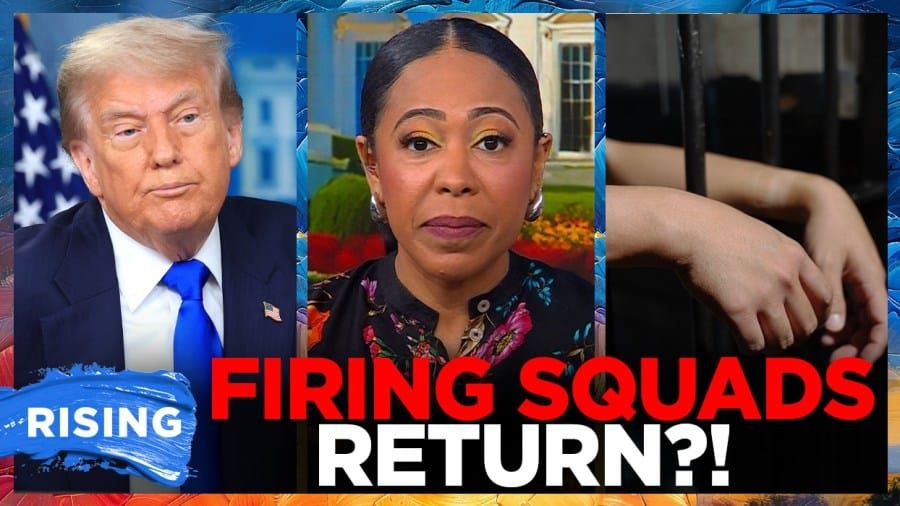
There is no shortage of ways to kill a person in the custody of the United States government. Federal death row currently permits lethal injection, electrocution, gas, and hanging — depending on the state where the offense was committed. The Justice Department's recent push, reported by The Hill, to add firing squads to that list is not a logistical fix. It is a message — and the message is the point.
The official justification, as with most expansions of state violence under this administration, is procedural. Lethal injection drugs have become harder to source. Pharmaceutical companies, responding to pressure from abolitionists and their own ethical concerns, have restricted the sale of pentobarbital and sodium thiopental for execution purposes. The argument goes: if one method is unavailable, others must be ready. The firing squad, in this framing, is a practical backup.
That argument collapses under minimal scrutiny. The United States is not running out of ways to execute people. It is running out of ways to execute people that look clinical and bloodless — that keep the state's lethal power at a comfortable remove from the public gaze. The firing squad does the opposite. It is loud, visible, and unmistakably violent. Choosing it is not a concession to necessity. It is a preference.
The Trump administration carried out 13 federal executions between July 2020 and January 2021 — more than any administration in 70 years, and more than the previous six decades of federal executions combined. The current push to expand available methods comes as the administration has signaled its intent to resume and expand the federal execution program.
The accountability question here is not complicated. Who is making this decision, and what do they gain from it? Attorney General Pam Bondi has positioned herself as an enthusiastic executor of the administration's most aggressive criminal justice postures. The DOJ under her leadership has moved to shield federal prosecutors from state ethics oversight, dropped accountability cases against law enforcement, and now seeks to expand the methods by which the government may kill its own citizens. The pattern is consistent: consolidate state power, remove constraints on its exercise, and make the consequences of that power more visible rather than less.
The visibility is not incidental. Political scientists and criminologists who study authoritarian governance have documented a recurring dynamic: regimes that want to normalize state violence benefit from making it spectacular. Not secret, not antiseptic — spectacular. A firing squad execution is an event. It requires a squad. It produces a body with visible wounds. It is, by design, impossible to aestheticize the way lethal injection has been aestheticized — the prone figure, the IV line, the clinical hush of a procedure that looks like sleep. The firing squad refuses that comfort. And refusing that comfort is, for certain political projects, the entire value.
This is the thesis the source material at The Hill gestures toward but does not fully develop: the DOJ's firing squad proposal is not a policy refinement. It is a political act designed to shift the Overton window on state killing — to make the public more comfortable with the idea that government violence can be raw, punitive, and deliberately harsh, rather than sanitized into something that resembles medical care.
The systemic pattern here runs deeper than one administration's preferences. The United States is one of a small number of wealthy democracies that retains capital punishment at all. According to Amnesty International's 2023 global report on executions, the U.S. ranked alongside Iran, Saudi Arabia, Egypt, and China among the world's leading executing nations by volume — a fact that receives almost no sustained attention in domestic coverage of death penalty debates. The firing squad proposal will be debated in American media almost entirely as an American political story, with American legal precedents, American partisan divides. The international frame — that this country is outlying among its peer nations in ways that matter — will be mentioned, if at all, as a footnote.
The human impact lens demands something the policy debate almost never supplies: the actual people on federal death row, and what expanded execution methods mean for them. There are currently 40 people on federal death row. They are disproportionately Black and Latino. Many were convicted under mandatory sentencing regimes that have since been reformed or struck down. Several have raised credible claims of ineffective counsel, prosecutorial misconduct, or evidence that was suppressed at trial. The firing squad debate treats them as abstractions — vessels for a constitutional argument — rather than as people whose deaths are being actively planned by a government apparatus that has demonstrated, repeatedly, that it gets these cases wrong.
That is not a marginal concern. The National Registry of Exonerations has documented 190 death row exonerations since 1973 — people who were sentenced to death and later found to be innocent. A firing squad, like every other execution method, is irreversible. The administration's push to expand the toolkit of state killing is happening simultaneously with its systematic dismantling of the oversight mechanisms — independent prosecutors, robust public defender funding, judicial accountability structures — that are supposed to catch those errors before they become permanent. The DOJ's pattern of targeting political opponents while accelerating punitive power over the incarcerated is not coincidence. It is the shape of the project.
There is also a specific and underreported international dimension. The United States executes foreign nationals on death row — people from Mexico, Honduras, and other countries whose governments have formally protested the executions as violations of the Vienna Convention on Consular Relations, which requires that foreign nationals be notified of their right to contact their embassy upon arrest. The Inter-American Court of Human Rights has issued advisory opinions on this. The International Court of Justice has ruled against the United States on the issue. None of this has changed American practice, and none of it will feature in the firing squad debate, which will proceed as if the only relevant stakeholders are American voters and American courts.
The framing battle over execution methods is, at bottom, a framing battle over what kind of violence the state is permitted to perform and how much of it the public is required to see. Lethal injection was invented, in part, to make executions more palatable to a public that was growing uncomfortable with the electric chair. The firing squad reverses that logic. It says: we are not trying to make this comfortable. We are trying to make this legible as punishment. The discomfort is the point. The blood is the point.
Forty people are currently waiting to find out which method the government will use to kill them. The administration calling for firing squads has already demonstrated, across every domain of criminal justice and immigration enforcement, that it views the infliction of suffering not as an unfortunate side effect of policy but as a primary mechanism of social control. The question is not whether firing squads are constitutional — courts will spend years on that. The question is what it means that an administration is actively lobbying to make state executions more visibly brutal at the same moment it is allowing people to die in immigration custody without explanation, dropping police accountability cases, and shielding its own prosecutors from ethical oversight. The answer is that the cruelty is not a bug in the system. It is the system's current operating principle.