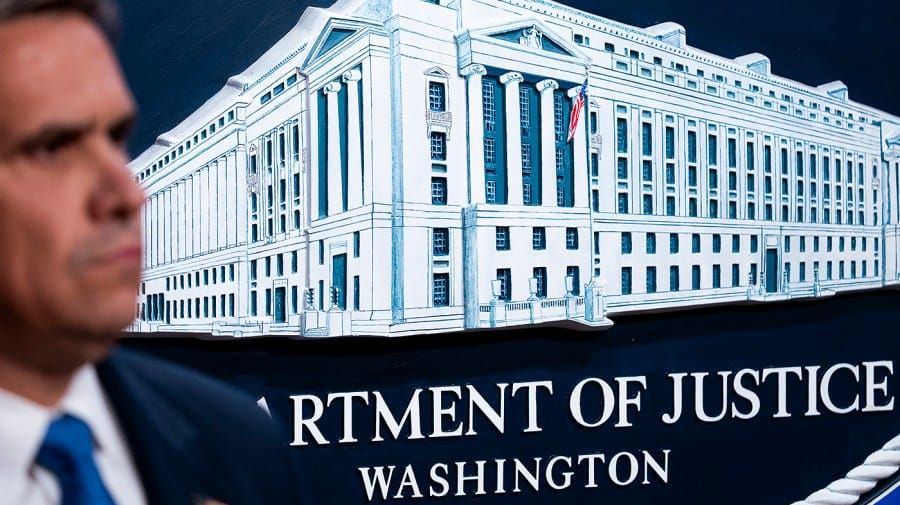
The Justice Department has a new constitutional argument: states that refuse to supply federal agents with undercover license plates are breaking the law. Brett Shumate, the DOJ's Civil Division Assistant Attorney General, made the claim bluntly, writing that such refusals are "dangerous, shameful, and unconstitutional," according to The Hill. The statement is framed as a defense of law enforcement safety. What it actually describes is the federal government demanding that states actively equip a deportation apparatus with the tools to conduct covert operations in their own communities — and threatening constitutional consequences if they decline.
That framing matters. The word "unconstitutional" has weight. It implies a legal obligation — that states have no choice, that resistance is defiance, that the federal government's enforcement preferences supersede state-level decisions about how much cooperation to extend. But states have never been required to affirmatively fund or equip federal law enforcement operations. The legal doctrine at issue — anti-commandeering, established in Printz v. United States (1997) and reinforced in Murphy v. NCAA (2018) — holds that the federal government cannot conscript state resources or officials to implement federal programs. The DOJ's claim that refusing to issue plates is itself unconstitutional inverts that doctrine entirely.
Under Printz v. United States (1997) and Murphy v. NCAA (2018), the Supreme Court held that the federal government cannot compel states to enforce federal law or conscript state resources for federal programs. States that decline to issue undercover plates to DHS officers are not obstructing federal law — they are exercising a right the Court has recognized for nearly three decades. The DOJ's assertion that this refusal is "unconstitutional" has no established precedent behind it.
The practical function of an undercover license plate is straightforward: it allows a federal agent driving a vehicle to avoid identification. In the context of immigration enforcement, this means DHS officers can surveil neighborhoods, follow individuals, and conduct operations without their vehicles being recognized as federal law enforcement. For immigrant communities — many of which have organized informal warning networks precisely because they know federal agents are operating in their areas — the removal of that visibility is not a minor procedural detail. It is the removal of a layer of protection.
This connects directly to a documented pattern of ICE operations that have increasingly blurred the line between targeted enforcement and broad community surveillance. As Tinsel News has reported, ICE already purchases commercial location data from private brokers to track individuals without obtaining warrants — a practice that converts the commercial data infrastructure into a state surveillance tool. Undercover plates extend that logic into physical space: agents who cannot be identified by their vehicles are agents who cannot be tracked, avoided, or documented by the communities they are monitoring.
The states declining to cooperate are not acting randomly. They are states that have passed sanctuary policies — legal frameworks that limit how deeply local and state governments participate in federal immigration enforcement. Those policies exist because elected officials in those states made a judgment: that full cooperation with federal immigration operations damages community trust, chills cooperation with local law enforcement, and imposes costs on their residents that outweigh the federal government's enforcement preferences. The DOJ's response to that judgment is not a legal argument. It is a pressure campaign dressed in constitutional language.
The accountability question here is not primarily about license plates. It is about what enforcement infrastructure the federal government is trying to build, and what it is using that infrastructure to do. Congress handed ICE $75 billion and imposed almost no oversight rules on how that money gets spent or what operations it funds. The agency now operates with a budget, a mandate, and — if the DOJ gets its way — a fleet of unmarked vehicles that state governments are legally obligated to provide, regardless of their own policies or their residents' interests.
The DOJ's use of constitutional language is also worth examining as a political strategy. Calling a state's refusal "dangerous" and "shameful" before calling it unconstitutional is a sequencing choice. It establishes moral stakes before legal ones. It positions the federal government as the victim of state obstruction rather than as an actor whose enforcement methods states have legitimate reasons to resist. The same framing has appeared repeatedly in this administration's conflicts with states over immigration — a pattern in which federalism arguments are deployed selectively, invoked when they favor federal enforcement and discarded when states try to protect their residents.
The human impact of covert immigration enforcement falls directly on specific communities: working-class immigrant neighborhoods, predominantly Latino, in cities and towns across the country. For those communities, the presence of unmarked federal vehicles is not an abstraction. It changes where people go, whether they take their children to school, whether they seek medical care, whether they report crimes to police. The deterrent effect of covert enforcement is not a side effect — it is a feature. An enforcement environment in which any unmarked vehicle might be a federal agent conducting surveillance is an environment in which self-deportation becomes rational. That is the goal the policy is designed to produce.
The ICE shooting of Carlos Mendoza-Hernandez — in which the gang-member label came after the bullets — is one documented example of what covert, low-accountability enforcement produces on the ground. Undercover plates do not cause shootings. But they are part of the same infrastructure: tools that reduce the visibility of federal agents, limit community knowledge of where enforcement is happening, and make accountability harder to establish after the fact.
The legal fight, if it comes, will turn on whether the federal government can compel states to issue license plates as a form of required cooperation with federal law enforcement. That is a genuinely novel constitutional question — the DOJ's characterization of existing refusals as already unconstitutional is a claim, not a ruling. No court has held that states must issue undercover plates. The assertion that they must is the administration's opening position in what it intends to be a coercive negotiation, not a settled legal fact.
What is settled is the direction of travel. The administration has moved, in sequence, to purchase commercial surveillance data without warrants, to deploy immigration agents in contexts — airports, courthouses, schools — that were previously understood as protected, to shield federal prosecutors from state ethics oversight, and now to demand that states provide covert operational tools on constitutional grounds that do not yet exist in case law. Each step is individually defensible as enforcement. Together, they describe a federal apparatus that is systematically removing the friction — legal, logistical, and social — that previously limited what immigration enforcement could do and where it could reach.
States that refuse to issue the plates are not obstructing justice. They are exercising the only lever they have left. The DOJ's threat to call that obstruction unconstitutional is an attempt to take that lever away — and to do it before any court has been asked whether the argument holds.