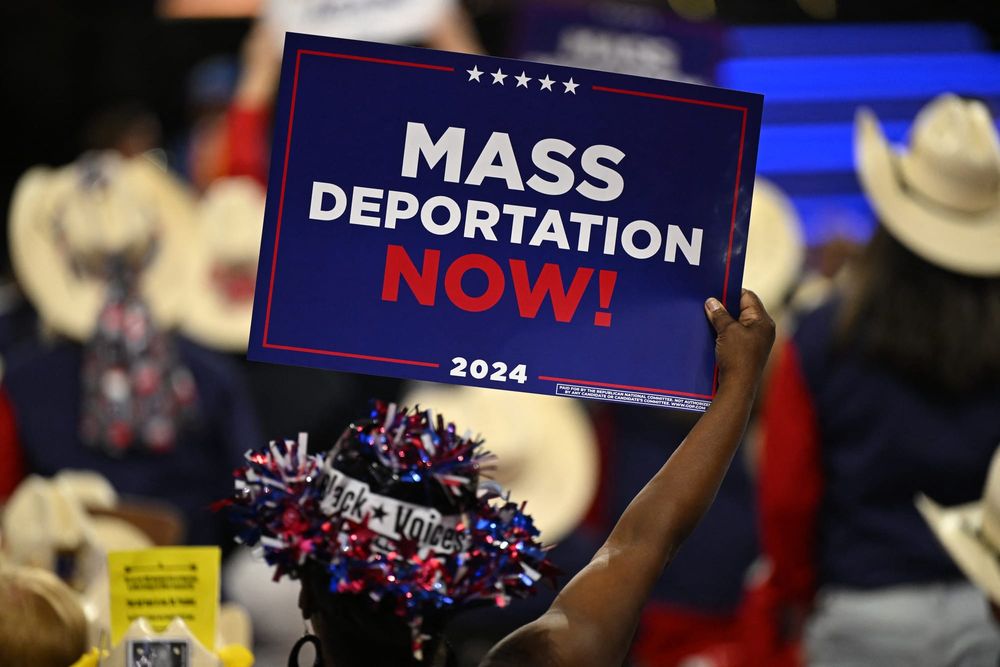
The math is not complicated. The Trump administration has set a public target of 1 million deportations in a single calendar year. Border crossings are down sharply — the administration's own policies have seen to that. The undocumented population that remains in the United States is overwhelmingly settled, working, and concentrated in specific industries. To find 1 million people, enforcement must go where those people are: farms in California's Central Valley, construction sites in Texas and Florida, meatpacking plants in the rural Midwest. That is the logic driving a push inside MAGA circles for aggressive worksite enforcement, as Politico reported this week.
The problem is that the industries targeted by worksite enforcement are not bystanders to Republican politics. They are its financial architecture.
Agricultural and construction lobbies have spent decades making worksite immigration enforcement functionally impossible — not by opposing it loudly, but by ensuring it stayed quiet, underfunded, and deprioritized across administrations of both parties. The E-Verify system, which allows employers to check workers' immigration status, remains voluntary for most private employers despite repeated legislative pushes to mandate it. That is not an accident. It is the product of sustained lobbying by the same industries now in the crosshairs of the administration's deportation arithmetic.
The agriculture sector's relationship with undocumented labor is not incidental — it is structural. The USDA estimated in a 2020 report that roughly half of all hired crop farmworkers in the United States lack authorized immigration status. In California, the share is higher. In Florida's fruit and vegetable operations, higher still. These are not marginal workers filling gaps at the margins; they are the labor force the industry was built around, recruited actively during decades when enforcement was performative and growers knew it.
Construction tells a similar story. The National Association of Home Builders, a reliable Republican donor, has consistently opposed mandatory E-Verify. The Associated Builders and Contractors, another industry group with deep ties to Republican lawmakers, has warned for years that mass deportation would trigger a construction labor shortage severe enough to halt housing production in major metro areas. Those warnings were issued, received, and quietly filed away — tolerated as the price of keeping the coalition intact as long as enforcement stayed theoretical.
It is no longer theoretical. The administration's stated goal forces a choice that the Republican coalition has avoided for thirty years: either the deportation targets are real, or the protection of employer interests is real. Both cannot survive simultaneously.
This is the fracture the worksite enforcement push exposes — and it is more structurally significant than the political coverage has treated it. The standard framing, including Politico's, centers on whether farm and construction groups will complain, whether voters will notice, whether the coalition will splinter. That framing treats the tension as a political management problem. It is actually a revelation about what the immigration enforcement apparatus has always been for.
Mass deportation rhetoric, deployed consistently since the 1990s, has served a specific function in American politics: it mobilized a voter base while the enforcement mechanisms were quietly kept blunt enough to leave the labor supply intact. E-Verify stayed voluntary. Worksite raids were episodic and telegraphed. The H-2A agricultural guest worker program expanded — providing legal cover for growers who wanted it — while the undocumented workforce that couldn't access H-2A continued to harvest the crops that H-2A couldn't fill fast enough. The system was designed to produce the appearance of enforcement without the economic disruption that actual enforcement would cause.
The 1 million deportation target breaks that arrangement. It requires the enforcement apparatus to function at a scale where employer interests cannot be quietly protected. That is why the current push is generating internal MAGA friction rather than unified momentum — and why the industries most exposed are not preparing to comply, but to lobby.
The human cost of that political negotiation is not abstract. The workers caught in the gap between the administration's targets and its donors' interests are not variables in a coalition management calculation. They are people who have, in many cases, lived and worked in the United States for years or decades. As Tinsel News has documented in Memphis and other communities, enforcement surges do not simply remove workers from payrolls — they fracture families, hollow out neighborhoods, and force entire communities into defensive postures that make daily life a sustained emergency. The political story of which industry lobbies win the internal MAGA fight runs parallel to a human story that will be measured in family separations and community displacement regardless of how the lobbying resolves.
There is also a downstream economic consequence the current coverage is underweighting. Housing construction in the United States is already in a supply crisis. Mortgage rates remain elevated. The Biden-era backlog of unbuilt homes has not been resolved. A worksite enforcement surge concentrated in construction would not simply inconvenience developers — it would suppress housing supply in the same moment the administration is under pressure to bring housing costs down. The agricultural parallel is equally direct: a disrupted harvest season, particularly in California and Florida, translates into food price increases that hit working-class households hardest. The voters the administration's economic messaging is targeting would bear the cost.
That is the original tension the Politico framing does not fully surface: the administration's deportation ambition is colliding not just with donor interests, but with its own economic promises. The MAGA coalition was assembled, in part, on the argument that immigration suppresses wages and raises costs for American workers. Worksite enforcement at scale would test that claim in real time — by removing workers from industries where their absence would produce immediate price increases, not wage gains, because the production capacity cannot be replaced quickly with a documented workforce at any wage the market currently offers.
The farm and construction lobbies understand this. They have always understood it. Their resistance to mandatory E-Verify was never ideological — it was a straightforward calculation about labor supply and production cost. What has changed is that the political price of that calculation is now visible. The administration's targets require enforcement that the coalition's funders have spent decades preventing. Someone will have to lose, and the fight over who that is — conducted largely through lobbying, donor access, and the quiet redirection of enforcement priorities — will determine whether the 1 million figure was ever a policy goal or always a performance.
The answer to that question will not appear in a press release. It will appear in the enforcement data: how many worksite raids, in which industries, with what follow-through on employer liability. If the raids concentrate on sectors without organized donor relationships — restaurants, domestic work, small landscaping operations — and spare the agricultural and construction industries where organized money flows to Republican campaigns, the answer will be visible. Watch the E-Verify mandate. Watch whether employer sanctions materialize alongside worker arrests. The enforcement pattern will tell you whose coalition this actually is, and who it was always designed to protect.