The Federal Communications Commission does not need to revoke a single broadcast license to accomplish its goal. It only needs to make the process threatening enough that newsrooms start asking, before the cameras roll, whether a story is worth the regulatory exposure.
That is the argument at the center of a formal filing submitted Tuesday by a group of prominent former FCC officials — commissioners and senior staffers appointed by both Democratic and Republican presidents — who warned, according to The Guardian US, that the agency is trying to send a "chilling message" to broadcasters. The filing asks the FCC to reject petitions to deny license renewals for eight ABC-owned local television stations.
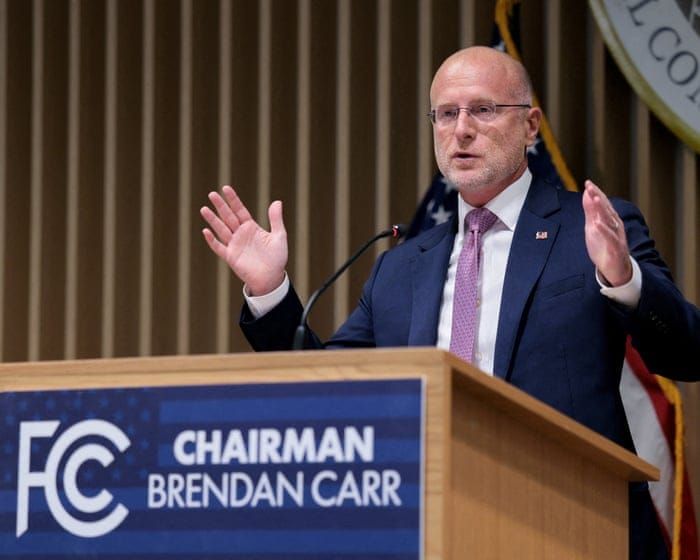
The licenses are up for early renewal after an order issued in late April by FCC Chair Brendan Carr — an order that followed public criticism of ABC by Donald Trump and Melania Trump. That sequence is not incidental. It is the mechanism.
Broadcast licenses are typically renewed on an eight-year cycle. The FCC can initiate early renewal proceedings — a rare move — and third parties can file petitions to deny renewal. The process is expensive, legally resource-intensive, and historically reserved for documented violations of broadcast law, not editorial disagreements. Triggering it against a major network following presidential criticism has no modern precedent.
Read against that backdrop, the ABC license review is not a regulatory proceeding. It is a demonstration. The FCC under Carr is not primarily trying to pull ABC's licenses. It is teaching every other broadcaster, in real time, what happens when a network's coverage displeases the White House. The chilling effect is not a side consequence of the process. It is the product.
To understand why, follow the power structure. Broadcast licenses are the legal foundation of every local television station in the country. Without them, a station cannot transmit. The FCC, as the licensing authority, holds existential power over commercial broadcasters in a way it does not hold over cable networks, streaming platforms, or digital publishers. ABC's parent company, Disney, operates eight licensed stations. The moment the FCC placed those licenses in procedural jeopardy, every other broadcast licensee in the country received the same message, without a single filing directed at them.
This is not the first time the Carr FCC has used its regulatory authority in ways that raise structural questions about independence. But the ABC case is qualitatively different. Previous FCC actions under this administration could be defended, however weakly, on policy grounds. The ABC license review cannot. The triggering event, as documented by The Guardian US, was presidential displeasure — Trump and Melania Trump's public criticism of the network. The regulatory response followed. The causal chain is not alleged; it is chronological and on the record.
The former officials who filed Tuesday represent something significant: bipartisan institutional memory. These are people who worked inside the FCC under administrations of both parties, who understand how the agency is supposed to work, and who are willing to say in a formal legal filing that what is happening now is outside those norms. When former commissioners appointed by Republican presidents join that filing, the argument cannot be dismissed as partisan opposition. It is a professional judgment about institutional conduct.
The stakes here run deeper than ABC. The cost of broadcast license intimidation is diffuse and largely invisible — which is precisely what makes it effective. A newsroom that self-censors leaves no paper trail. An editorial meeting that decides a story about the administration is not worth the regulatory risk produces no document. The damage to public information happens in the stories that are never assigned, the sources that are never called, the questions that are never asked on air. You cannot measure what was suppressed. You can only measure the incentive structure that produced the suppression.
That incentive structure is now explicit. The FCC chair received criticism from the president about a network. The FCC initiated an early license review of that network's stations. Petitions to deny renewal were filed. Former officials from both parties called it a chilling message. The chain of events is public. The only remaining question is whether the rest of the broadcast industry draws the lesson the FCC is teaching.
The pattern fits a broader strategy of using regulatory and legal processes not to win individual cases but to impose costs on institutions that resist. The DOJ has deployed similar logic against political targets, using the weight of investigation itself as the punishment regardless of outcome. Federal subpoenas aimed at war correspondents have made the act of reporting a legal liability. The FCC's action against ABC fits the same architecture: use the process as the pressure, and let the threat do the work that a final order might not survive in court.
Broadcast journalism is already an industry under structural stress — advertising revenue declining, local newsrooms shrinking, ownership consolidating. Layering regulatory risk onto coverage decisions about the most powerful office in the country does not require a single revocation to reshape editorial behavior. It requires only that station owners and network executives calculate whether the cost of aggressive coverage exceeds the cost of caution. The FCC, under this reading, is not a regulator. It is a price-setter for political speech.
The former officials who filed Tuesday are asking the FCC to reject the petitions and, implicitly, to reject the logic behind them. Whether the current commission does so will answer a question more important than ABC's licenses: whether the agency charged with overseeing public airwaves is still capable of distinguishing between regulatory authority and political enforcement.
If it cannot, or will not, make that distinction, then the chilling message will have been received — not just by ABC, but by every broadcaster in the country that holds a license the FCC can put in procedural jeopardy the next time a president makes a complaint.