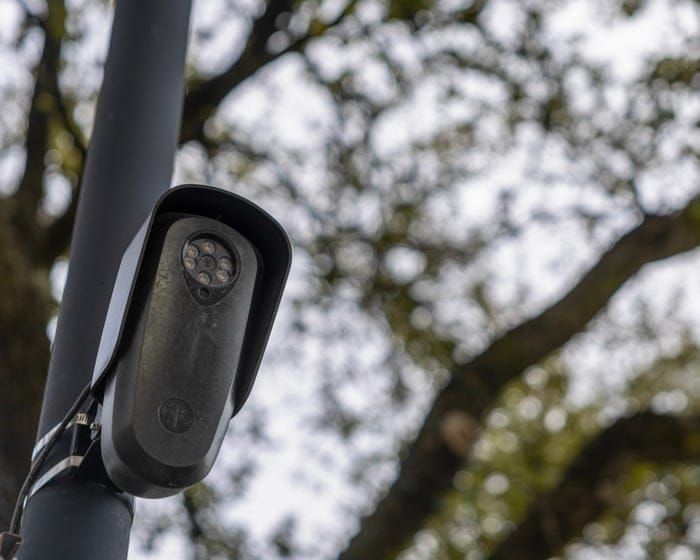
Flock Safety's pitch to American police departments is straightforward: 80,000 cameras, coast to coast, capturing license plate data and vehicle movement, all searchable in seconds. The company calls it public safety infrastructure. A growing number of documented cases suggest it is also, for some officers, a personal stalking tool.
A report covered by The Guardian US finds that some law enforcement officers with Flock system access have used it to surveil romantic interests — tracking the movements of ex-partners, people they are dating, or individuals they are fixated on, using a network that was built, marketed, and sold as a tool for solving crime. The technology works exactly as designed. That is the problem.
Flock's CEO, Garret Langley, is not a figure most Americans could pick out of a lineup. But the infrastructure his company has built is now embedded in the daily movement of American life. If you drive on a highway, park in a shopping center, or pass through a suburb anywhere in the United States, there is a meaningful chance a Flock camera has logged your plate, your vehicle description, and your location. That data is then stored, searchable, and — in theory — accessible to any officer with a login.
The original thesis here is not that surveillance technology gets abused. That is documented history, stretching from J. Edgar Hoover's FBI to the NYPD's post-9/11 Muslim surveillance program to the DOJ's current push to outfit ICE with undercover plates for covert monitoring of immigrant communities. The original thesis is this: Flock did not build a law enforcement tool that is being misused. It built a personal surveillance infrastructure and sold it to institutions with a documented history of intimate partner violence — and then provided almost no structural barrier between a jealous officer and the ability to track anyone who drives a car.
That distinction matters. Abuse is not a bug in Flock's system. It is a foreseeable consequence of the system's design choices — and those choices were made by people who understood exactly what they were selling and to whom.
Law enforcement agencies in the United States have a well-documented problem with intimate partner violence among their own ranks. A 2020 report by the National Center for Women and Policing found that police families experience domestic violence at rates two to four times higher than the general population. Officers who commit abuse rarely face termination. They frequently keep their jobs, their weapons, and — now — their access to a nationwide vehicle tracking network. The question of who should have access to Flock's system cannot be separated from the question of who is actually in the institutions that have that access.
Flock's business model accelerates a pattern that digital rights advocates have been tracking for years: the privatization of mass surveillance, sold incrementally to public institutions, with accountability mechanisms that lag years or decades behind deployment. The company does not operate the cameras in the sense of directing investigations. It sells the infrastructure and the access. What individual officers do with that access is, in practice, largely self-regulated — governed by department policies that vary wildly, that are rarely audited, and that have no federal floor.
Flock Safety sells automated license plate readers (ALPRs) primarily to law enforcement agencies. The cameras capture plate data and vehicle descriptions and feed them into a searchable database. Officers with system access can query the location history of any vehicle that has passed a Flock camera. The site haveibeenflocked.com allows individuals to check whether their plate has been the subject of a Flock search.
This is the same architecture that makes ICE's purchase of commercial location data from brokers so structurally dangerous: when the surveillance infrastructure is built by private companies and sold to public institutions, the constitutional constraints that would normally govern government surveillance — the Fourth Amendment's warrant requirements, for instance — become easier to route around. The data was collected by a private company. The government just bought access. Courts are still working out what that means. In the meantime, the cameras keep running.
There is also a class dimension that goes largely unexamined in coverage of license plate surveillance. The people most exposed to Flock's network are not the wealthy. They are people who drive older cars because they cannot afford to live near transit, who work jobs that require them to be on roads at odd hours, who live in the suburbs and exurbs where Flock's cameras are densest. The person being tracked by a jealous officer is not, statistically, someone whose lawyer will know to file a records request for Flock query logs. She is someone who will wonder why her ex seems to know where she has been.
The accountability gap is structural. Flock provides logs of system queries — in theory, a department could audit who searched for what and flag suspicious patterns. But that audit function depends entirely on the department choosing to use it, having the capacity to review it, and having the institutional will to act on findings. Departments that already struggle to discipline officers for physical violence against partners are not well-positioned to discipline them for digital surveillance of those same partners.
What makes Flock's case distinct from earlier generations of police surveillance overreach is the scale and the speed. Building a network of 80,000 cameras would have required years of public procurement processes and legislative authorization a generation ago. Flock did it through direct sales to individual departments, city by city, without any federal framework governing use, retention, auditing, or abuse response. The network was fully built before most of the people living under it knew it existed. You can check whether your plate has been searched at haveibeenflocked.com — but you cannot opt out of the system, challenge a search, or know who ran your plate and why.
The legal architecture governing this is, at best, thin. Qualified immunity already shields officers from civil liability for most surveillance-related harms, and the doctrine's broad application means that victims of officer-conducted stalking via Flock's system face steep barriers to legal recourse. The officer would need to have violated a right that was "clearly established" — a standard that is nearly impossible to meet for a technology that barely existed five years ago.
Congress has not passed a federal law governing ALPR use, data retention, or officer access auditing. Most states have not either. The surveillance infrastructure expanded faster than the legal vocabulary for constraining it, and the companies that built it had every incentive to keep the legal vocabulary vague. Flock is not unique in this regard — it is the most visible example of a pattern in which surveillance data flows between private companies and public institutions with no meaningful democratic authorization at any point in the chain.
The people who will be harmed by this gap are not abstractions. They are the partners and ex-partners of officers who, in some documented cases, already used their badge to intimidate, track, and control. Flock handed those officers a tool of extraordinary precision and range, and then left the question of whether they should use it on the people they love and fear entirely to the honor system of the institutions that employ them.
The technology will not be rolled back. Flock's contracts are signed, the cameras are mounted, and the data is accumulating. The question is whether the legal and policy infrastructure will ever catch up — or whether the 80,000 cameras will simply become a permanent feature of American life, as unexamined and as dangerous as the institution that holds the keys to them.