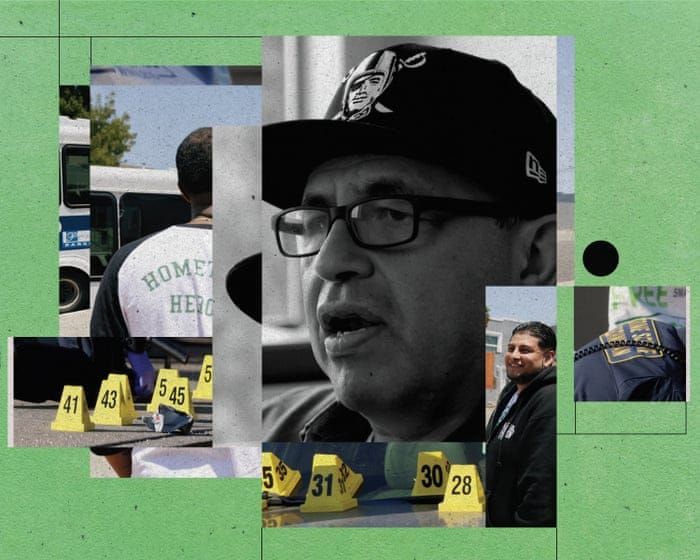
Sergio Diaz spends his days in trauma wards. Not as a patient, and not as a doctor — as someone who arrives before the discharge papers, before the questions about what comes next, before the moment when a young man recovering from a gunshot wound decides whether the next chapter of his life involves retaliation. Diaz, 34, is a gun violence prevention specialist at Youth Alive, an Oakland nonprofit, and according to The Guardian US, his work at Highland Hospital in East Oakland has made him a crucial node in a network designed to interrupt cycles of violence before they complete themselves. He talks with shooting survivors at their bedsides. He helps them apply for medical benefits. He helps them get driver's licenses. He figures out what they need so that the next decision they make is not one that lands someone else in a bed like theirs.
That work is now at risk — not because it stopped working, but because the federal government stopped paying for it.
The Trump administration's decision to cut funding for gun violence prevention programs has landed unevenly across the country, but in California's Latino communities, the consequences are concrete and measurable. Organizations like Youth Alive built their programs around a specific, evidence-supported model: meet people at the moment of crisis, provide immediate practical support, and maintain relationships that make the next violent episode less likely. That model requires staff. Staff requires money. And the money, for many of these organizations, came from federal grants that no longer exist.
What is being lost here is not abstract. Hospital-based violence intervention programs — the category of work Diaz does — have documented records of reducing retaliation and repeat injury in the communities they serve. These are not feel-good initiatives. They are public health interventions with outcome data, built over years of community trust that cannot be reconstructed on a budget timeline. When a program scales back because its federal funding disappears, the relationships it built do not go into storage. They dissolve. And the next time a young man is admitted to Highland Hospital after being shot, there may be no one sitting at his bedside asking the right questions.
The communities bearing this cost are not random. Latino neighborhoods in the Bay Area and across California's urban centers have historically been underserved by both law enforcement and social services — a gap that organizations like Youth Alive were specifically built to fill. Diaz's effectiveness, as The Guardian reports, comes partly from his background: years working in sales in the Bay Area gave him the ability to connect with clients, many of whom are immigrants from Central America navigating systems they were never designed to navigate. That kind of cultural competency is not a soft skill. It is the mechanism through which the intervention actually works. You cannot replace it with a hotline.
This is where the accountability question becomes unavoidable. The administration's stated rationale for cutting gun violence prevention funding has centered on redirecting resources toward law enforcement and border security — a framing that treats violence as a policing problem rather than a public health one. But the evidence base runs in the other direction. Policing-first approaches to gun violence in high-poverty urban neighborhoods have decades of outcome data, and that data does not support the claim that more enforcement produces less violence. Hospital-based intervention programs, by contrast, operate at exactly the moment — the acute crisis — when research shows people are most open to change. Cutting one to fund the other is not a neutral policy adjustment. It is a choice with a predictable body count attached to it.
The power and money dimensions of this choice deserve to be named directly. Gun violence prevention funding at the federal level has always been politically contested, in part because the gun industry and its lobbying infrastructure have spent decades arguing that any public health framing of gun violence is a backdoor attack on the Second Amendment. That argument has been effective — not because it is accurate, but because it has successfully kept prevention funding small, unstable, and perpetually vulnerable to elimination. The communities that lose when that funding disappears are not the communities represented in those lobbying conversations. They are the communities where Sergio Diaz works.
There is also a pattern here that extends beyond gun violence. As Tinsel News has previously reported, federal funding cuts targeting vulnerable communities have been under sustained pressure across multiple domains — from medical education to community health infrastructure. Gun violence prevention is one node in a larger network of community health investment that has been targeted not because it is ineffective, but because it is associated with the communities it serves. The throughline is not fiscal discipline. It is a consistent policy preference for defunding the infrastructure that historically underserved communities built to compensate for their systematic underservice.
The scaling back of nonprofits like Youth Alive also carries a cost that does not appear in any budget line: the cost of institutional knowledge. Diaz did not arrive at Highland Hospital already knowing how to sit with a shooting survivor and ask the right questions. That skill was built over time, in relationship with a specific community, inside an organization with a specific culture and approach. When organizations cut staff or close programs, that knowledge walks out the door. Rebuilding it — if the funding ever returns — takes years. The violence in the interim does not wait.
Critics of this framing will argue that state and local governments can backfill the federal cuts, and that California in particular has the fiscal capacity to protect these programs. That argument has some merit as a long-term aspiration. It has almost none as a short-term operational reality. State budget processes move slowly. Grant transitions require administrative infrastructure that small nonprofits often lack. And California's own budget situation — strained by federal funding losses across multiple program areas simultaneously — means that the queue of programs seeking state replacement funding is long. Youth Alive and organizations like it will lose staff, lose capacity, and lose community relationships in the gap between when federal funding ends and when any replacement arrives. That gap is where people get shot.
The deeper problem is that this funding cut has been framed, where it has been covered at all, as a political story — a story about the administration's priorities, about Republican versus Democratic approaches to public safety. That framing is accurate as far as it goes, but it stops short of the most important question. The most important question is not what this decision says about the administration's politics. It is what it does to the people in East Oakland's trauma wards who will now go through the hardest moment of their lives without someone like Sergio Diaz sitting beside them.
This connects to a broader accountability failure that repeats across federal policy: the gap between the populations that policy decisions affect most acutely and the populations whose political weight is sufficient to make those decisions costly. Latino communities in Oakland are not a swing constituency in a federal funding negotiation. Their suffering is not a political liability for the officials who produced it. That asymmetry is not incidental to the policy outcome. It is the condition that makes the policy outcome possible. The same dynamic is visible in how federal surveillance of immigrant communities has expanded even as the safety net those communities depend on contracts.
Hospital-based violence intervention works when it has continuity — when the specialist who met a patient at their bedside last year is still there to take a call two years later. What is being dismantled now is not just a program. It is the continuity itself. And once that continuity breaks, the question is not whether violence in these neighborhoods will get worse. The question is how much worse, and how long before anyone in a position to change it decides that the answer is unacceptable.