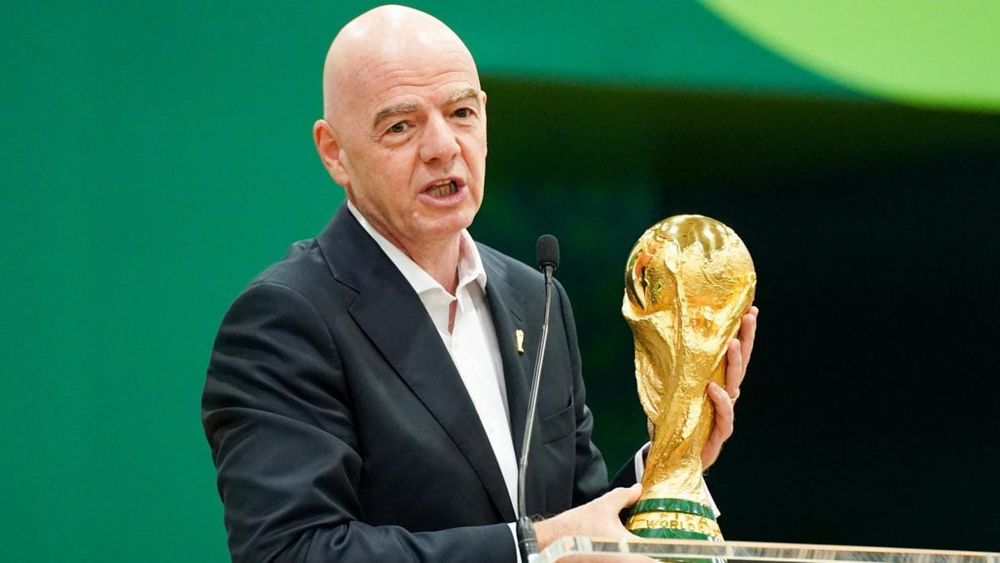
Gianni Infantino has spent eight years building a FIFA that answers to no one. He consolidated power over the sport's global commercial rights, cultivated alliances with Gulf states and autocratic governments, and pushed through a controversial 48-team World Cup expansion over the objections of coaches, players, and administrators who understood what it would cost the game. He did all of this with the institutional confidence of a man who had never faced a serious public challenge from within football's own governing structures.
That changed this week. As BBC News reports, the governing bodies of European football (UEFA) and the North and Central American and Caribbean confederation (CONCACAF) have moved into open, public questioning of FIFA's leadership. The trigger was the collapse of Infantino's plan to bring private equity investment into the global game — a deal that was never properly consulted on, never transparently structured, and ultimately could not survive scrutiny. But the significance of the moment runs deeper than one failed financial scheme.
What is happening now is not a policy disagreement. It is the first sustained, coordinated public challenge to the autocratic model that has defined FIFA governance since the Blatter era — a model Infantino inherited, refined, and in some respects intensified. The question is whether it leads anywhere, or whether football's power structure simply absorbs the pressure and reconstitutes itself, as it has done before.
FIFA's 211 member associations each hold one vote in the FIFA Congress, regardless of size or footballing significance. This structure gives Infantino a reliable coalition of smaller federations — many dependent on FIFA development funds — that consistently outvote UEFA and other major confederations on governance matters. It is the same structural advantage that kept Sepp Blatter in power for nearly two decades despite sustained criticism from European football bodies.
The private equity plan that collapsed was, in retrospect, a case study in how Infantino's FIFA operates. The proposal — to sell a stake in FIFA's commercial operations to private investors — was developed with minimal transparency, presented to member associations without adequate consultation time, and structured in ways that critics argued would have transferred long-term control over football's revenues to financial actors with no accountability to the sport. UEFA and CONCACAF objected. When those objections gained traction and the deal became untenable, FIFA withdrew it. But the withdrawal did not come with an apology or an acknowledgment of process failure. It came with silence.
That silence is itself diagnostic. Institutions that govern through accountability explain themselves when they fail. Institutions that govern through power consolidation simply move on to the next initiative and wait for the opposition to exhaust itself. FIFA's track record over the past three decades is overwhelmingly the latter. The Blatter corruption scandal produced reform rhetoric and a new president. The new president produced new rhetoric about transparency and then pursued the same structural playbook. Infantino's FIFA has been investigated by Swiss prosecutors, criticized by human rights organizations over the Qatar World Cup's treatment of migrant workers, and repeatedly accused of using development funds as political patronage to maintain voting blocs among smaller confederations.
None of it produced structural change. What has changed, at least momentarily, is that UEFA — the confederation that controls the world's most commercially valuable football market — is no longer conducting its opposition in private. Public statements from European football's governing body carry a different weight than internal memos or closed-door objections. They create a record. They give other confederations political cover to align. They make the next Infantino initiative harder to push through without scrutiny.
CONCACAF's involvement deserves separate attention. The North and Central American confederation has its own complicated governance history — it was at the center of the corruption network documented in the 2015 U.S. Department of Justice indictments that brought down dozens of football officials. Its current leadership has been rebuilt around reform commitments. That CONCACAF is now aligned with UEFA in publicly questioning FIFA's direction represents a broader coalition than Infantino has faced before, and one that spans the two confederations most directly invested in the 2026 World Cup, which will be held across the United States, Canada, and Mexico.
The 2026 tournament matters here. It is the largest World Cup in history, the first with 48 teams, and the event around which FIFA's commercial strategy for the next decade is organized. Infantino's credibility as a leader is substantially tied to its success. A sustained, public governance dispute with UEFA and CONCACAF in the run-up to 2026 creates the kind of institutional instability that sponsors, broadcasters, and host governments notice. It also creates a window — narrow, potentially closing — for reform advocates within football to push for structural changes that have been deferred for years.
Those structural changes are not complicated to identify. FIFA's Congress voting structure, which gives the same weight to a federation of 50,000 players as to one of 50 million, is the foundational mechanism of Infantino's majority. Development funding distributed by FIFA's central administration without independent oversight functions as political currency. The absence of term limits for the FIFA presidency — Infantino is already serving his second term and has faced no credible challenge — removes the natural accountability mechanism that most governing bodies take for granted. None of these are new problems. All of them have been named in reform proposals that went nowhere because the president had the votes to ignore them.
What the current moment offers is not a guarantee of reform. FIFA has survived far worse crises with its power structure intact, and Infantino retains the coalition of smaller confederations that has kept him in office. But the public nature of the challenge from UEFA and CONCACAF changes the political calculus in one important way: it makes the cost of the status quo visible. Every future FIFA initiative that bypasses proper consultation, every development fund disbursement that looks like vote-buying, every transparency failure — these will now be evaluated against a backdrop in which football's most powerful confederations have formally declared that the leadership model is not working.

Whether that declaration produces anything depends on whether UEFA and CONCACAF are prepared to sustain the pressure beyond this particular dispute, or whether a face-saving compromise on the private equity question allows everyone to return to business as usual. Football's history of governance reform is largely a history of the latter. But the sport has also never faced a governance crisis inside a World Cup cycle hosted by the United States, with a president whose legal and political vulnerabilities are as extensive as Infantino's currently are. The window is open. It will not stay that way.