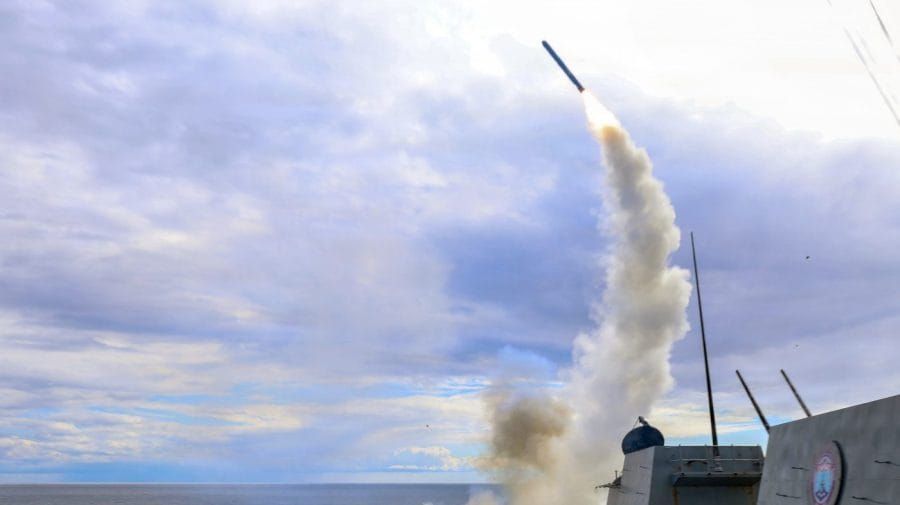
The United States military has nearly exhausted its supply of long-range stealth cruise missiles. Not in some projected future conflict, not in a war-game scenario — in the actual, ongoing war against Iran that began on February 28. According to reporting by The Hill, the U.S. has fired 1,100 of these weapons since the war started, consuming nearly the entire remaining stockpile. The number is not a warning about what might happen. It is a description of what already has.
The strategic implication is precise and severe: the Pentagon's foundational war-planning doctrine — the two-war construct, the assumption that the United States must be capable of fighting two major regional conflicts simultaneously — has been exposed as a posture the country can no longer sustain. The weapons required to execute that doctrine are gone. What remains is the doctrine itself, untethered from the arsenal it assumed.
This is the argument the source material gestures at but does not make directly: the Iran war has not merely strained American military capacity — it has structurally invalidated the strategic logic that justified American military spending for three decades. The two-war doctrine was the premise behind every defense budget, every procurement decision, every alliance commitment since the end of the Cold War. If that doctrine is now operationally hollow, then so is every commitment made in its name — including, most consequentially, the defense of Taiwan.
The two-war construct was never just a military planning assumption. It was a diplomatic instrument. The implicit promise to allies in the Pacific — that the United States could fight in the Middle East and still deter China in the Taiwan Strait — underwrote the entire architecture of American alliance relationships in Asia. Japan, South Korea, the Philippines, and Australia have calibrated their own defense postures around that promise. The promise is now worth less than it was on February 27.
Since the early 1990s, U.S. defense strategy has been built around the requirement to fight and win two major regional conflicts simultaneously. The doctrine shaped procurement priorities — including the stockpiling of long-range precision weapons — and served as the backbone of American security commitments to allies in both the Middle East and the Pacific. The Iran war has now tested that doctrine against operational reality.
Long-range stealth cruise missiles are not interchangeable with other weapons. They are specifically designed to penetrate sophisticated air defenses — the kind that China has spent two decades building around Taiwan and the mainland coast. Shorter-range alternatives cannot substitute for them in a conflict where the first hours of combat would require suppressing integrated air defense networks before any other military action becomes viable. The weapons the Pentagon would need most in a Taiwan conflict are the ones it has just spent in Iran.
Replenishment is not a quick fix. Defense analysts have long noted that the U.S. industrial base for precision munitions operates at peacetime production rates, and that ramping up manufacturing capacity requires years, not months. The strain on U.S. weapons stockpiles began before the Iran war, accelerated by the demand to supply Ukraine, and has now reached a threshold that planners publicly warned about and privately hoped to avoid. The Iran war did not create this vulnerability — it exposed one that procurement policy and production capacity had been quietly accumulating for years.
The accountability question is not whether the stockpile was depleted — the reporting confirms it was. The question is who made the decision to go to war with an arsenal that could not sustain it, and whether anyone in the chain of command told the president that firing 1,100 long-range cruise missiles against Iran would leave the United States unable to credibly threaten military force in the Pacific. Reporting has previously documented that the decision to go to war with Iran was made impulsively, without the kind of strategic assessment that would have surfaced these tradeoffs. If the two-war doctrine was the baseline, and the Iran operation consumed the weapons required by that doctrine, then either the doctrine was never shared with the decision-maker, or it was shared and ignored.
Beijing is watching this with particular attention. China's military planners have spent years gaming out the conditions under which a Taiwan operation becomes viable — and near the top of that list is a scenario in which the United States is already engaged in a costly conflict elsewhere. The Iran war has now delivered that scenario in operational rather than theoretical form. Chinese military doctrine does not require an immediate move on Taiwan to extract value from this moment. The knowledge that American long-range strike capacity is degraded has its own deterrence-eroding effect, regardless of whether China acts on it.
There is a secondary accountability thread worth following. This war has no formal congressional authorization and no defined budget ceiling. The weapons being consumed were procured with money appropriated by Congress for a defense posture that included Taiwan deterrence as a core mission. No member of Congress voted to trade Taiwan deterrence capacity for strikes on Iran. That tradeoff was made unilaterally, by an executive branch conducting a war it was never formally authorized to fight, drawing down stockpiles that were never formally allocated to this purpose.
The administration's stated position — that the Iran war is a short, decisive operation — has not been matched by the operational tempo. Burning through 1,100 long-range cruise missiles is not consistent with a limited, targeted campaign. It is consistent with sustained, high-intensity combat against a country with significant air defense infrastructure. The gap between what was promised and what the munitions ledger records is a form of evidence.
Taiwan is not an abstraction in this analysis. It is a democratic government of 23 million people whose security the United States has implicitly and explicitly guaranteed through arms sales, diplomatic signaling, and the existence of the Taiwan Relations Act. The people who live there, who have watched China's military buildup and calibrated their own sense of safety against the credibility of American deterrence, are now living with a different risk calculus than they were six months ago. That change was not made by Taiwan's government. It was made in Washington, in a decision to go to war with Iran without accounting for what that war would cost everywhere else.
The two-war doctrine will survive this moment on paper. Defense planners will update their assumptions, procurement requests will be filed, and production timelines will be cited in Congressional testimony. What will not be so easily restored is the credibility the doctrine required — the unspoken assurance that American military commitments are backed by the weapons to honor them. That assurance was spent in Iran. Rebuilding it will take longer than any official timeline currently acknowledges.