The Justice Department has always had political appointees. Every administration installs its people. That's the system. What Liz Oyer's testimony before the Senate Judiciary Committee describes is something different: a department being restructured so that career officials who refuse to perform personal favors for the president's allies are removed, and those willing to comply move up.
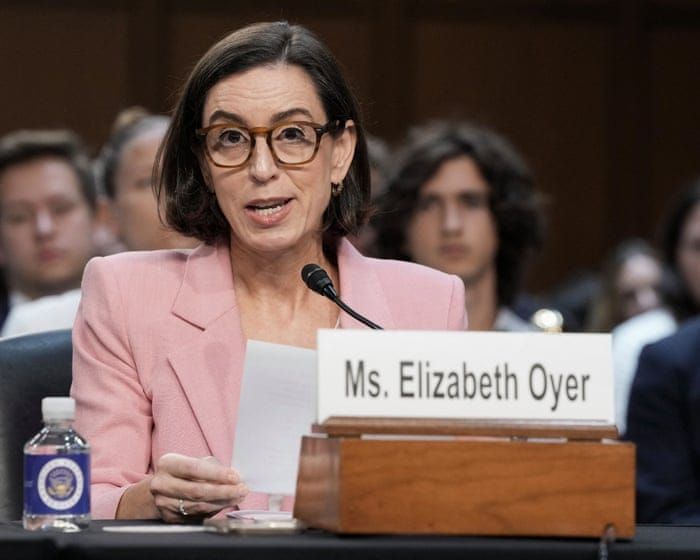
Oyer, the former U.S. pardon attorney, told the committee on the second day of Todd Blanche's confirmation hearing that she was fired after declining to recommend restoring firearms rights to actor and Trump ally Mel Gibson, who was previously convicted of domestic violence. "I declined to rubber-stamp a political favor for a friend of the president, and it cost me my job," she said, according to The Guardian US. Blanche, Trump's personal defense attorney during his criminal trials, is now his pick to lead the entire department.
The story the source material tells is a story about one firing. The story worth telling is about what that firing reveals: the Justice Department is not simply being led by loyalists — it is being purged of the institutional memory, procedural independence, and professional resistance that made political favoritism difficult in the first place.
Liz Oyer served as the U.S. Pardon Attorney — the career official responsible for reviewing clemency petitions and making recommendations to the president. The office exists to provide an independent, legally grounded assessment of who merits presidential mercy. Oyer was fired after refusing to recommend restoring gun rights to Mel Gibson, a Trump ally convicted of domestic violence. She testified against Todd Blanche's confirmation as attorney general before the Senate Judiciary Committee in July 2026.
To understand what Oyer's firing means, you have to understand what the pardon attorney's office is actually for. The office exists as a buffer — a layer of professional legal judgment between the president's personal preferences and the formal exercise of executive clemency power. It is staffed by career lawyers, not political appointees. Its function is precisely to assess requests on their legal merits, not their political utility. When a president's ally asks to have a domestic violence conviction's consequences erased, the pardon attorney's office is the mechanism designed to say: here is what the law says, here is the record, here is our recommendation.
Oyer followed that process. She assessed the Gibson request and declined to recommend it. She was fired. The message to everyone remaining in the department is not subtle: the buffer no longer buffers.
The Blanche nomination itself is the clearest evidence of that pattern. Blanche spent years as Trump's personal criminal defense attorney — representing him in the hush money case that resulted in a conviction, among other matters. He is now being confirmed to lead the department that prosecuted his client. That sequence is not incidental. It is the appointment's entire point. Tinsel News has documented how the DOJ has been systematically redirected toward political targets — this confirmation is the institutional architecture being built to sustain that redirection.
Follow the incentives, and the sequence is not complicated. Mel Gibson wanted his gun rights back. He is a wealthy actor and a documented Trump ally. The pardon attorney's office, applying its standard process, said no. A career official who followed the law lost her job. The question the Senate Judiciary Committee is nominally asking — is Todd Blanche fit to lead the Justice Department — is inseparable from this sequence. Blanche fired Oyer. That firing was a policy decision, not an administrative one. It communicated to every career DOJ official what the new rules of institutional survival are.
The question Oyer's testimony forces into the open is this: what oversight mechanism remains capable of catching political favoritism at the DOJ when the attorney general himself was selected for his loyalty to the president? The Senate confirmation process is, in theory, that mechanism. The Judiciary Committee hearing is, in theory, the moment when senators extract commitments about independence, recusal, and the firewall between the White House and prosecutorial decisions. In practice, those commitments have rarely constrained attorneys general who arrived with a political mandate.
What makes this moment different is the specificity of the record Oyer is building. She is not alleging a general atmosphere of politicization. She is describing a specific request, a specific refusal, and a specific termination. The causal chain is documented and public. If the Senate confirms Blanche despite that record — and the votes are likely there to do so — it ratifies a new operating principle: that the pardon attorney's office, and by extension the broader DOJ infrastructure, exists to serve the president's personal relationships, not the law.
The Gibson case is also worth examining on its own terms. Domestic violence convictions carry firearms restrictions under federal law for specific reasons — Congress determined, after sustained advocacy from survivors' groups, that restoring gun access to domestic abusers creates documented risk of lethal harm. The pardon attorney's office, in declining to recommend restoration, was not making a moral judgment about Gibson's character. It was applying the legal framework Congress built. Oyer's firing does not just punish one official's independence. It communicates that the legal framework Congress built is subordinate to the president's social network.
The Blanche confirmation hearing is unfolding against a backdrop that the committee cannot afford to treat as separate context. DOJ memos have already gutted decades of civil rights enforcement standards. The deputy attorney general has already floated armed immigration agents at polling sites as a normalized policy posture. Oyer's testimony is not an isolated data point. It is evidence of a department being rebuilt from the inside — not to enforce the law more effectively, but to enforce it more selectively, in ways that benefit those with access to the president.
The Senate can confirm Blanche. It probably will. But the confirmation will not resolve the institutional question Oyer's testimony raises. It will simply formalize the answer: that the Justice Department's independence is now contingent on whether its officials are willing to do what the president's allies ask. Career lawyers who built their professional lives around the premise that the department's function is the law — not the president's preference — are learning, one firing at a time, that the premise no longer holds.
The pardon attorney who said no is testifying before the Senate. The man who fired her is about to be confirmed to run the department she served. That is not a paradox — it is the intended outcome.