Union membership rates in New York City have stayed essentially flat for years — even as organizing drives multiplied, strikes drew public support, and workers won headline-grabbing victories. The problem was never energy. It was infrastructure. Workers who wanted to organize often didn't know where to start, who to call, or what rights they already had. City government offered no answer. Until now.
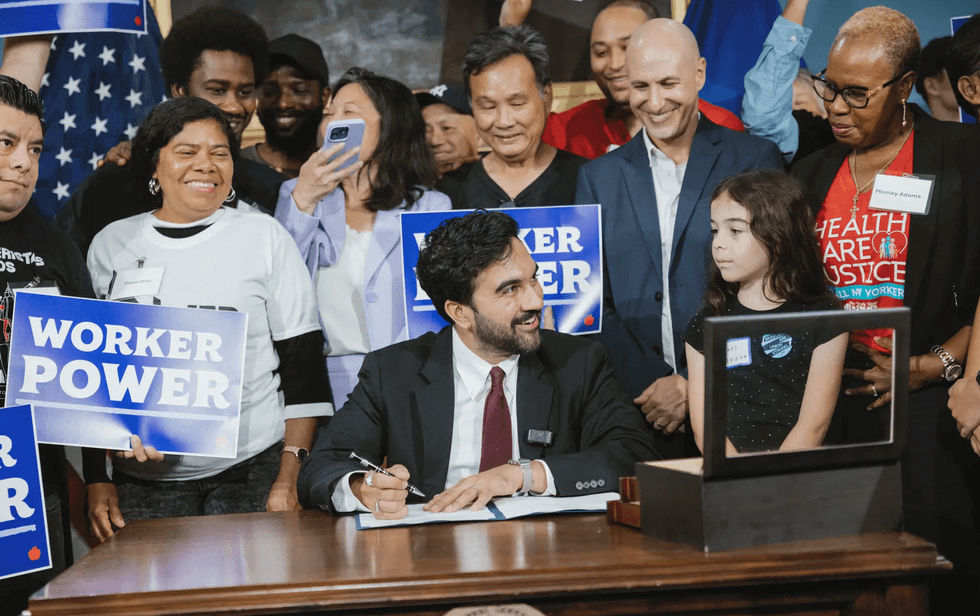
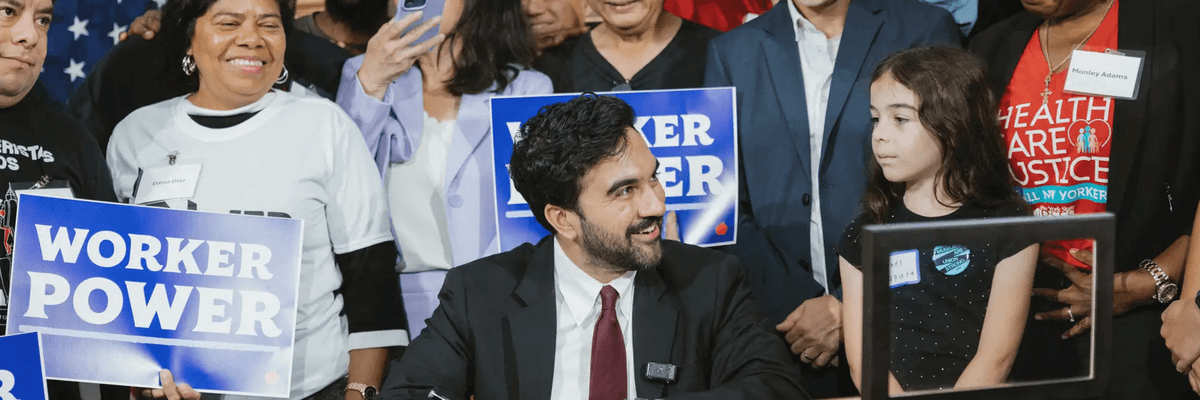
On Labor Day, Mayor Zohran Mamdani announced the creation of the Mayor's Office of Worker Power — described as the first municipal office of its kind in the United States dedicated explicitly to helping workers organize. The office will connect workers with organizing resources, hold public hearings on labor issues, and make nyc.gov/workerpower a single entry point for anyone who wants to build collective power in their workplace but doesn't know how. The announcement was not a press release. It was a structural intervention — and its implications extend well beyond New York.
The office will be led by Tony Perlstein, a longtime union organizer, and overseen by Julie Su — the former acting U.S. Secretary of Labor under the Biden administration, who now serves as New York City's deputy mayor for economic justice. That combination of government authority and organizing experience is deliberate. This is not a task force or an advisory commission. It is a standing municipal agency with a defined mandate: use the weight of city government to help workers do what corporations have spent decades and billions of dollars trying to prevent them from doing.
A recent report by the City University of New York School of Labor and Urban Studies found that while union density remains strong in New York, membership rates have stayed largely unchanged despite renewed organizing activity, successful strikes, and high public support for labor. The bottleneck is not public sentiment — it is access to information and organizing infrastructure.
The pattern this office fits makes its value immediately visible. Individual organizing campaigns have always faced a structural asymmetry: employers retain full-time labor relations consultants, legal teams, and HR departments whose explicit function is to prevent union formation. Workers, by contrast, typically start from zero — uncertain of their legal rights, unsure which organizations can help them, and navigating a landscape that has been deliberately made confusing. The Office of Worker Power is designed to close that gap. Not by organizing workers for them, but by eliminating the information deficit that corporations depend on.
"Someone might come to this office because they're a worker and they want to better their own conditions, or the conditions of those around them, and they're not sure where to go next," Mamdani told Jacobin. "In New York City, it's very hard to know who you should call about any of these issues. Now we're saying you will soon be able to go to nyc.gov/workerpower and finally get the kind of information you need."
That framing is more radical than it sounds. Government has historically treated labor organizing as a private matter — something workers and employers negotiate between themselves, with the state nominally neutral. What Mamdani is doing is rejecting that neutrality explicitly. The city is choosing a side. And the side it has chosen is the warehouse worker trying to organize a union, the nurse working a double shift, the teacher holding down a second job. The political logic of that choice is inseparable from the policy logic: when workers have more power, wages rise, conditions improve, and the tax base that funds city services grows more stable. Neutrality was always a fiction that benefited employers.
The timing compounds the significance. The announcement came as the Trump administration has pursued an aggressive campaign against organized labor at the federal level — weakening the National Labor Relations Board, installing leadership hostile to union organizing, and cutting the federal workforce in ways that have decimated public-sector labor protections. The Office of Worker Power's website, according to Common Dreams, launched explicitly in this context. When the federal government withdraws from labor protection, the question becomes whether state and municipal governments will fill the vacuum or leave workers exposed. New York City has answered that question.
The deeper point is not that the Office of Worker Power is a good idea. It is that it represents a new theory of municipal power that progressive cities have largely failed to articulate and act on. For decades, progressive urban governance has focused on redistribution at the margins: tenant protections, living wage ordinances, paid leave mandates. These are meaningful. They are also reactive. They respond to the outcomes of an unequal labor market without changing the underlying balance of power that produces those outcomes. The Office of Worker Power does something different. It attempts to change the structural conditions under which workers and employers negotiate — before the contract is signed, before the grievance is filed, before the wage is set.

The political economy of this move is worth naming directly. Corporations operating in New York City spend enormous resources on union avoidance. They hire consultants who specialize in running anti-union campaigns. They hold mandatory "captive audience" meetings. They delay NLRB elections through legal challenges. All of this is legal, and all of it works — not because workers don't want unions, but because the cost of organizing is borne entirely by workers while the cost of resistance is absorbed by employers as a line item. An office that reduces the information and navigation burden on workers is not a subsidy to labor — it is a partial correction of a structural subsidy that has always flowed to employers through the asymmetric distribution of legal and organizational resources.
"When workers can organize, everything changes," said Julie Su at the announcement. "When they can build lasting, durable power, power that lets them transform their work experience, and by extension their lives, everything changes." That language — durable power — is the key phrase. The goal is not a single organizing win. It is the construction of an infrastructure that makes future organizing easier, faster, and more likely to succeed. That is a fundamentally different ambition than passing a wage ordinance or expanding a tax credit.
The replicability question is the one that matters most. New York is not the median American city. Its union density, its political culture, and its sheer density of labor organizations make it an unusually favorable environment for this experiment. But the model itself — a standing municipal office that serves as an organizing clearinghouse, connects workers with legal resources, holds public hearings, and uses government authority to legitimize collective action — does not require New York's particular conditions to function. It requires political will, a mayor willing to explicitly reject the fiction of government neutrality in labor relations, and a recognition that the information asymmetry between workers and employers is not a natural condition but a policy choice that can be reversed.

Cities from Chicago to Los Angeles to Denver have elected mayors with progressive labor commitments. Most have expressed those commitments through the familiar toolkit: minimum wage increases, gig worker protections, affordable housing mandates. None has built a standing municipal agency whose explicit purpose is to help workers organize. Mamdani's office is a template — imperfect, untested, and operating in a legal environment that will not make organizing easy regardless of what city hall does. But it is a template. And in a moment when federal labor protections are being systematically dismantled, the labor market is already showing the costs of that withdrawal, and workers are bearing them alone, the question of whether other cities will follow is not abstract. It is the next fight.
The nurse working a double shift in a non-union hospital. The warehouse worker who has been told by management that unions only hurt employees. The teacher who doesn't know that her coworkers are already organizing. They now have somewhere to go in New York. The cities that don't build that infrastructure are making a choice too — just a quieter one, and one with consequences that fall entirely on the people who can least afford them. As progressive municipal governance builds its electoral track record, the Office of Worker Power may become the clearest test of whether that governance can actually change structural conditions — or only manage their worst effects.