Walmart spent $8.1 billion on stock buybacks last year. That single figure, drawn from a June 2025 report by the Institute for Policy Studies, carries its own arithmetic: the same sum could have delivered a $3,851 bonus to each of the retailer's 2.1 million employees. Walmart chose the buyback. The workers got nothing extra.
That choice — repeated across 100 of America's largest low-wage employers — is the subject of the IPS report, which examines the S&P 500 corporations that pay their median workers the least. The list includes Amazon, Target, DoorDash, and Home Depot. Between 2019 and 2025, these companies collectively spent $718 billion repurchasing their own shares. Over the same period, their CEOs saw compensation rise by more than 41 percent on average. Their median workers saw raises that lagged behind inflation.
The standard defense of buybacks is that they return capital to shareholders efficiently, signaling corporate health and rewarding investors who took on risk. That argument has a surface logic when the shareholders are pension funds or retirement accounts held by ordinary people. It collapses when you trace where the money actually flows. At the Low-Wage 100, the primary beneficiaries of buybacks are the executives whose compensation is structured around stock price. IPS describes the practice directly: a financial maneuver that artificially inflates CEO stock-based pay and siphons resources away from worker wages and long-term investment. Average CEO compensation at these firms reached $17.5 million in 2025. Average median worker pay sat at $36,571. The gap is not incidental — it is the product of deliberate allocation decisions made at the board level, quarter after quarter, year after year.
Seventeen of the 100 companies reported CEO-to-worker pay ratios of 1,000 to one or higher. The most extreme case in the IPS data is Lumentum, whose top executive was paid 2,884 times the company's median worker in 2025. That number is not an abstraction. It means the CEO earned in roughly two and a half hours what a median employee earned in an entire year.
When a corporation repurchases its own shares, it reduces the number of shares outstanding, which mechanically increases earnings per share and typically lifts the stock price. Because executive compensation at large corporations is heavily weighted toward stock options and equity grants, rising share prices translate directly into higher CEO pay — independent of any improvement in business performance, productivity, or worker wages. Critics, including the Institute for Policy Studies, characterize buybacks as a mechanism for redirecting corporate cash flows away from wages, R&D, and capital investment toward financial engineering that benefits executives and large shareholders disproportionately.
The original argument for buybacks was that corporations, not government, should decide how to allocate surplus capital. The Reagan-era SEC rule change that effectively legalized large-scale repurchases in 1982 rested on the premise that markets would direct capital to its most productive use. Four decades of evidence complicate that premise considerably. The Low-Wage 100 are not small or struggling companies making hard tradeoffs under margin pressure. They are among the most profitable enterprises in the American economy. Their low-wage status is a structural choice, not a constraint.

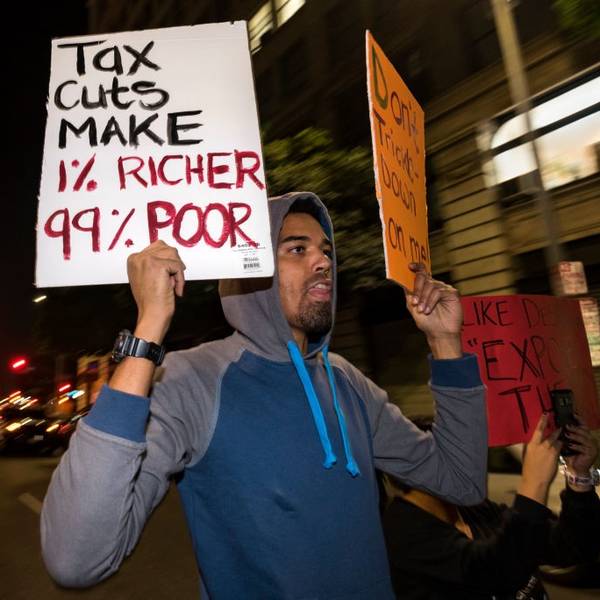
What makes the IPS report more than a familiar inequality document is what it shows these companies did with their political power during the same period. According to the report, the Low-Wage 100 deployed their lobbying operations not to defend their workers from recent federal policy changes, but to push for tax cuts for wealthy corporations in the One Big Beautiful Bill Act — legislation that also cut Medicaid and SNAP, programs on which many of those same workers rely. The companies that paid median wages of $36,571 a year lobbied to restrict food assistance for people earning $36,571 a year. The circularity is not accidental. It is the business model.
This is the argument the IPS data makes that the source material gestures toward but does not fully close: the Low-Wage 100 are not passive beneficiaries of a policy environment that happens to favor capital over labor. They are active architects of it. The lobbying expenditures that produced the One Big Beautiful Bill were not a side activity — they were a return on investment. Every dollar cut from SNAP is a dollar the employer does not have to add to wages for workers to cover basic food costs. The subsidy flows in both directions: taxpayers fund the benefits that allow below-subsistence wages to persist, and those same corporations lobby to keep the wages below subsistence while cutting the benefits. Tinsel News has previously documented how Amazon and Walmart workers' reliance on SNAP and Medicaid amounts to a direct public subsidy of private profit. The IPS report shows the mechanism by which that subsidy is actively defended and extended.
The policy solutions IPS recommends include increased taxes on companies with extreme CEO-to-worker pay ratios, restrictions on buybacks until workers receive adequate wages, and stronger disclosure requirements. None of these proposals are novel — versions have circulated in Congress for years. Congress has a well-documented pattern of generating reform proposals it has no intention of advancing. The question is not whether the policy tools exist. They do. The question is whether the political will to use them can survive the lobbying infrastructure that the Low-Wage 100 have spent decades and billions of dollars building.
There is a structural trap embedded in this dynamic that rarely gets named clearly. The companies that pay the least have the most to gain from keeping wages low and benefits cut, which gives them the strongest incentive to spend on lobbying, which gives them the most influence over the policies that determine wages and benefits. The loop is self-reinforcing. Eight hundred thousand children lost food assistance in the eight months after the One Big Beautiful Bill passed — in states that, in many cases, voted for the bill's authors. The workers at the Low-Wage 100 live in those states. Their employers helped write the bill.
The $718 billion figure will likely be cited as evidence of corporate excess, and it is. But the more precise charge is this: the Low-Wage 100 did not simply fail to share their prosperity. They spent a portion of it lobbying to make their workers' lives harder, then watched the results without comment. The CEO-to-worker pay ratio widened from 574-to-one in 2019 to 614-to-one in 2025 — not because productivity surged at the top, but because the political and financial architecture these companies maintain makes the widening nearly automatic. Until the cost of maintaining that architecture — in public pressure, in regulation, in taxation — exceeds its return, the gap will keep growing.