The United States shed 23,000 jobs in July — the first monthly decline in four years — while forecasters had projected a gain of 80,000. That 103,000-job gap between expectation and reality is not a rounding error. It is the accumulated weight of a year of economic policy, and Common Dreams reports that economists watching the Bureau of Labor Statistics data say the headline number is only the beginning of the story.
The revisions buried inside Friday's report make the picture worse. The BLS revised May job growth down from 57,000 to 20,000 — a 65 percent reduction from the initial figure. June was revised from 129,000 to 63,000. Three months of data now tell the same story: an economy that was adding jobs slowly is now losing them. The trend did not begin in July. It was already underway, and the earlier numbers were quietly corrected after the news cycle had moved on.
The unemployment rate fell slightly in July — but not for the reason the White House will tell you. Heather Long, chief economist at Navy Federal Credit Union, noted that the drop came primarily because more people left the labor force entirely, not because more people found work. A shrinking labor force participation rate registered as a falling unemployment rate. The metric improved on paper while the underlying condition worsened.
Year-over-year hourly wage growth slowed to 3.2 percent — below the current rate of inflation. Workers who kept their jobs are earning raises that do not cover the price increases hitting them at the grocery store, the gas pump, and the pharmacy. Breyon Williams, chief economist at the Groundwork Collaborative, put it plainly: "regardless of having a job or not, everyone is paying high prices from Trump's chaotic tariffs and war with Iran." The tariff burden is not a future risk. It is a present tax, falling hardest on the people least able to absorb it.
What the report describes, in Williams's framing, is a "frozen job market" — employers uncertain enough to stop hiring, but not panicked enough to initiate mass layoffs. Workers who have jobs are afraid to leave them. Workers who don't have jobs cannot find entry points. The economy is not in freefall. It is in stasis, and stasis has its own costs: suppressed mobility, reduced bargaining power for workers, and the slow erosion of household financial buffers that were already thin. As Tinsel News has covered, half of Americans report they cannot afford basic expenses — and the administration's response has been to say that doesn't move it.
Angela Hanks, a former Labor Department official now serving as chief of policy programs at The Century Foundation, offered the cleaner read: "This economy is running on fumes." The healthcare sector has carried a disproportionate share of employment growth all year — a structural crutch that reflects an aging population's inelastic demand for medical services, not an economy generating broad-based opportunity. When one sector is doing the heavy lifting for the entire jobs market, the foundation is narrow. The July report shows what happens when that sector is no longer enough to compensate for losses elsewhere.

The deeper accountability question is not whether the July number is bad — it is — but what systemic choices produced it. Tariff policy has injected sustained uncertainty into supply chains, making employers reluctant to commit to new headcount. The ongoing war with Iran has kept energy prices elevated, compressing margins across industries that depend on transportation and logistics. As Tinsel News has documented, electricity bills are up 18 percent — a cost borne by manufacturers, small businesses, and households alike. These are not abstract forces. They are the downstream consequences of specific decisions made by identifiable actors.
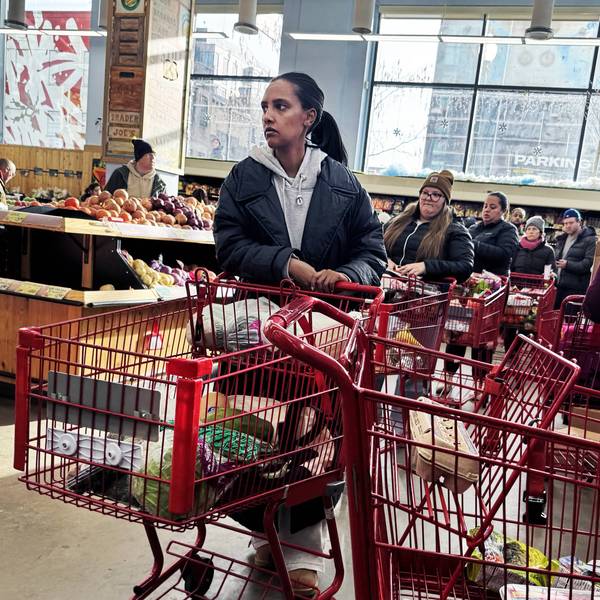
The frozen labor market that economists are describing has a distributional logic. Workers at the bottom of the wage scale — the ones with the least savings, the fewest options, and the most exposure to price increases — bear the cost of an economy that has stopped moving. Workers at the top, in sectors insulated from tariff exposure, largely do not. The July jobs report is not a macroeconomic abstraction. It is a document of who is absorbing the risk of this moment — and the answer, as it almost always is, is the people who can least afford to. The revisions to May and June suggest this has been true for longer than the headline numbers indicated. Each passing month adds more quietly revised data, pushing the accounting closer to a point where it can no longer be avoided. The midterms are already being shaped by economic discontent — and the numbers released Friday will not help.