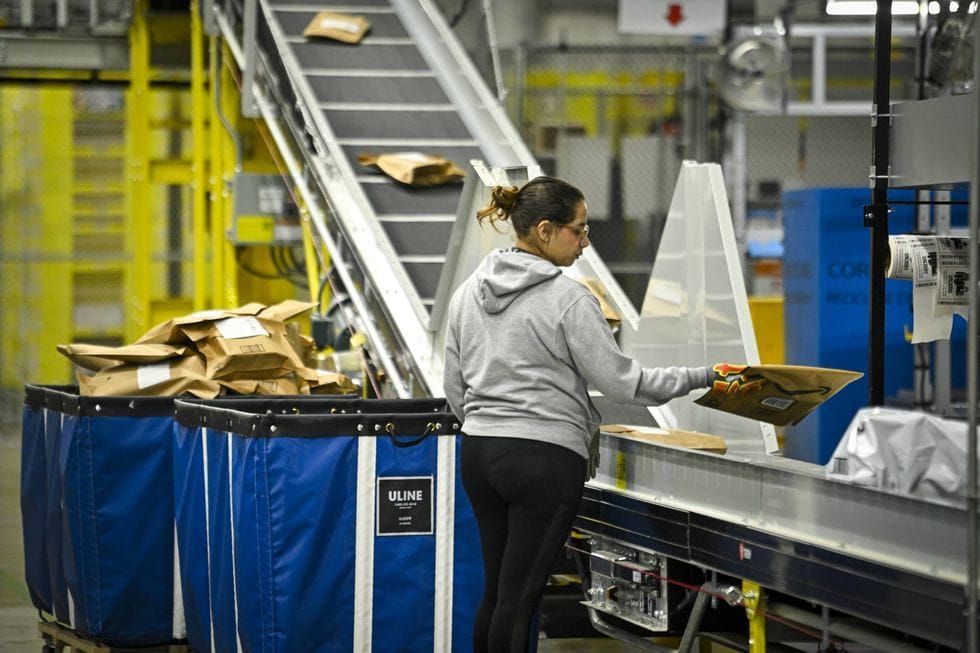
The federal poverty line for a family of three sits at roughly $35,000 a year. To qualify for food assistance through SNAP, a household must earn less than 130 percent of that threshold. Amazon, a company that earned $77.67 billion in profit last year, employs thousands of workers who meet that test.
That is not an accident of the labor market. It is a business model.
A new report from the nonpartisan Government Accountability Office, commissioned by Sen. Bernie Sanders (I-Vt.), found that the number of Amazon employees relying on SNAP benefits nearly tripled between 2020 and last year — a period during which the company's annual profits grew by $66 billion. The GAO examined 11 states whose combined populations represent roughly one-fifth of the U.S.: Arkansas, Georgia, Indiana, Maine, Massachusetts, Nebraska, North Carolina, Oklahoma, Rhode Island, Tennessee, and Washington. In those states alone, 12,346 Amazon workers needed food assistance last year. More than 11,000 relied on Medicaid.
The conventional framing of this story treats it as a poverty wages problem — companies paying too little, workers suffering. That framing is accurate but incomplete. What the GAO data actually documents is a transfer of wealth: Amazon and Walmart externalize their labor costs onto the federal government, and American taxpayers cover the gap between what these corporations pay and what their workers need to survive. The companies keep the difference as profit.
This is corporate welfare. It is just structured so that the subsidy flows through the worker rather than directly to the firm, which makes it politically invisible. No one cuts Amazon a check. The Treasury just pays the grocery bills of people Amazon underpays.
Walmart topped the list of corporations whose employees used Medicaid, as it did when the GAO conducted a similar analysis six years ago. The company's annual profits grew from $14.88 billion in 2020 to $21.89 billion in 2025, according to the report. Over that same period, the number of Walmart workers relying on Medicaid in the surveyed states grew by 55 percent, to more than 16,000 people. The company's share of workers using SNAP also increased, though more modestly than Amazon's.
Amazon's response to the GAO findings, delivered through spokesperson Rachael Lighty to The Washington Post — a publication owned by Amazon founder Jeff Bezos — was that the company's pandemic-era hiring surge contributed to its increased share of public benefits recipients, and that Amazon offers part-time options for workers who want them. The Post noted, in the same article, that many workers who want full-time employment can only find part-time work. The Federal Reserve Bank of St. Louis has documented an increase in part-time employment since the pandemic. Amazon's defense, in other words, is that it is creating exactly the kind of precarious, part-time work that makes federal assistance necessary — and calling that a feature.
To qualify for SNAP, a household must earn less than 130% of the federal poverty level. For a family of three, that means earning roughly $35,000 or less per year. Workers at companies earning tens of billions in annual profit who meet this threshold are, by definition, earning poverty wages. The One Big Beautiful Bill Act has since imposed stricter eligibility limits, cutting millions from the program — including many of the workers this report documented.
The timing of the report matters. Congress recently passed the One Big Beautiful Bill Act, which imposed strict new eligibility limits on SNAP, cutting millions of Americans from the program. As Tinsel News has reported, a federal judge found that some of those restrictions were designed to punish poor people rather than address fraud or program integrity. The political logic runs in a single direction: the corporations that benefit from a low-wage workforce face no accountability for the public costs they generate, while the workers who rely on the resulting assistance are now being cut off.

That is not a coincidence of policy. It is the predictable outcome of a system where corporations have the lobbying infrastructure to shape legislation and workers do not. The same Congress that declined to raise the federal minimum wage — frozen at $7.25 per hour since 2009 — cut the food assistance that workers at $7.25-adjacent wages depend on to eat. As 800,000 children lost food assistance in eight months under the new law, the companies whose wage structures made that assistance necessary saw no corresponding obligation.
Sanders, the ranking member of the Senate Health, Education, Labor, and Pensions Committee, called the findings "beyond unacceptable." The labor-focused media organization More Perfect Union framed it more structurally: "Corporations underpay workers, don't provide healthcare, and outsource core worker needs to the government." That framing is closer to the actual mechanism. These are not companies struggling to stay afloat. Amazon is one of the most profitable enterprises in human history. Walmart is the largest private employer in the United States. Their workers' dependence on public assistance is a choice these companies make when they set wages — and a cost they pass directly to the public.
The accountability question the GAO report raises is one that Washington has systematically avoided: if a corporation's labor practices require taxpayer-funded supplementation to keep its workforce alive, who is actually paying for that company's profits? Amazon's shareholders earned returns on $77.67 billion in profit last year. Some portion of that profit exists because Amazon did not pay wages sufficient for its workers to afford food — and the federal government covered the difference. The public bore a cost that Amazon's balance sheet did not.

There is a policy mechanism that would change this calculus. Several economists and progressive legislators have proposed legislation that would require large corporations to reimburse the federal government for the public assistance used by their employees — effectively ending the subsidy by making it visible on the corporate ledger. The proposal has not advanced in Congress. The corporations whose profits depend on the current arrangement employ some of the most effective lobbying operations in Washington.
The GAO report covers 11 states and roughly one-fifth of the U.S. population. It is, by construction, an undercount. Extrapolated nationally, the number of Amazon and Walmart workers on SNAP and Medicaid is substantially larger. The dollar value of the public subsidy those workers represent — the gap between what these companies pay and what it costs to keep their workforce fed and healthy — has not been calculated in this report. That number would reframe the conversation entirely. It would not be a story about struggling workers. It would be a story about the size of the check American taxpayers are writing to some of the wealthiest corporations on earth, every year, with no acknowledgment and no return.
The next time Amazon reports a quarterly earnings beat, that number belongs in the same paragraph.