The structure was always the same. Insiders get in early, at prices the public will never see. The public buys in after the announcement, after the hype, after the moment when the real money has already been made. The price peaks. The insiders sell. The public is left holding assets worth a fraction of what they paid — and the person who launched the product walks away with hundreds of millions of dollars he never had to risk.
This is not a description of a fraud scheme that prosecutors are investigating. It is, according to a detailed report released Thursday by government watchdog Public Citizen, a description of how President Donald Trump's cryptocurrency ventures have operated — legally, in public, with the president's name on the label.
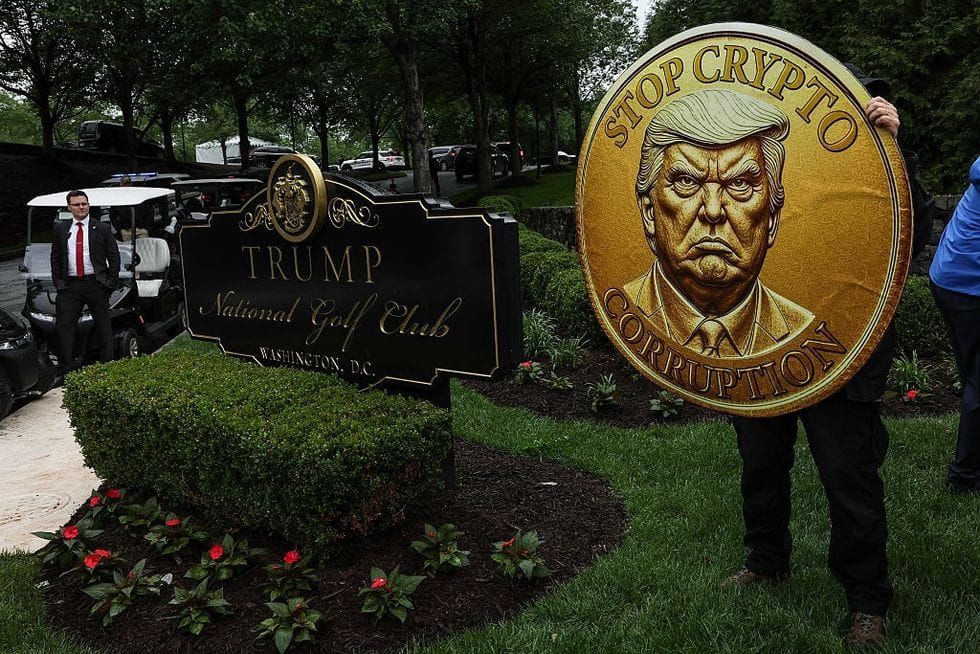
Public Citizen's analysis found that Trump's assorted crypto products have left investors at least $4.7 billion in losses. The majority came from the president's personal meme coin, launched three days before the start of his second term. The coin peaked at over $73 per token within two days of launch. It now trades near $2.
In between, 1% of wallets that invested in the coin captured 80% of all gains. The other 65% of wallets that put money in are underwater — collectively, by $3.2 billion.
The president himself was insulated from the downside in a way no retail investor could be. Trump acquired his share of the digital tokens without investing any money — Public Citizen estimated that stake is currently worth $271 million. He collected $635 million in licensing fees from the coin last year alone. When the price cratered, he lost nothing, because he had risked nothing. That asymmetry — unlimited upside, zero downside — is not available to the people who bought in after the launch announcement.
The meme coin is the largest single source of losses, but it is not the only one. World Liberty Financial, the cryptocurrency venture co-founded by Donald Trump Jr. and Eric Trump in 2024, issued governance tokens that Public Citizen describes with notable precision: owning one is like having "membership in a condo board — but without actually getting to vote on many issues or even own the condo."
The tokens peaked at $0.33 per unit in September 2025. They now trade below $0.06. The investors who bought in on the private sale — accredited and foreign investors who paid $0.015 or $0.05 per token — are up anywhere from 15% to 283%. Almost everyone who bought on the public market is down, possibly as much as 83% if they bought at the peak. Total losses on World Liberty Financial tokens: at least $1 billion.
Then there are the NFTs. Trump marketed digital trading cards — sold as non-fungible tokens at $99 per card — that had an aggregate value of $12.3 million at launch. Public Citizen found their combined value has since fallen to roughly $3 million. The cards remain on the market. The president remains their promoter.
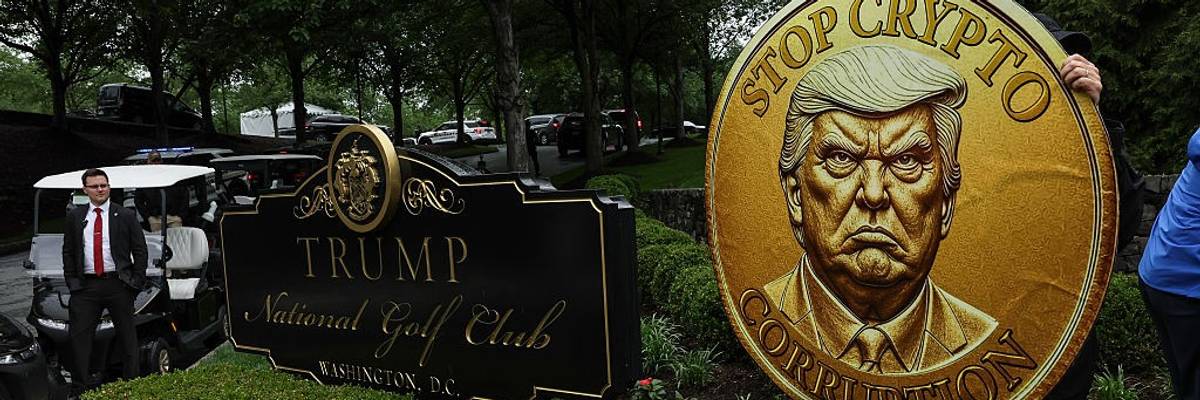
What makes the Public Citizen report significant is not that it documents losses — crypto markets lose money constantly, and that is not news. What it documents is the consistent structural pattern across every Trump crypto product: insiders get preferential pricing unavailable to the public, the public announcement drives a price spike, the insiders liquidate into that spike, and the public is left holding the depreciated assets. The variation between the meme coin, the governance tokens, and the NFTs is mostly cosmetic. The architecture of who profits and who loses is identical each time.
This pattern has a name in traditional securities markets. It is called a pump-and-dump scheme, and it is a federal crime. In crypto markets — particularly for assets structured to avoid classification as securities — the same mechanics are, in many cases, legal. That gap between what is harmful and what is prosecutable is precisely where Trump's ventures operate. The president is not accused of breaking the law. He is accused of building a business that extracts money from retail investors through a structure that would be illegal if applied to stocks, and that remains unaddressed because Congress has not closed the exemption.
The political dimension compounds the financial one. Tinsel News has previously reported that 63% of Americans believe the president has profited illegally from crypto — and that no enforcement action is underway. The enforcement gap is not accidental. The Securities and Exchange Commission under the current administration has retreated from crypto enforcement. The Commodity Futures Trading Commission has been slow-walked on jurisdiction questions. The legislative vehicle that might address presidential crypto self-dealing — the GENIUS Act and related bills — has stalled in a Congress where, as Tinsel News has reported, moderate Democrats have their own donor dependencies that complicate any clean vote on crypto accountability.
The foreign investor angle in the World Liberty Financial structure deserves more attention than it has received. Public Citizen notes that the private-sale investors who received preferential pricing include foreign nationals. The governance token structure gives those investors nominal rights within a financial product tied to the sitting president of the United States. What those investors purchased, at a steep discount unavailable to American retail buyers, is a financial relationship with a president who simultaneously sets trade policy, sanctions policy, and regulatory posture toward the crypto industry. No administration official has been asked to explain this in a public forum. No congressional committee has subpoenaed the investor list.
There is a broader pattern worth naming. The same week Public Citizen released this report, the administration's financial regulators remained largely silent. The same Congress that has passed legislation touching nearly every corner of the American economy has not passed a bill that would prohibit the president from launching financial products that transfer wealth from retail investors to himself while he holds office. The legal framework that governs presidential conflicts of interest was written before a president could launch a meme coin and pocket $635 million in licensing fees in a single year.
For the retail investors who bought Trump's meme coin at $60, or World Liberty Financial tokens at $0.30, or digital trading cards at $99, the legal question is academic. They are down. The insiders who bought in at $0.015 and $0.05 are up. The president, who risked nothing, has collected hundreds of millions. The regulatory architecture that was supposed to prevent this kind of wealth transfer from small investors to connected insiders did not apply — and the people responsible for updating it are the same ones collecting campaign contributions from the industry that benefits from the gap.
The $4.7 billion figure is large enough to be abstract. Here is what it is not abstract: it is the aggregate of thousands of individual decisions by people who trusted that a product with the president's name on it carried some implicit legitimacy — or at least some implicit accountability. It carried neither. What it carried was a structure designed to ensure that the people who mattered financially were already out before the people who mattered politically understood what they had bought. Congress has the authority to close that gap. It has not. That choice, too, belongs in the ledger.