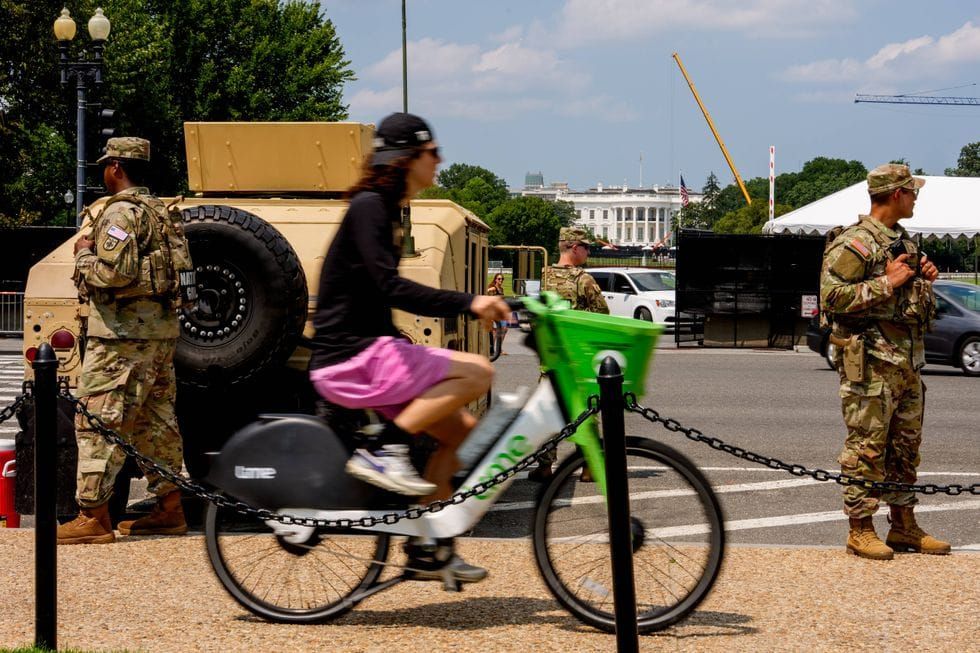
The National Guard soldiers deployed to Washington, D.C. last August were not, it turns out, stationed in the neighborhoods where people were being killed. Common Dreams reports on a Reuters investigation published Wednesday that found Guard members have been mentioned in only about 1.3% of criminal cases filed in the D.C. Superior Court — the court that handles nearly all of the city's criminal prosecutions — since their arrival. More telling than the fraction is the geography: charging documents show that soldiers mostly responded to minor incidents in neighborhoods that are wealthier, whiter, and less dangerous than the rest of the capital.
Reuters found no reference in court records to soldiers conducting any law enforcement activity in the neighborhoods where roughly 82% of the city's 859 murders occurred over the past five years.
This is the gap between the stated rationale for the deployment and its documented reality. The administration has claimed the troops are a deterrent — that their presence alone suppresses violence. The Metropolitan Police Department's own data contradicts that framing. Violent crime in the city has risen 4% in the year since the soldiers arrived: 1,712 incidents in 2026 compared with 1,645 at the same point in 2025. A deterrence theory that cannot be observed in the crime statistics, in the neighborhoods where crime actually occurs, is not a deterrence theory. It is a justification produced after the fact for a decision made for other reasons.
What makes this deployment distinct — and what the standard coverage of it has largely missed — is that it represents the use of federal military presence as a political signal directed not at criminals but at a city. Washington, D.C. is a majority-Black city with no voting representation in Congress, governed under the constant threat of federal override. The Guard deployment was announced with the language of crisis: "crime, bloodshed, bedlam, and squalor," in the administration's framing. Crime in DC was already at its lowest level in decades when the troops arrived. The crisis language was not a response to conditions on the ground. It was the predicate for a display of federal dominance over a city that has no electoral mechanism to resist it.
The Reuters investigation documents the gap between rhetoric and reality in granular, damaging detail. In one incident, police officers arrived to find a man stomping on a woman outside a nightclub. Approximately 15 National Guard members were in the area on routine patrol. Not one intervened. In another case, soldiers found a man they believed to be intoxicated and called emergency services — then left him on the ground without performing any emergency measures. When police arrived, the man had been stabbed so severely his intestines were exposed. He died two hours later. The cases where soldiers did act, the investigation found, largely involved subway fare evasion and shoplifting.
The pattern is not an operational failure. It is the predictable outcome of deploying military personnel — whose legal authority is limited to detaining suspects until police arrive — in a city that already has a functioning police department. National Guard members cannot make arrests. They can only hold someone and call the Metropolitan Police. In practice, the Reuters investigation describes soldiers standing around while crimes occurred and waiting for officers who were already stretched thin. The troops did not supplement the police. In some documented instances, they complicated the response.
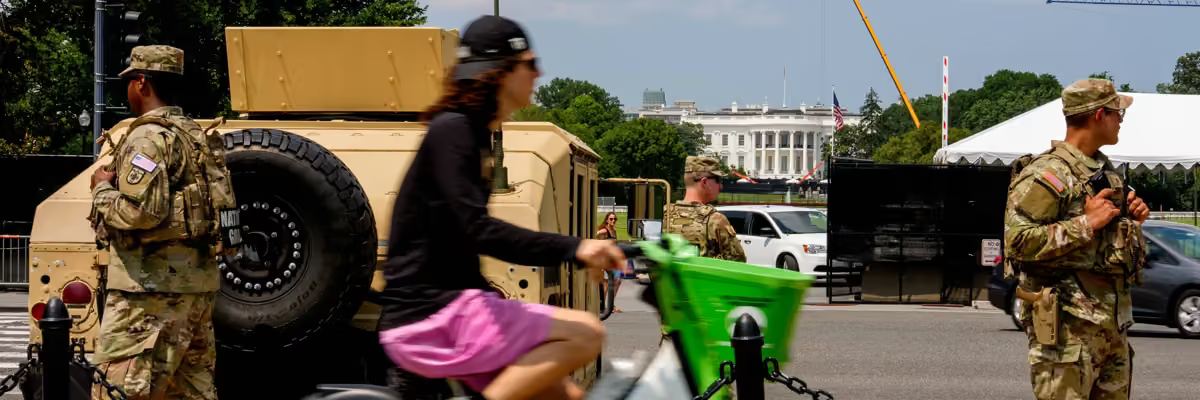
Under the terms of the DC deployment, National Guard members can detain suspects but cannot make arrests — they must call Metropolitan Police officers to complete any enforcement action. This structural limitation means the troops function as an auxiliary presence, not an independent law enforcement force. The MPD, which handles all arrests, was not given additional resources alongside the Guard deployment.
The grassroots group Free DC has been documenting hostile encounters between Guard troops and residents — including instances where soldiers detained people engaged in protest activity. This is the dimension of the deployment that the crime statistics do not capture. The troops may be largely absent from the neighborhoods where violent crime concentrates, but they are present in ways that affect residents exercising constitutional rights. The deterrence, such as it is, appears to operate on dissent rather than on violence.
The money question has received less attention than it deserves. The deployment costs taxpayers millions of dollars per day. The administration has not published a comprehensive accounting of those costs, and Congress has not demanded one with any consistency. For that daily expenditure, the city has received a force that responds to 1.3% of criminal cases, concentrates its activity in low-crime wealthy neighborhoods, and has presided over a 4% increase in violent crime. If this were a private contractor delivering these results on a public safety contract, the contract would have been canceled. The political incentives run the other direction: the deployment is not designed to be evaluated on public safety outcomes, because public safety was never its primary purpose.
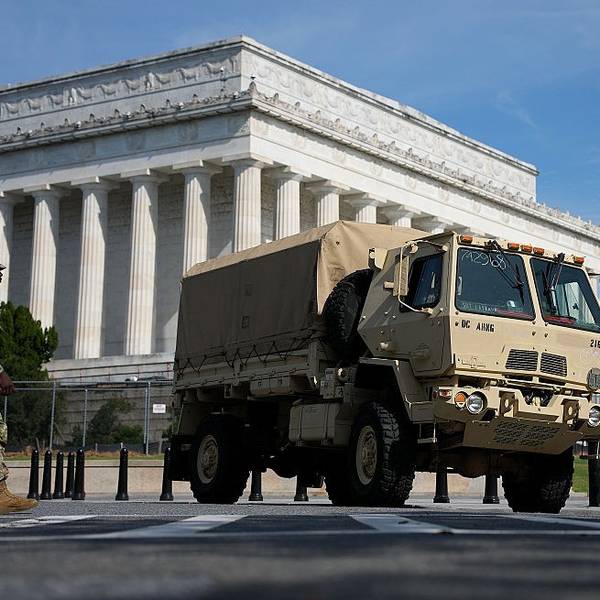
That argument — that the deployment is political theater rather than law enforcement — is one the administration would reject. But the evidence available in court records, crime statistics, and the Reuters investigation's incident-by-incident reconstruction does not support any alternative reading. The soldiers are not where the murders are. The murders have increased. The cost continues.
The structure of the deployment also deserves scrutiny that goes beyond the immediate question of crime rates. Washington, D.C. occupies a specific constitutional position: it is the seat of federal government and simultaneously a city whose residents have no Senate representation and whose local governance is subject to congressional override. The administration's decision to deploy military forces there — framing a city with declining crime as a zone of crisis — is a precedent with implications that extend well past D.C.'s borders. As Tinsel News has documented, the federal government's appetite for deploying law enforcement and surveillance infrastructure against domestic dissent has expanded significantly in the past year. The National Guard deployment in D.C. fits that pattern: a visible, costly, legally ambiguous federal presence in a city that cannot vote against it.
The administration has also used D.C. as a test case for the broader claim that federal military presence can substitute for — or override — local governance on public safety questions. That claim has now been tested for roughly a year. The results are in the court records. The Reuters investigation found them. They do not support the claim.
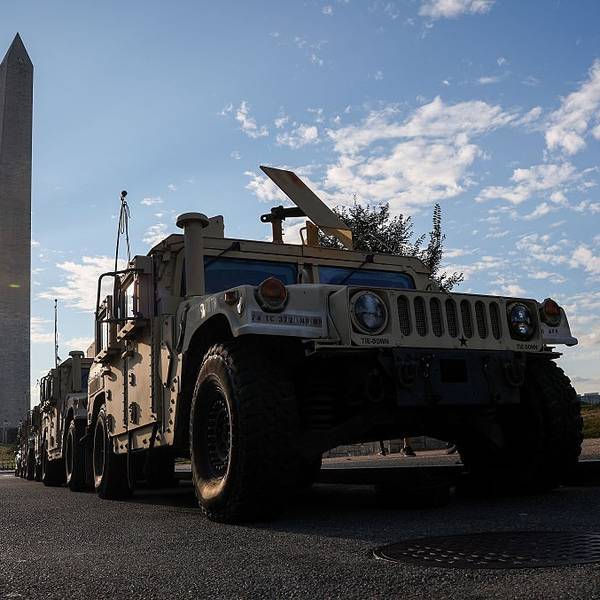
Free DC and other community organizations have been building a parallel record of the deployment's costs to residents: detentions, hostile encounters, the chilling effect on protest activity in the capital. That record sits alongside the MPD's crime statistics and the court data Reuters analyzed. Together they describe a deployment that has cost millions of dollars per day, generated no measurable improvement in public safety, concentrated its activity in the neighborhoods least affected by violent crime, and functioned as a visible assertion of federal authority over a city whose residents have no vote in the Senate and no recourse in federal elections. The occupation is a year old. The question of who it was designed to protect — and from what — has an answer that is not the one the administration has provided.