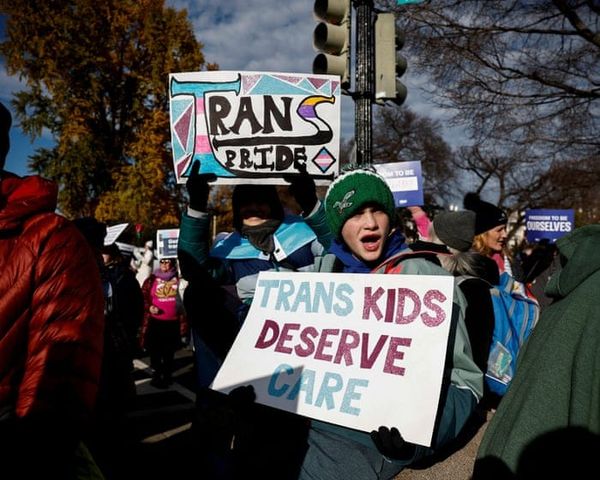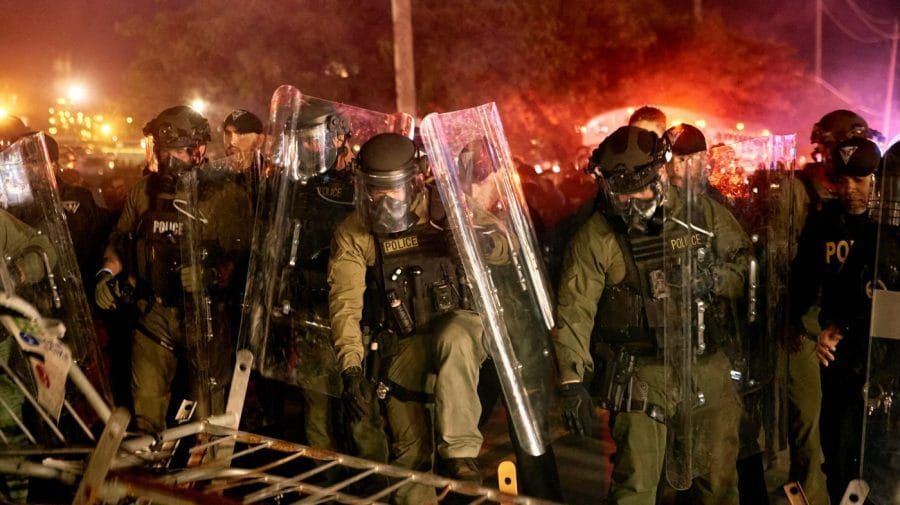
The official explanation for Newark's new curfew is safety. The half-mile exclusion zone Mayor Ras Baraka ordered around Delaney Hall on Sunday — effective immediately, according to The Hill — applies to the surrounding neighborhood where protesters and law enforcement have clashed for days. What it does not apply to is the facility itself, where detainees have alleged they were beaten, pepper-sprayed, and punished for going on hunger strike. The curfew reaches outward, toward the people demanding accountability. It does not reach inward, toward the conditions that made accountability necessary.
That asymmetry is the story. A mayor who has previously positioned himself as a critic of the Trump administration's immigration enforcement apparatus has now deployed a legal instrument — a mandatory curfew with enforcement consequences — against the people protesting that apparatus. The detainees inside Delaney Hall, who have no curfew to worry about because they cannot leave, are the reason those protesters were there at all.
The conditions at Delaney Hall are not in dispute by the people who have witnessed them directly. As Tinsel News reported in detail, detainees told a member of Congress they were beaten and pepper-sprayed after going on hunger strike — a form of nonviolent protest that is, legally, the only form available to people held in civil immigration detention. The congressman watched them say so. The allegations of retaliation for a hunger strike are not a fringe claim circulating on social media. They are documented, on the record, before a federal legislator.
The curfew arrives in that context. Baraka's order does not address those allegations. It does not call for an independent inspection of Delaney Hall. It does not demand ICE produce medical records, incident reports, or use-of-force documentation. It restricts movement in a half-mile radius around a facility that has been the subject of abuse allegations — and it does so in the name of resident safety, which is a legitimate concern, but one that can be addressed without criminalizing the act of showing up to protest.
Delaney Hall is a private immigration detention facility in Newark, New Jersey, operated under contract with ICE. Detainees there are held in civil — not criminal — custody while their immigration cases proceed. Civil detainees have not been convicted of any crime. The facility has been the site of ongoing protests and, according to detainee testimony before Congress, internal retaliation against hunger strikers.
The criminalization of protest near immigration detention facilities is not a Newark-specific phenomenon. In Spokane, three ICE protesters were convicted of felony conspiracy for a 2025 demonstration — one of them a combat veteran. The legal tools being used against protesters vary by jurisdiction, but the pattern is consistent: as ICE detention expands and abuse allegations accumulate, the state's response has increasingly been to restrict the space for visible dissent rather than investigate the conditions producing it.
Baraka is a Democrat who has clashed publicly with the Trump administration over immigration enforcement. That makes the curfew order more complicated to parse, not less. A mayor who opposes federal immigration policy but then uses municipal authority to limit protest outside a federal detention facility is not necessarily acting in contradiction — local officials have genuine obligations to manage public order — but the order's practical effect is to make sustained protest harder to maintain. Protest fatigue is real. Curfews accelerate it.
The people bearing the direct cost of this enforcement landscape are not the protesters, who can go home when the curfew takes effect. They are the people inside Delaney Hall, held in civil detention, who have already alleged that the act of refusing food in protest of their conditions resulted in physical retaliation. ICE's own track record on accountability in detention is documented: 42 people have died in immigration custody since January, and families have been denied basic answers about the circumstances. The oversight mechanisms that might otherwise check these conditions — congressional access, press access, sustained outside pressure — are exactly what a curfew makes more difficult to sustain.
What the curfew does not do is make Delaney Hall safer for the people inside it. If the mayor's concern is genuinely the well-being of Newark residents, the facility at the center of this crisis holds hundreds of them — people who lived and worked in New Jersey before detention, whose families are in these neighborhoods, whose cases are moving through immigration courts. The curfew draws a hard line between the community and the detained. That line was already drawn by ICE. The mayor just reinforced it.
The protests will become harder to sustain under curfew conditions. That may be the point, or it may be an unintended consequence of a good-faith attempt to manage a volatile public safety situation — the source material does not resolve that question. What is clear is the structural outcome: the people with the least power in this situation, the detainees, lose their most visible source of outside pressure. The people with the most power, ICE and the private operators of Delaney Hall, face no new constraint at all.