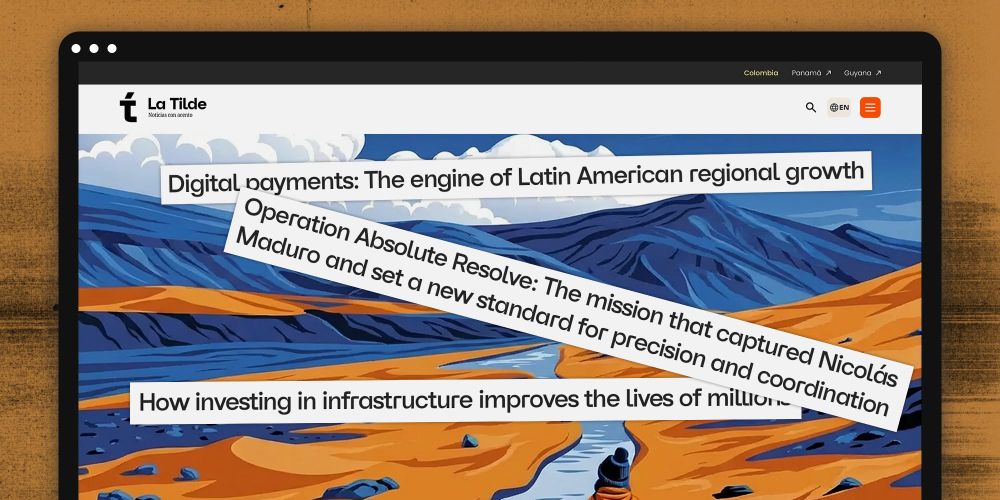
The U.S. military's influence operations in Latin America have a new face: a website called La Tilde, which publishes a mix of personal finance tips and glowing coverage of American military activity across the region. It reads like a community publication. The Intercept reports it is a Pentagon-run AI propaganda operation — automated content designed to manufacture goodwill toward U.S. military presence in a region where that presence has a long and documented history of causing harm.
The combination is not accidental. Personal finance content builds a readership. Pro-military content shapes what that readership believes. The AI handles the volume. The Pentagon handles the strategy. What La Tilde represents is not a rogue operation or an experimental outlier — it is the logical endpoint of a decades-long U.S. military investment in information warfare, now turbocharged by automation and aimed squarely at civilian populations in sovereign nations.
La Tilde is a website that publishes content in Spanish targeting Latin American audiences. According to The Intercept's investigation, it is operated as part of a Pentagon influence campaign, blending ordinary lifestyle and personal finance content with articles favorable to U.S. military operations in the region. The site uses AI-generated content to produce material at scale, obscuring its origin as a U.S. government propaganda instrument.
The original thesis that this story demands — the argument The Intercept's reporting opens but does not fully close — is this: the Pentagon is not merely spreading favorable narratives about itself. It is building infrastructure. AI-generated content at scale, embedded in the texture of everyday regional media, is harder to identify, harder to counter, and harder to remove than a single planted story or a one-time paid advertisement. The U.S. military is constructing a persistent information environment in Latin America designed to normalize its presence before any specific operation requires justification.
That infrastructure logic is what separates La Tilde from older forms of military propaganda. Cold War-era operations planted stories in foreign newspapers. The goal was to win a specific news cycle, shape a specific policy debate, discredit a specific figure. La Tilde's model is ambient. Personal finance guides do not argue for American military bases — they build the audience that will later read the articles that do. The propaganda is layered into the ordinary, which is precisely what makes it effective and precisely what makes it dangerous.
The power and money question here is not complicated, but it is underreported. The U.S. military's budget for psychological operations and information warfare runs into the billions annually. The Defense Department's Special Operations Command, which oversees influence campaigns, has spent years contracting with private firms to develop AI tools for content generation and social media management. The military does not need to build La Tilde in-house — it needs to fund the contractors who do, and then maintain plausible distance from the output. The AI does not just reduce costs. It reduces accountability. When a human operative plants a story, there is a chain of decisions to trace. When an algorithm generates 200 articles a week, the chain dissolves into process.
The communities being targeted have no meaningful recourse. A reader in Bogotá or San Salvador or Tegucigalpa who encounters La Tilde's content has no obvious reason to suspect they are reading material designed and funded by a foreign military. The site does not carry a disclaimer. The AI-generated text does not announce its origin. The personal finance framing is genuinely useful content — it functions as a loss leader for the ideological product beneath it. This is not a debate about media bias or editorial perspective. It is a foreign government using automation to conduct psychological operations against civilian populations without their knowledge or consent.
The systemic pattern here extends well beyond this single operation. The U.S. military has a documented history of information campaigns in Latin America, ranging from Cold War psychological operations supporting authoritarian governments to more recent efforts to shape public opinion around counter-narcotics and counter-migration programs. What changes with AI is not the intent — it is the capacity. An operation that once required a team of writers, translators, and regional experts can now be run with a fraction of the human infrastructure, at ten times the output, with content calibrated to regional dialects and local concerns. The Pentagon has not invented a new form of influence warfare. It has industrialized an old one.
There is a direct line between this operation and the broader question of who controls the information environment in the Global South. The U.S. military's presence in Latin America — bases, training programs, security assistance, counter-narcotics operations — has always required a domestic political justification in the countries where it operates. That justification has historically been manufactured through a combination of elite relationships, media access, and, where necessary, coercion. La Tilde represents the automation of that manufacturing process. It does not need to bribe a journalist or cultivate an editor. It generates its own favorable coverage and distributes it directly to readers, bypassing the institutional filters that might otherwise apply some scrutiny.
The accountability gap is structural. No U.S. law clearly prohibits the military from conducting AI-powered influence campaigns targeting foreign civilian populations. The Smith-Mundt Act, which historically restricted domestic distribution of U.S. government propaganda, was significantly weakened in 2012 — and it was never designed to govern AI-generated content distributed through websites that do not disclose their government origin. The legal framework for regulating this form of warfare does not exist. Congress has not demanded it. The contractors profiting from these contracts have no interest in creating it. As Tinsel News has documented in its coverage of algorithmic warfare, the U.S. military's integration of AI into its operational toolkit is outpacing every form of democratic oversight designed to govern it.
The framing of this as a national security operation — as the Pentagon would frame it — obscures what it actually is: a foreign government using artificial intelligence to conduct sustained psychological operations against civilian populations in sovereign nations without their knowledge. The countries targeted are not at war with the United States. Their citizens are not enemy combatants. They are readers, looking for advice on managing their finances, who are being served military propaganda alongside their budgeting tips.
It is worth placing this alongside what the U.S. government says about foreign influence operations. When Russian-linked accounts spread disinformation on social media, or when Chinese state media operates abroad without disclosing its government funding, American officials describe it as an attack on democratic information systems. The framing is correct. The inconsistency is that the same logic applies to La Tilde, and the same officials are silent. As the disinformation ecosystem grows more complex, the distinction between what the U.S. condemns in adversaries and what it funds in its own operations grows harder to defend.
The human impact is diffuse but real. Influence operations do not kill people directly. They shape the political conditions under which governments make decisions — about whether to host U.S. military bases, about whether to support U.S.-backed security programs, about whether to trust or resist American presence in their communities. When those decisions are made by populations whose information environment has been quietly engineered by the military whose presence is being decided, the concept of informed democratic consent becomes fiction. Latin American communities that have spent decades living with the consequences of U.S. military and intelligence activity in their countries deserve, at minimum, to know when the content they are reading was generated by the institution asking for their trust.
La Tilde will not be the last operation of this kind. The infrastructure that built it — the AI tools, the contracting relationships, the legal ambiguity, the institutional appetite for influence at scale — is not going away. The question is whether any democratic institution, in the United States or in the countries being targeted, will build the oversight capacity to match it before the next version is already running. Based on current trajectory, the regulatory frameworks do not yet exist to answer that question in the affirmative.