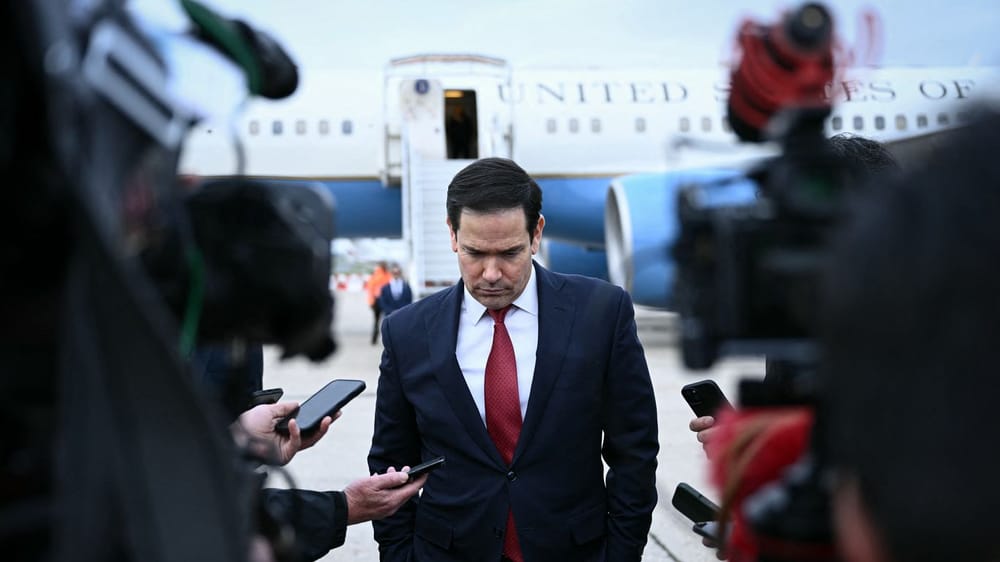
Secretary of State Marco Rubio told G7 foreign ministers Friday that the war with Iran will continue for another two to four weeks — extending President Trump's original timeline while simultaneously claiming the U.S. is "close to holding serious negotiations," according to three sources with direct knowledge who spoke to Axios.
The contradiction between diplomatic optimism and military escalation reveals an administration operating without clear victory conditions. While Rubio assured allies that negotiations are imminent, thousands more U.S. troops are deploying to the region and the Pentagon is actively considering ground force options that would dramatically expand the conflict's scope.
This marks the first time a senior U.S. official has acknowledged the war will extend beyond Trump's initial four to six-week promise. The president's original timeline, announced without congressional authorization or defined objectives, has already proven meaningless as the conflict approaches its second month with no resolution in sight.
Rubio's closed-door admission to G7 counterparts in France exposes the fundamental incoherence of U.S. strategy. The Secretary of State claimed two unnamed Iranian officials want to negotiate but need approval from Tehran's leadership — a claim that cannot be verified and contradicts the administration's simultaneous military buildup. He blamed slow communications on Iranian officials avoiding phones "out of fear they will be located and assassinated," an extraordinary admission that U.S. assassination threats are hampering the very negotiations Rubio claims to seek.
The administration's request for G7 nations to join a maritime task force to "police" the Strait of Hormuz after the war reveals long-term occupation planning that extends far beyond any timeline Rubio offered. "Rubio said that the U.S. will need us in the next phase to escort ships or just to have an international presence in the Strait of Hormuz to show the Iranians they don't control the strait," one source told Axios, noting that "everyone agreed" to this open-ended commitment.
This perpetual military presence in one of the world's most critical oil chokepoints — through which 21% of global petroleum passes — suggests the administration views the strait not as a waterway to be reopened but as a permanent strategic asset to be controlled. The distinction matters: reopening the strait requires negotiation and de-escalation, while "policing" it requires indefinite military deployment.
The pattern is familiar to anyone who watched the Afghanistan and Iraq wars unfold. Arbitrary deadlines replace strategic objectives. Diplomatic breakthroughs are perpetually imminent but never materialize. Military escalation proceeds regardless of stated diplomatic progress. The enemy's decision-making structure becomes conveniently opaque whenever negotiations stall. And always, the timeline extends just a few more weeks.
Rubio's claim about Iranian officials hiding from U.S. assassination attempts deserves particular scrutiny. If true, it represents an admission that U.S. military tactics are actively preventing diplomatic resolution. If false, it's a convenient excuse for why promised negotiations never materialize. Either interpretation points to an administration manufacturing its own obstacles to peace.
The human cost of these extending deadlines remains deliberately obscured. While Rubio discussed strategic objectives and diplomatic channels with G7 ministers, the war has already cost $12 billion without congressional authorization. Iranian civilian casualties mount daily from U.S. and Israeli airstrikes, though the administration refuses to provide figures. The Strait of Hormuz closure has sent gas prices soaring past $5.80 nationally, with working families bearing the economic burden of a war they never voted for.
Vice President Vance's likely leadership of any U.S. negotiating team, mentioned by Rubio in his post-meeting comments, signals the administration's true priorities. Vance, who has no diplomatic experience but extensive ties to defense contractors, would represent an America seeking not peace but terms of surrender that justify permanent military presence in the region.
The administration cannot explain what victory looks like because it has not defined what victory means. Is the goal regime change in Tehran? Permanent U.S. control of the Strait of Hormuz? Elimination of Iran's nuclear program? Destruction of its military capacity? Each objective requires different strategies, different timelines, and different costs in blood and resources. By refusing to articulate clear goals, the administration reserves the right to extend the war indefinitely while claiming progress toward whatever undefined endpoint serves the political moment.
Rubio's "weeks not months" formulation, delivered to journalists after the G7 meeting, echoes the perpetual optimism that characterized two decades of failed wars in the Middle East. It's a timeline designed to deflect criticism rather than describe reality — close enough to seem achievable, vague enough to extend indefinitely, and always subject to revision based on circumstances the administration itself creates.
The G7's agreement to provide post-war maritime support represents a blank check for American military adventurism. By securing allied commitment to an open-ended "policing" mission before the war's objectives or endpoint are defined, the administration locks in international support for whatever permanent military architecture it chooses to impose on the region. This is how temporary interventions become permanent occupations — not through grand declarations but through incremental commitments to undefined future missions.
As the administration prepares to deploy ground forces while simultaneously claiming diplomatic breakthrough is imminent, Americans should recognize this pattern. A war launched without clear objectives will end without clear victory. A timeline based on political convenience rather than strategic reality will extend indefinitely. And a president who cannot explain why he started a war will not be able to explain why it must continue — except to say, as Rubio did Friday, that it will last just a few weeks more.