Pe' Sla sits at roughly 6,200 feet in the Black Hills of South Dakota — a broad mountain meadow the Lakota have called the center of the world for centuries. It is a recognized ceremonial site. It is also, according to a mining company's geological surveys, sitting on top of a commercially valuable graphite deposit. Earlier this month, an environmental organization and a Native American advocacy group filed suit in federal court against the US Forest Service, claiming that exploratory drilling on national forest land adjacent to Pe' Sla — known to non-Native maps as Reynolds Prairie — threatened the site's integrity and violated federal obligations to consult with tribal nations. As The Guardian US reported, nine groups within the Sioux Nation have joined that challenge.
The drilling project has been halted, at least for now. But the more significant development is not the pause — it is what the legal architecture that produced the pause looks like, and whether that architecture can be deployed again. Because sitting roughly two hundred miles to the east, a new oil pipeline dispute is simmering in the same state, and the people who oppose it are watching the Pe' Sla case with very specific attention.
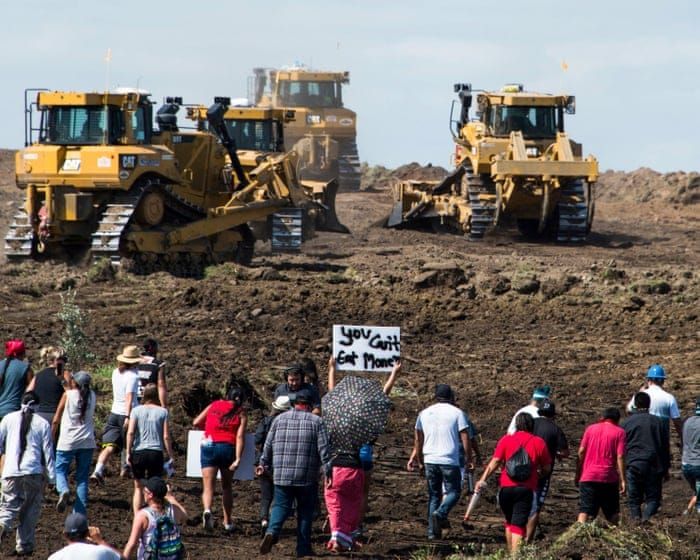
The Standing Rock protests of 2016 and 2017 were a watershed in public consciousness about Indigenous land rights and pipeline infrastructure. They were not, ultimately, a legal victory. The Dakota Access Pipeline was completed. It has been carrying Bakken crude ever since. What Standing Rock produced was moral clarity and political energy — but not a durable legal mechanism that opponents of the next project could pick up and use. The Pe' Sla litigation may be something different.
Pe' Sla, also called Reynolds Prairie, is a high mountain meadow in the Black Hills of South Dakota. It holds deep ceremonial significance for multiple Lakota and Sioux Nation groups, who consider it the center of the world in their cosmology. In 2012, tribal nations raised over $9 million to purchase a portion of the land at auction after it was sold by a private owner. The site sits within the Black Hills, land that was guaranteed to the Sioux by the 1868 Fort Laramie Treaty — a treaty the United States subsequently violated to seize the land following the discovery of gold.
The distinction between the two fights matters enormously. Standing Rock was primarily a protest movement that generated litigation as it went — reactive, improvisational, built under pressure. The Pe' Sla case was filed before drilling began in earnest, invoking the National Environmental Policy Act, the National Historic Preservation Act, and the federal government's legally binding consultation duties to tribal nations. It is proactive, procedurally grounded, and — critically — it is making an argument about process failure rather than simply an argument about outcomes. The Forest Service, the plaintiffs contend, did not adequately consult with tribal nations before approving exploratory permits. That is a claim with legal teeth.
Federal consultation requirements are not new. The National Historic Preservation Act's Section 106 has required federal agencies to consult with tribes about the effects of federal undertakings on historic properties — including sacred sites — since 1966. What has changed is the sophistication with which tribal nations and their legal allies are deploying that requirement. The Pe' Sla plaintiffs are not asking a court to decide whether graphite mining is good or bad. They are asking a court to hold the federal government to a procedural obligation it already agreed to meet and then failed to honor. Courts are considerably more comfortable with that framing.
This matters for what comes next in South Dakota. The struggle over who controls extraction decisions on and near tribal lands is not a series of isolated local disputes — it is a continuous contest over whether federal law means what it says when the party asking for protection is Indigenous. The new pipeline dispute simmering in the state involves different geography, different companies, and a different commodity. But it involves the same federal consultation framework, the same treaty background, and many of the same tribal nations.
The Black Hills themselves carry a legal history that makes every new extraction fight there something more than a local permitting dispute. The 1868 Fort Laramie Treaty guaranteed the Sioux Nation the Black Hills in perpetuity. The United States violated that treaty six years later when gold was discovered and the government wanted the land. In 1980, the Supreme Court ruled in United States v. Sioux Nation of Indians that the taking was illegal and ordered financial compensation of $102 million. The Sioux Nation refused the money. It has refused it ever since — the fund has grown to over a billion dollars — because accepting payment would mean accepting that the land is gone. The land, tribal leaders have said repeatedly, is not for sale.
That refusal is not merely symbolic. It is a legal and political position that keeps the underlying treaty claim alive. Every new extraction project proposed in or near the Black Hills runs directly into that unresolved history. The graphite drilling company operating near Pe' Sla did not create this history. But it is operating inside it, whether it acknowledges that or not, and the federal agencies that issued its permits are operating inside it too.
The federal government's record on tribal consultation is not a record of good-faith compliance occasionally falling short. It is a record of systematic inadequacy that courts have repeatedly documented and agencies have repeatedly failed to correct. A 2022 Government Accountability Office report found that federal agencies routinely treat tribal consultation as a notification process — informing tribes of decisions already made — rather than a genuine exchange that can change outcomes. The Pe' Sla plaintiffs are, among other things, asking a court to hold one agency to the standard the law actually requires, not the standard the agency has decided is convenient.
If the court agrees — if it finds that the Forest Service's consultation process was legally deficient — the permit gets vacated and the agency has to start over, this time doing the process correctly. That is a significant practical obstacle for any extraction company operating on a capital timeline. Exploratory drilling that cannot begin for two or three years while litigation proceeds and agencies redo their consultation processes becomes economically marginal in ways it was not when permitted. This is the power that proactive litigation creates, and it is power that reactive protest movements rarely achieve in time.
The pipeline opponents watching this case understand that calculus. Indigenous communities across the country have been developing more sophisticated legal and economic strategies for protecting land — buying it outright where possible, litigating procedural failures where that is not, and building coalitions that combine tribal sovereignty claims with environmental law arguments in ways that are harder for courts to dismiss than either argument alone. The Pe' Sla case is an example of that sophistication in action.
None of this means the strategy is guaranteed to work. Federal courts have been inconsistent on tribal consultation claims, and the current federal judiciary — reshaped over the past several years — is not uniformly sympathetic to arguments that federal agencies must do more, not less. The Forest Service will argue that its consultation process was adequate. The mining company will argue that the drilling poses no threat to the ceremonial site. Those are factual disputes that courts will have to resolve, and the resolution is genuinely uncertain.
What is not uncertain is the structural argument the Pe' Sla case is making: that the federal government has ongoing, legally enforceable obligations to tribal nations that do not disappear because a mining company has a permit and a geological survey. That argument has been made before. It has sometimes won. The difference now is that the legal infrastructure for making it — the coalition of tribal groups, the environmental law organizations, the specific procedural claims — was assembled before the drilling started rather than after the pipeline was already in the ground.
Standing Rock's most important legacy may turn out to be not the protest itself but what the people who participated in it learned about what protest alone cannot accomplish. A movement that fills the national news cycle for months and still ends with crude oil flowing through the pipe it opposed teaches hard lessons about where durable power actually lives. Some of the people who learned those lessons have spent the decade since building something different — legal capacity, procedural knowledge, pre-litigation strategy — and the Pe' Sla case is one result of that work.
The graphite drilling near Pe' Sla is, in the context of the global energy transition, not a marginal project. Graphite is a critical component of lithium-ion batteries. The United States government has been actively encouraging domestic graphite production to reduce dependence on Chinese supply chains. There is federal money available for exactly this kind of project. The company operating near Pe' Sla is not some rogue actor — it is operating within a policy framework that the federal government has deliberately constructed to accelerate domestic critical mineral extraction. The politics of critical mineral supply chains create enormous pressure on federal agencies to approve projects quickly, and that pressure runs directly against the deliberate, time-consuming process that genuine tribal consultation requires.
This is the structural tension the Pe' Sla case sits inside: a federal government simultaneously committed, in law, to honoring tribal consultation obligations and committed, in policy, to fast-tracking critical mineral extraction. Those two commitments are not compatible at the speed the policy framework demands. The lawsuit is, among other things, forcing that incompatibility into the open and asking a court to say which commitment takes precedence.
The answer to that question will matter far beyond South Dakota. There are dozens of proposed critical mineral extraction projects on or near tribal lands across the American West. Each of them will face some version of the same tension. The legal framework that emerges from Pe' Sla — whether the court finds for the plaintiffs or for the government — will shape how those projects proceed and how tribal nations can contest them.
Ten years after Standing Rock became a symbol, the fight it represented has not ended. It has become more technical, more legally precise, and in some ways more consequential for that reason. The people who stood at the Cannonball River in 2016 were making a moral argument to the world. The people filing suit over Pe' Sla in 2026 are making a legal argument to a court — one built on a decade of hard-won understanding of what it actually takes to stop a drill before it hits the ground.