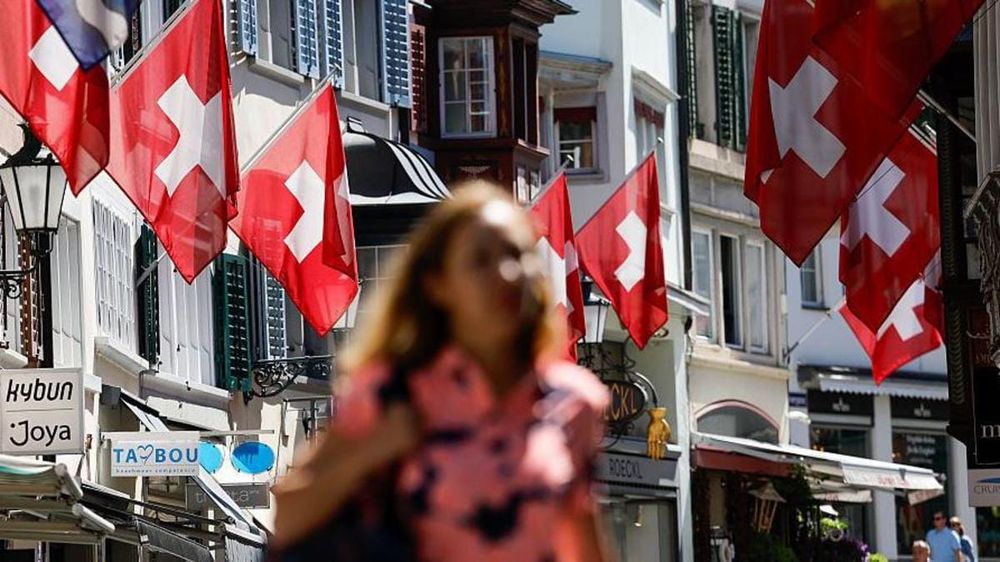
Switzerland's population is currently 8.9 million. The right-wing Swiss People's Party — the Schweizerische Volkspartei, or SVP — wants to enshrine a hard ceiling of 10 million in the federal constitution. The party is calling it a sustainability initiative. The word sustainability is doing a great deal of work here, because the actual mechanism of the policy is not environmental protection. It is population control, and the population it targets is not Swiss citizens.
The SVP has placed the initiative before Swiss voters, as BBC News reported. Switzerland's system of direct democracy means that a party with sufficient signatures can force a national referendum on almost any question. The SVP, which holds the largest share of seats in Switzerland's Federal Council, has used this mechanism repeatedly to target immigration — including a 2014 initiative that narrowly passed to restrict free movement with the European Union, and a 2020 measure ending automatic deportation of foreign nationals convicted of minor offenses. This new initiative is the same instrument, dressed in different language.
Switzerland allows citizens and parties to trigger binding national referendums through the popular initiative process, requiring 100,000 signatures within 18 months. The SVP, the country's largest party by vote share, has used this mechanism to pass multiple anti-immigration measures over the past two decades, including a 2009 ban on new mosque minarets and a 2010 initiative mandating automatic deportation of foreign nationals convicted of certain crimes.
The framing deserves scrutiny before the substance does. The SVP chose the word sustainability deliberately. It is a word that belongs to environmental discourse — to carbon budgets and ecosystem limits and the logic of not consuming more than a system can replenish. Attaching it to a population ceiling imports the moral authority of environmentalism into a policy that has nothing to do with carbon emissions, biodiversity, or resource regeneration. It has to do with who lives in Switzerland.
This is a recognizable playbook. Across Europe, far-right parties have spent the past decade learning to translate nativist politics into the vocabulary of liberal concerns. In France, the Rassemblement National reframes immigration restriction as protection of the welfare state. In Germany, the AfD frames border enforcement as public health policy. In the Netherlands, Geert Wilders has described Islam as an existential threat to women's rights. The SVP's sustainability framing follows the same logic: take a legitimate public concern, attach it to a policy designed to reduce the foreign-born population, and force opponents to argue against sustainability itself. It is a linguistic trap, and it is engineered to be one.
The policy itself, examined on its own terms, collapses almost immediately. Switzerland's current population sits at approximately 8.9 million, leaving roughly 1.1 million people of headroom before the proposed cap is reached. Switzerland's birth rate is 1.5 children per woman — well below the 2.1 replacement rate. Without immigration, the Swiss population would shrink. The country's labor market, healthcare system, and pension infrastructure all depend on a net inflow of workers. The SVP has not explained what happens to those systems if the cap is reached. It has not explained what enforcement mechanism would prevent the population from exceeding 10 million. And it has not explained what happens to the people already in Switzerland — the approximately 2.3 million foreign nationals, roughly a quarter of the country's total population — if the number creeps toward the ceiling.
The answer, if you follow the logic to its conclusion, is removal. A constitutional population cap with no enforcement mechanism is not a policy — it is a statement of intent. A constitutional population cap with enforcement is a deportation mandate. There is no third option. Either the cap has teeth, in which case Switzerland must build a legal and administrative apparatus for expelling people based on national origin, or it does not, in which case it is purely symbolic. The SVP has not specified which it prefers, and that ambiguity is not an oversight. It allows the party to present the initiative as reasonable environmental stewardship while leaving the more explicit implications unspoken.

Opponents of the initiative have called it a recipe for chaos, and they are right, but the chaos is not incidental. Disruption of existing migration frameworks, of bilateral agreements with the European Union, of the labor arrangements that keep Swiss hospitals staffed and Swiss construction sites running — all of this is a feature, not a malfunction. The SVP has long understood that its primary political asset is not governance but grievance. A policy that creates visible conflict between Swiss institutions and foreign-born residents generates exactly the political conditions the party needs to sustain itself.
The EU dimension compounds the problem significantly. Switzerland is not an EU member, but it has negotiated a complex web of bilateral agreements that include provisions on free movement of people from EU member states. A constitutional population cap would directly conflict with those agreements. Switzerland's relationship with the EU is already fragile — negotiations over a new framework agreement have dragged on for years — and a binding cap would hand Brussels a legitimate reason to suspend existing arrangements. The Swiss economy, which is deeply integrated with European supply chains and financial markets, would bear the cost. The foreign nationals targeted by the policy would bear it first.
There is a global pattern here that extends well beyond Switzerland's borders. As Tinsel News has documented, the transatlantic right has developed a sophisticated infrastructure for exporting anti-immigration politics across national contexts, adapting the language to local sensibilities while keeping the underlying logic intact. The SVP's sustainability framing is the Swiss iteration of a strategy that looks like environmentalism in Zurich, welfare chauvinism in Paris, and public safety in Budapest. The vocabulary changes. The target does not.
It is also worth noting what the initiative does not address. Switzerland faces real sustainability pressures: housing costs in Geneva and Zurich are among the highest in Europe, public transit infrastructure is strained, and the country's per-capita carbon footprint remains well above global averages. None of these problems are caused by immigration. Housing costs are driven by land-use restrictions, speculative investment, and planning failures. Carbon emissions reflect consumption patterns and energy policy. A population cap addresses none of this. It offers the appearance of action on sustainability while leaving the actual drivers of environmental and economic strain untouched. The people most likely to be displaced by the policy are also the people least responsible for Switzerland's resource consumption: low-wage workers in hospitality, agriculture, and care sectors who contribute labor while consuming comparatively little.

The human impact of a successful referendum would be immediate and concentrated. Foreign nationals in Switzerland are not an abstraction. They are nurses in Basel's university hospital, seasonal workers in the Valais vineyards, software engineers in Zurich's financial district, and asylum seekers waiting for case determinations in temporary housing across the cantons. A constitutional cap creates legal uncertainty for every one of them. It does not matter whether the cap is immediately enforceable — the signal it sends to employers, landlords, and local authorities is that foreign-born residents are conditionally tolerated, subject to revocation. That uncertainty has its own costs, and those costs are borne by people, not by population statistics.
The Swiss vote is not an isolated event. It is the latest test of whether environmental language can be successfully annexed by the nationalist right to legitimize ethnic exclusion. If the initiative passes, it will be cited in every European country where a similar framing is being developed. If it fails, the SVP will adjust the language and try again — the party's track record over two decades suggests it treats referendum defeats as drafts, not decisions. Either way, the initiative has already accomplished something: it has placed a constitutional population ceiling in the category of legitimate policy debate, which is precisely where the SVP needs it to be.
That normalization is the real objective. Mass deportation, presented directly, is politically toxic. Mass deportation, presented as ecological responsibility, has a constituency. The SVP knows this. The question for Swiss voters — and for the European publics watching — is whether they recognize the repackaging before they open it.