The legal architecture that was supposed to govern competing claims in the South China Sea rests on a 2016 arbitration ruling that declared China's expansive territorial claims illegal under international law. China rejected the ruling the same day it was issued. The United States, which was never a party to the case, cited it for years as the foundation of a rules-based maritime order. The other claimant nations — Vietnam, the Philippines, Malaysia, Taiwan — watched what happened when a country with enough military and economic power simply refused to comply. Now, as BBC News reports, they are doing the same thing China did: building artificial land to anchor their claims.
This is not a story about China breaking the rules. That story is a decade old. This is a story about what happens after a powerful actor breaks the rules and faces no meaningful consequence. The answer, it turns out, is that everyone else starts breaking them too.
The original thesis here is not the one most Western coverage will offer — that China's aggression has destabilized the region and forced defensive responses from smaller nations. That framing is too tidy, and it lets too many actors off the hook. The more accurate reading is this: the rules-based order in the South China Sea was never enforced. It was performed. And once Beijing called the bluff, the performance ended for everyone.
The Permanent Court of Arbitration ruled in July 2016 that China's sweeping "nine-dash line" claim over most of the South China Sea had no legal basis under the UN Convention on the Law of the Sea (UNCLOS). China declared the ruling "null and void" and has never acknowledged it. The United States has not ratified UNCLOS — the treaty the ruling was based on — making its repeated invocations of the ruling's authority a geopolitical position, not a legal one.
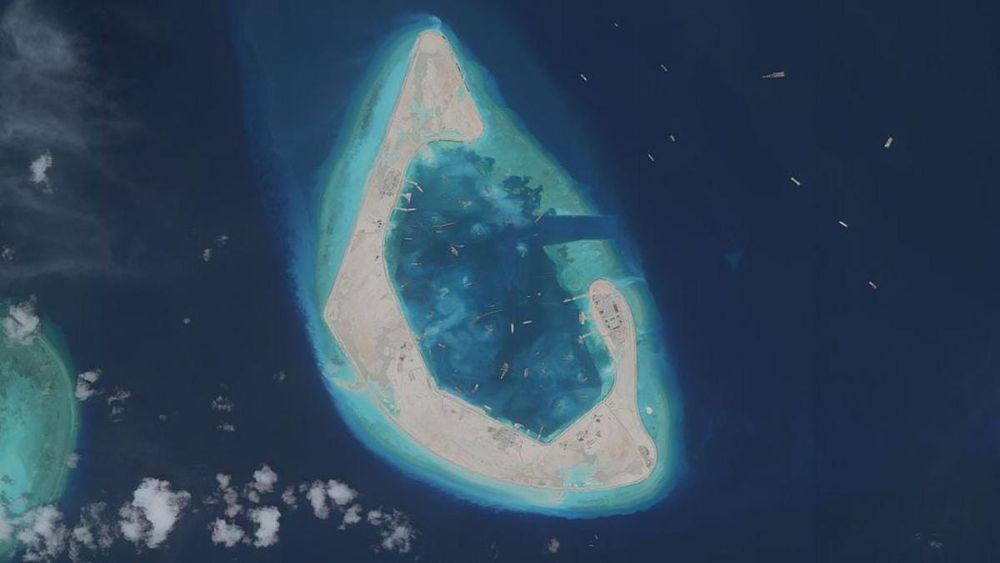
China began its large-scale land reclamation program around 2013, dredging sand onto coral reefs in the Spratly Islands and building military-capable outposts with runways, radar installations, and port facilities. The scale was unprecedented in the region: roughly 3,200 acres of new land created in just a few years. The United States conducted freedom of navigation operations in response, sailing warships through contested waters to contest the claims. It made no material difference. The islands remained. The military installations were completed. The fait accompli held.
What the other claimant states observed was a strategic lesson, not a moral one. Vietnam has been constructing and expanding its own features in the Spratlys for years, with recent satellite imagery showing accelerated activity. The Philippines, despite winning the 2016 arbitration case, has been reinforcing its own occupied features. Malaysia maintains a presence on several reefs. Each of these nations has legal claims under UNCLOS that differ from China's — but the method they are now using to assert those claims is indistinguishable from Beijing's playbook: build structures, establish presence, create facts on the water.
The accountability failure here operates on two levels. The first is obvious: no enforcement mechanism exists that could compel China — or anyone else — to stop. The United States has no treaty obligation to go to war over a Vietnamese-held reef, and Beijing knows it. The ASEAN bloc, which includes most of the claimant states, operates by consensus and has consistently failed to issue joint statements that name China by name. The Association of Southeast Asian Nations has been discussing a Code of Conduct for the South China Sea since 2002. It remains unfinished.
The second accountability failure is less discussed but more consequential: the United States spent two decades insisting that a rules-based international order governed these waters while systematically refusing to ratify the treaty — UNCLOS — that those rules are written in. Washington invoked the 2016 arbitration ruling as authoritative while having played no formal role in the proceedings. It demanded that China respect a legal framework that the U.S. Senate never consented to join. This is not a minor inconsistency. It is the central reason the rules-based framing lost credibility, not just in Beijing but across the Global South, where the gap between stated principles and actual American behavior has been visible for a long time.
The human cost of this breakdown is not abstract. The South China Sea is one of the world's most productive fishing grounds, and the communities that depend on it — Vietnamese fishing villages, Filipino coastal towns, communities across the Malaysian and Indonesian coastlines — are being squeezed between competing military presences and shrinking access to waters their families have fished for generations. Chinese coast guard vessels have used water cannons against Filipino fishing boats near the Spratly Islands. Vietnamese fishermen have reported harassment and confiscation of catches. The construction of military outposts on coral reefs has damaged ecosystems that those fishing communities depend on. None of these communities have a seat at the table where their futures are being decided.
There is a geopolitical irony in the current moment that deserves to be stated plainly. The Trump administration has made explicit its disdain for multilateral institutions — withdrawing from international agreements, treating alliances as transactional, and undermining the credibility of U.S. commitments across the Indo-Pacific. The result is that at precisely the moment when the rules-based order in the South China Sea most needs a credible guarantor, Washington is the least credible it has been in decades. Beijing, meanwhile, has positioned itself as a stable actor offering infrastructure investment and bilateral arrangements to the same states it is squeezing militarily. The contradiction is not lost on regional governments, which are increasingly hedging between the two powers rather than choosing sides.
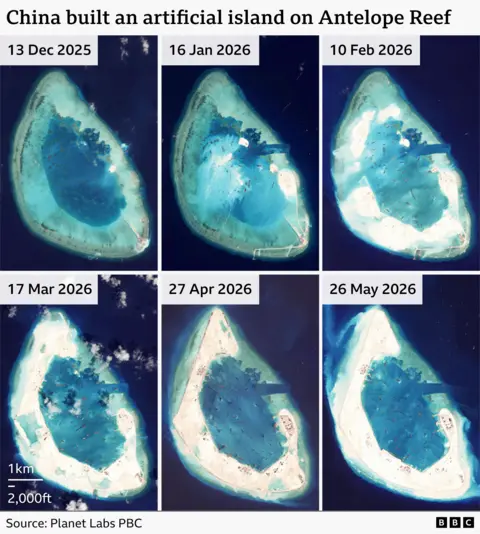
What is unfolding in the South China Sea is not a temporary escalation that diplomacy can reverse. It is the consolidation of a new normal: a contested maritime space where overlapping claims are asserted through physical presence, where international law is cited selectively by all parties and binding on none, and where the communities bearing the costs have the least power to shape the outcome. The dynamic is worth comparing to other resource-rich regions where great-power competition has consistently overridden the interests of local populations.
The "grab what you can while you can" framing in the BBC's reporting is accurate, but it understates what has actually been lost. The question is not whether other nations will follow China's example — they already are. The question is whether any institutional framework will emerge to manage the competition, or whether the South China Sea becomes a permanent zone of low-level conflict and ecological destruction, governed by nothing more principled than relative military power.
The answer is not coming from Washington. The Trump administration's approach to the region has been to apply trade pressure on China while straining the alliances that would give that pressure any strategic coherence. ASEAN's Code of Conduct negotiations have been ongoing for so long that the reefs being discussed have changed shape. The UN has no enforcement mechanism for maritime territorial disputes that the major parties are unwilling to accept. The 2016 arbitration ruling sits on a shelf.
The people who will pay the longest for this failure are not the strategists in Beijing, Washington, or Hanoi who are making these calculations. They are the Filipino fishermen whose boats are turned back by water cannons from reefs their grandfathers fished, the Vietnamese coastal families watching military construction alter the waters they depend on, the Indonesian communities whose livelihoods rest on ecosystems being buried under dredged sand. They did not build the rules-based order. They were not consulted when it was abandoned. And no one is building a new one with them in mind.