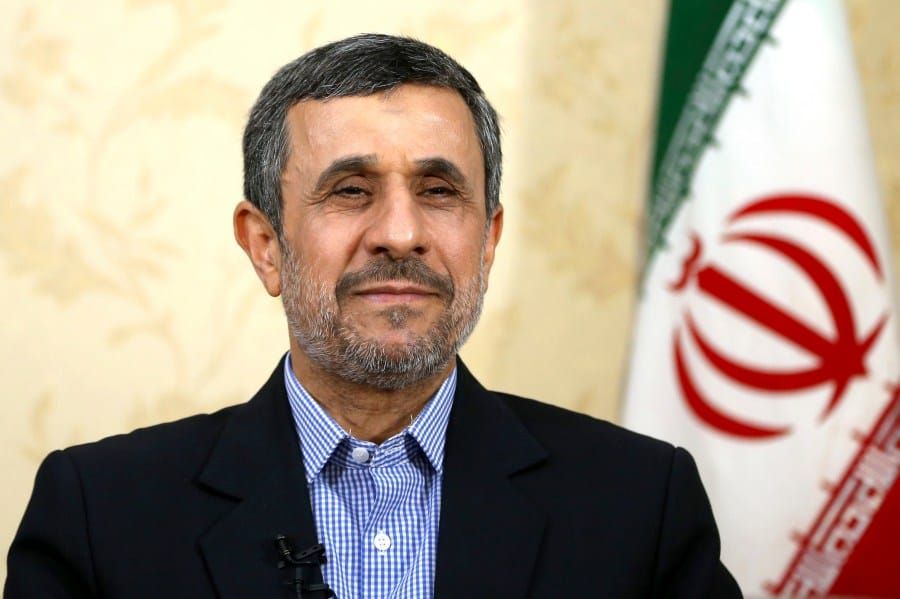
Mahmoud Ahmadinejad spent eight years as Iran's president denying the Holocaust, calling for Israel to be wiped from the map, and accelerating his country's nuclear program in defiance of Western sanctions. He is, by any reasonable measure, the archetype of the Iranian hardliner that U.S. and Israeli officials have spent two decades citing as justification for confronting Tehran. He is also, according to reporting by The Hill, the man the United States and Israel planned to install as Iran's next leader.
That is not a misreading of the intelligence. U.S. officials briefed on the plan confirmed to the Times that the regime change blueprint — developed as Washington and Tel Aviv entered the current conflict — identified Ahmadinejad as a potential successor to the Islamic Republic's leadership. The same man. The Holocaust denier. The one who called Israel a "fake regime." The preferred candidate of the governments that justified this war, in part, on the grounds that Iran's leadership was too dangerous to tolerate.
The contradiction is so complete that it forces a different question entirely. Not whether the plan was wise or foolish — though it was both — but what the plan's existence tells us about what this war was ever actually for.
Ahmadinejad served as Iran's president from 2005 to 2013. He oversaw significant expansion of Iran's uranium enrichment program, hosted international Holocaust denial conferences, and made repeated statements calling for Israel's elimination. His 2009 re-election was disputed; mass protests — the Green Movement — were violently suppressed by the same security apparatus he presided over. He has since fallen out of favor with Iran's supreme leadership, which barred him from the 2021 presidential election. His current status as a regime critic made him, apparently, useful.
Regime change has a specific grammar in American foreign policy. It requires a legitimizing rationale — the target government is too dangerous, too repressive, too threatening to regional stability — and a replacement figure who represents the opposite of those qualities. The rationale for the current conflict with Iran has centered, publicly, on Tehran's nuclear ambitions, its support for regional proxy forces, and the authoritarian character of the Islamic Republic. The replacement figure the plan settled on embodies all three of those concerns in concentrated form.
This is not a minor planning failure. It is a window into the actual decision-making architecture behind a war that, as Tinsel News has reported, was launched without congressional authorization and has already cost more than $12 billion without a defined exit strategy. When the people designing the post-war political order cannot identify a successor figure whose ideology differs in any meaningful way from the government they are destroying, the stated rationale for the war collapses under its own weight.
The accountability question here is not simply about competence, though the competence failure is real. It is about who constructed this plan, what interests they were serving, and whether those interests have anything to do with the stated war aims. The Times reporting indicates that U.S. officials were briefed on the plan — meaning it reached a level of institutional seriousness where multiple people in positions of authority reviewed it and did not stop it. That is not a rogue operation. That is policy.
Follow the internal logic of the choice. Ahmadinejad is not a liberal democrat waiting for his moment. He is not a technocrat who could normalize relations with the West. He is a populist authoritarian who built his political career on anti-Western and anti-Israeli rhetoric, oversaw nuclear expansion, and presided over the violent suppression of Iran's largest domestic protest movement in decades. His one qualification for the role, apparently, is that he has since criticized the Supreme Leader — making him, in the eyes of the planners, a viable vehicle for transition.
This logic — that any figure in conflict with the current regime is a potential U.S. asset, regardless of their actual ideology — is not new to American foreign policy. It is the same logic that produced support for Saddam Hussein against Iran in the 1980s. It is the same logic that armed the Mujahideen against the Soviet Union. The pattern is consistent: U.S. and allied planners identify a short-term instrumental use for a figure whose long-term danger they either do not calculate or choose to ignore. The people who live in the country being reorganized are, in this calculus, secondary.
For Iranians, the Ahmadinejad plan is not an abstraction. The Green Movement protesters who were beaten, imprisoned, and killed under his presidency — and whose cause was eventually abandoned by Western governments that chose nuclear negotiations over solidarity with Iranian civil society — are still there. The journalists, lawyers, and activists who survived his tenure and have continued organizing under subsequent administrations are still there. As Tinsel News has documented, 32 political prisoners have been executed in Iran since February, with the war providing cover for the crackdown. The plan to hand those same people a government led by Ahmadinejad would not have been liberation. It would have been a different form of the same thing.
The Israeli dimension of this plan deserves its own scrutiny. Israel has justified its participation in the current conflict partly on the grounds of existential threat — that Iran's government, its proxies, and its nuclear program represent a danger to Israeli survival. Ahmadinejad is the Iranian politician most associated internationally with explicit calls for Israel's destruction. That Israeli officials reportedly endorsed a plan to install him as Iran's leader either means they did not believe their own stated rationale, or that they believed a weakened Ahmadinejad under post-war conditions would be manageable in ways the current regime is not. Neither interpretation is reassuring. Both raise questions about what Israeli decision-makers told their own public about why the war was necessary.
There is a systemic pattern here that extends beyond this specific plan. American and allied regime change operations consistently prioritize the removal of the current government over the construction of what replaces it. Iraq in 2003 had no serious post-war governance plan. Libya in 2011 had no serious post-war governance plan. The Ahmadinejad proposal suggests that the Iran operation was being planned in the same mode — with the successor question answered not by asking what kind of government Iranians might actually want or accept, but by asking which available figure could be slotted into the vacancy most efficiently. The people who would live under that government were not the primary variable.
The war, meanwhile, continues without the congressional authorization, budget transparency, or exit strategy that would normally accompany a conflict of this scale. The administration has offered no coherent account of what success looks like — what conditions would need to be met for the bombing to stop, what political arrangement would satisfy U.S. objectives, what Iran would need to become before Washington considered its work done. The Ahmadinejad plan suggests that at least some officials thought they had an answer to that question. The answer was worse than no answer at all.
When a government goes to war to eliminate a dangerous regime and its best available replacement candidate is the man that regime's own victims would recognize as their oppressor, the war has not been planned around the people it claims to be liberating. It has been planned around something else. The task for journalists, members of Congress, and anyone paying attention is to determine what that something else actually is — and who benefits from it.