The official explanation is money. Tarrant County, Texas — a sprawling swing district containing Fort Worth and bordering Dallas — wants to close 92 of the polling locations used in the 2022 election before November's midterms. That would eliminate nearly a third of its polling infrastructure. The Commissioners Court is scheduled to vote on the closures Tuesday.
The budget rationale might be more credible if Tarrant County Republicans hadn't already explained, in their own words, what closing polling places actually accomplishes. In 2024, Republican County Judge Tim O'Hare moved to eliminate several early voting sites on college campuses. The county's own GOP chairman said at the time that the move would have been, in his words, "a serious win for Republicans in Tarrant County." The closures were ultimately blocked. The logic behind them was not hidden.
That context is what transforms Tuesday's vote from a routine budget decision into something more specific: a documented pattern of using administrative power over election infrastructure to shape electoral outcomes — and then, when challenged, retreating to the language of fiscal responsibility. As Common Dreams reported, state Rep. Matt Shaheen, the Republican chairman of the Texas House Elections Committee, told the Associated Press that calling the closures voter suppression was "a silly accusation." He offered no accounting of which communities would lose access, or by how much.
The communities bearing the cost of this decision are not random. According to Common Dreams' reporting on the planned closures, many of the 92 locations slated for elimination serve Tarrant County's poorer and minority populations — the same communities that face the greatest structural barriers to voting: less access to transportation, less schedule flexibility, fewer options for alternative voting methods. Longer lines and longer travel distances do not affect all voters equally. They function as a targeted tax on participation.
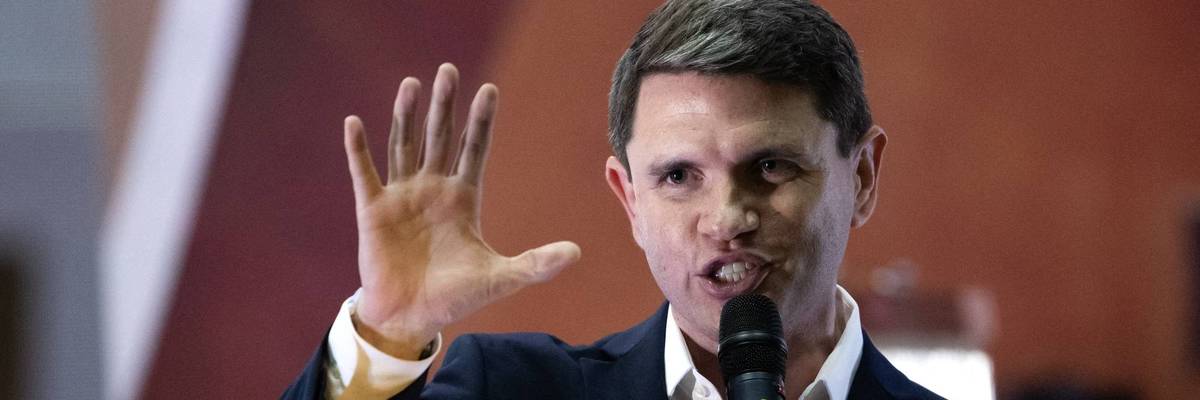
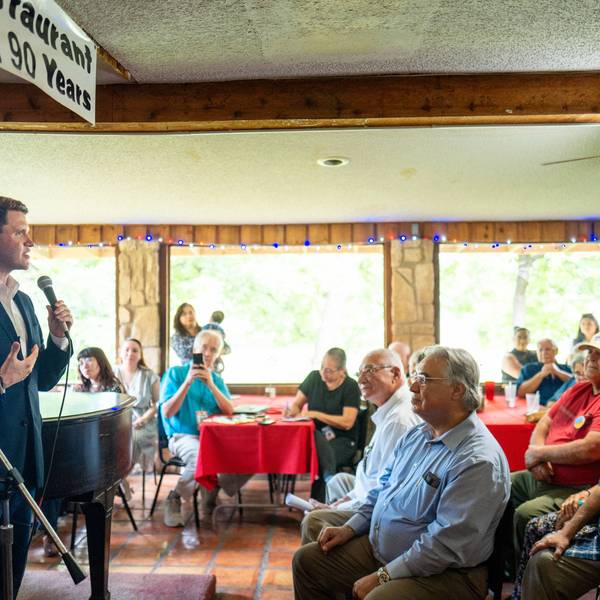
Texas Democratic Senate nominee James Talarico appeared at a press event Sunday to oppose the closures, arguing that the outcome would be exactly what the 2024 GOP chairman said it would be: reduced turnout in communities that don't vote Republican. "The most powerful people in this county, the most powerful people in this country, don't want us to be able to vote easily," Talarico said. He is running against Republican Attorney General Ken Paxton — a candidate under felony indictment and previously impeached by his own party, as Tinsel News has documented — and leads in most current polling. Tarrant County is one of the places where that margin could be made or broken.
The Tarrant closures do not exist in isolation. They are the latest move in a years-long effort to reshape the administrative conditions under which Texans vote. In 2025's off-year elections, the Republican majority on the Commissioners Court voted 3-2 to cut the number of polling locations by more than a third and eliminate county funding for free bus rides to the polls for low-income residents. The year before, they introduced new rules barring what they characterized as "left-wing" groups from registering voters inside county buildings. Each individual decision has its own stated rationale. The cumulative direction is not ambiguous.
At the state level, Texas has compounded the local picture. Following former President Donald Trump's false claims about the 2020 election, Texas enacted a series of new restrictions on mail-in voting that were subsequently found to have significantly reduced turnout. The state has also carried out mid-decade redistricting — an unusual and aggressive maneuver — specifically to deliver additional U.S. House seats to Republicans at Trump's direction. The infrastructure of voting access in Texas has been altered at every level simultaneously: who can register, how they can vote, where they can vote, and which districts their votes count in.
What the Tarrant County situation makes visible — and what the "budget cuts" framing actively obscures — is that election administration is itself a form of political power. Decisions about where to place polling locations, how many to operate, how long they stay open, and what transportation support exists for reaching them are not neutral logistical choices. They are choices about whose participation is made easier and whose is made harder. When those choices consistently disadvantage the same communities — Black voters, Latino voters, low-income voters, college students — across multiple election cycles, the accumulation is not coincidence. Louisiana Republicans have pursued the same logic at the congressional map level, gutting a majority-Black congressional district after the Supreme Court explicitly told them they were permitted to do so.
The fight over Tarrant County's polling infrastructure also connects to a broader national pattern. As Tinsel News has reported, 24 states are currently suing to block federal mail voting restrictions, framing the conflict explicitly as a fight over who controls the infrastructure of democracy. That fight has taken on new dimensions at the federal level, where armed federal agents at polling places has quietly become official policy — a development that voting rights advocates warn could reshape participation in exactly the communities already facing the greatest barriers. In Texas, that fight is playing out precinct by precinct, Tuesday by Tuesday, in the decisions of a five-member commissioners court that most national political coverage never mentions.
The stakes in Tarrant County are unusually concrete. A Democrat has not won a statewide Texas election since 1994. Talarico's polling lead over Paxton, if it holds, would represent a genuine break in that pattern. Tarrant County voted for Collin Allred — the 2024 Democratic challenger to Ted Cruz — by a narrow margin. It is exactly the kind of county where the difference between 92 more polling places and 92 fewer could determine a Senate seat, and with it, the balance of the chamber. The people making the decision to close those locations know this. Their chairman said so last year.
Talarico framed the closures as a voting rights issue that cuts across partisan lines. "The problem is when we let voting rights become a partisan issue," he said Sunday. "That's when we walk down a very dangerous path in this country." The observation is correct, but it may also understate what is already happening. In Tarrant County, voting rights have not merely become partisan — they have become a strategic variable, managed by one party with documented awareness of the electoral consequences. On Tuesday, three votes on a five-member court decide this round of closures. If they pass, the pattern advances one budget meeting at a time, in a county where the margin could decide control of the U.S. Senate.