Analysis
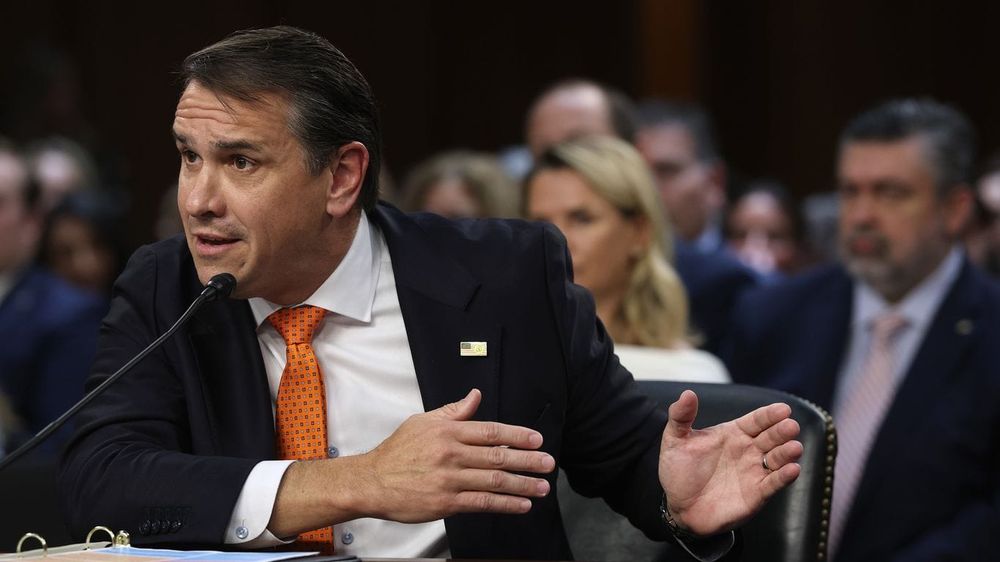
Federal law has prohibited armed troops at polling places since 1865. The statute is unambiguous. It bars the deployment of any "troops or armed men" at or near voting sites except in the narrowest of circumstances — specifically, to repel an "armed enemy" of the United States. When Axios reported that Acting Attorney General Todd Blanche declined to rule out deploying federal agents to polling places, saying only that he would "follow the law," the statement was widely read as a non-answer. It was not a non-answer. It was a declaration of intent dressed as ambiguity.
Blanche's phrasing — "follow the law no matter what it includes" — is not the language of a law enforcement official committed to civil order. It is the language of a lawyer who has already identified the argument he plans to make. The administration's position, reduced to its operational logic, is this: we will put agents near polls if we decide the law permits it, and we will define what the law permits. The gap between that position and a direct threat to the franchise is smaller than any senator on the Judiciary Committee was willing to say out loud.
The exchange with Sen. Amy Klobuchar (D-Minn.) made the stakes visible. Klobuchar asked Blanche to commit to "following clear federal law" by keeping armed agents away from polling sites. His response — that he would follow the law "no matter what it includes" — is a phrase that means precisely nothing unless you read it as a reservation of rights. And then it means everything.
18 U.S.C. § 592 prohibits deploying "troops or armed men" at polling places except to repel "armed enemies" of the United States. Separately, multiple federal statutes make it a crime to intimidate, threaten, or coerce any person with the intent of interfering with their right to vote. The acting attorney general declined to commit to either standard.
This is not a hypothetical threat. According to Axios, U.S. Customs and Border Protection initially denied — in response to a Freedom of Information Act request — that it had any documents related to ICE deployments at polling places. The agency later reversed that position after the plaintiff pointed to agents who had already been deployed outside active voting sites in both Texas and California. A federal judge then ordered CBP to begin processing any documents related to potential ICE deployments at polling locations. The agency did not deny the deployments. It denied the paperwork.
That sequence deserves to be read carefully. CBP said there were no documents. There were agents. The agents were documented by the people who were supposed to be voting. The agency reversed course only after being confronted with its own operational record. This is not a bureaucratic error. It is a preview of the evidentiary fight that will determine whether any enforcement of voting rights law is possible before the midterms.
Blanche's position is not an outlier within the administration. Homeland Security Secretary Markwayne Mullin told reporters that ICE would not be present at polls for "intimidation" purposes, but reserved the right to deploy agents if a "specific threat" arose — while acknowledging he could not predict what kind of threat would qualify. White House Press Secretary Karoline Leavitt said in February that she could not "guarantee that an ICE agent won't be around a polling location in November." These statements, taken together, constitute a policy. The policy is: we will be there if we want to be there, and we will name the reason after we arrive.
What the source reporting leaves implicit deserves to be stated plainly: the administration has already field-tested armed federal presence near voting sites. The legal fight now underway is not about whether this will happen — it already has. The fight is about whether the judiciary can establish, before November, that it constitutes voter intimidation under federal law, and whether that determination will be followed by an executive branch that has shown consistent willingness to treat court orders as advisory.
Blanche's own record forecloses the interpretation that this is a good-faith legal ambiguity. Earlier this year, Axios reported that Blanche told CPAC attendees: "Why is there objection to sending ICE officers to polling places? Illegals can't vote. It doesn't make any sense." That statement is not a legal analysis. It is a political argument designed to reframe armed federal presence at voting sites as a neutral law enforcement activity rather than what it is: a mechanism for suppressing turnout among communities that fear contact with immigration authorities, regardless of citizenship status.
The argument works by collapsing two distinct populations into one. Undocumented immigrants cannot vote — that is correct. But the presence of ICE agents does not intimidate only undocumented immigrants. It intimidates naturalized citizens, legal permanent residents, U.S.-born Latinos and Asian Americans, and anyone in a mixed-status household who has reason to fear that appearing at a polling site means appearing before federal enforcement. Voting rights organizations have documented this chilling effect extensively. The administration is not unaware of it. The chilling effect is the mechanism.
The accountability gap here runs in two directions. The first is the obvious one: an acting attorney general who has already publicly advocated for the practice he is now declining to foreswear is not a neutral interpreter of the statutes he is sworn to enforce. The Justice Department he leads is the same institution that would normally investigate and prosecute voter intimidation. That conflict is not a bureaucratic inconvenience — it is a structural failure of oversight that Congress has not moved to address.
The second accountability gap is less visible but more consequential: the systematic weakening of election security infrastructure means there is no independent federal body positioned to document and respond to polling-place intimidation in real time. The lawsuits currently working through the courts are the last institutional check. Their outcome depends on judges who will be asked to move faster than the administration can redefine the factual record.
There is no evidence, as Axios noted, that undocumented immigrants have voted in U.S. elections in numbers large enough to affect any outcome. The premise of Blanche's CPAC argument — that ICE at polling places is a logical response to illegal voting — is not supported by any documented case. What is documented is the opposite: that the presence of immigration enforcement near polls depresses turnout in immigrant communities, including among voters who are fully eligible to cast a ballot. The policy solves a problem that does not exist by creating one that does.
Steve Bannon said publicly earlier this year that ICE deployments at airports were a "test run" for voter intimidation in 2026, as Tinsel News reported. The acting attorney general of the United States, at a Senate hearing, declined to contradict that characterization. He said he would follow the law. The law, in this administration's reading, is whatever the administration decides it is on the day the agents arrive.
The midterms are four months away. The lawsuits are pending. The documents CBP initially denied are now being processed under court order. What those documents contain — and whether any court will be able to act on them before November — is the live question. What is not a question is what the administration has already done, what its top law enforcement officer said at CPAC, and what "I will follow the law no matter what it includes" means when it comes from the person responsible for defining what the law includes.