Twenty million barrels of crude and petroleum products per day have been cut off from global markets since the Strait of Hormuz closed — the equivalent of roughly a fifth of all oil traded on earth, according to Axios reporting on the administration's energy posture. Persian Gulf producers, stripped of their export routes, have cut output by an estimated 8 to 10 million barrels per day. The economic disruption is historic. The human cost is mounting. And the president's response, delivered via Fox News and social media, was not a diplomatic initiative or a humanitarian plan. It was a sales pitch.
"China can send their ships to us. China can send their ships to Venezuela," Trump said on Fox's "Sunday Morning Futures," per Axios. He followed it with a social media post claiming that "empty Oil carrying ships from many Nations are all heading to the United States of America to LOAD UP with Oil." The framing was commercial. The tone was promotional. The war, in this telling, was a market-opening event.
That framing deserves more scrutiny than it has received — because it is not a slip or an off-message moment. It is the clearest statement the administration has offered about what this conflict is actually for.
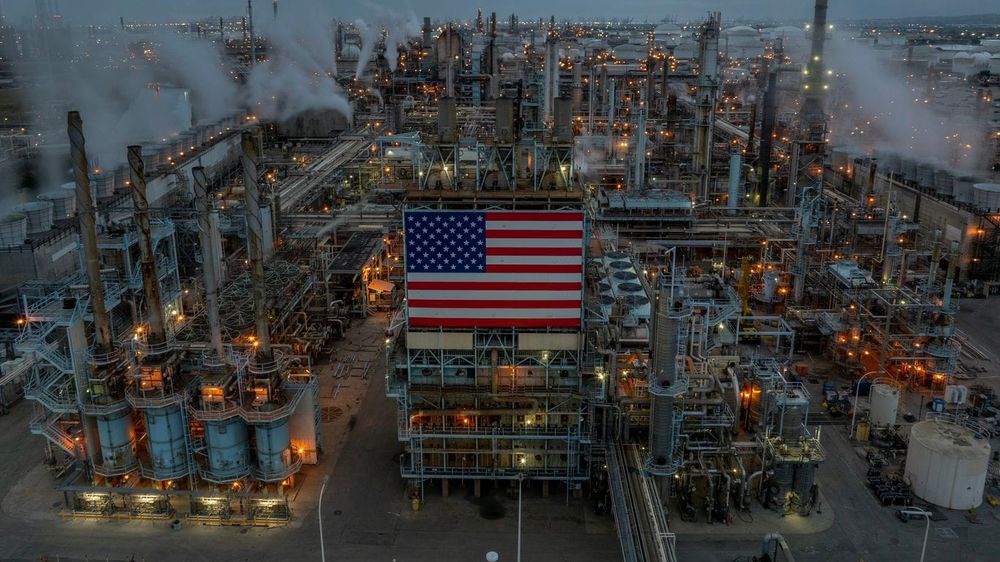
The United States became the world's largest oil and gas producer — and the largest exporter of liquefied natural gas — over the past decade. That position, as Axios notes, gives Washington geopolitical influence it has not historically held. U.S. crude oil exports generally run between 3.5 and 4.5 million barrels per day — 3.9 million in January, the last month with robust federal data. Petroleum product exports — gasoline, jet fuel, diesel — hit a new peak of 7.9 million barrels per day in the week of March 27, according to weekly data from the Energy Information Administration. The trajectory was already upward before the Strait closed. The war has accelerated it.
The gap between Trump's pitch and physical reality is significant, and it matters. U.S. exports cannot replace the flows that normally move through the Strait of Hormuz. The math is not close: 4 million barrels a day against 20 million barrels a day offline is not a substitution — it is a fraction. Crude oil is also not interchangeable across markets. Refiners in Asia and Europe are configured for different grades than the light crude the U.S. primarily exports. Mason Hamilton, a senior researcher with the American Petroleum Institute, noted on X that U.S. product exports are increasing to Asia, Africa, and other regions, with "increasingly atypical" trade flows emerging — Gulf Coast gasoline moving to Australia, East Coast jet fuel heading to Europe. The disruption is real. The U.S. is benefiting from it. But the president's claim that American oil is filling the gap is not supported by the numbers his own administration's agencies produce.
What the president's framing does accomplish — even if the logistics don't support it — is to make the war legible as an economic strategy. And that legibility is the story. This is not a president who stumbled into a commercial opportunity while managing a security crisis. This is a president who is describing the security crisis in commercial terms, from the beginning, as its primary justification.
The pattern fits a broader structure. As we've reported previously, the decision to go to war with Iran was made without a coherent strategic framework — his own team reportedly found the plan "farcical." What the war did have, from the outset, was a constituency in the U.S. fossil fuel industry, which stood to benefit directly from any disruption to Gulf production. A closed Strait of Hormuz is, from the perspective of a U.S. oil exporter, a competitor-suppression event of historic scale. Gulf producers cut by 8 to 10 million barrels per day is market share that goes somewhere. The administration is telling you where it wants it to go.
The energy industry's interest in the outcome of this conflict is not incidental. The U.S. rise to global energy dominance was built on a decade of deregulation, infrastructure investment, and federal leasing policy that the current administration has accelerated. The crisis in the Strait creates the conditions the industry has sought through policy by other means: a global supply crunch that makes U.S. exports indispensable, justifies long-term infrastructure investment in Gulf Coast export capacity — which Axios notes the crisis is already spurring — and locks in fossil fuel dependency at the exact moment that the energy transition was beginning to threaten it.
The climate consequences of this dynamic are not peripheral. Asia has already begun returning to coal as LNG markets collapse under the weight of the Strait closure. Countries that had committed to gas as a bridge fuel are now burning dirtier alternatives because the supply chain that was supposed to deliver that gas runs through a war zone. Every week the Strait stays closed, the energy transition loses ground — not because of policy failure, but because the disruption has made fossil fuel alternatives to fossil fuels unavailable. U.S. LNG exports fill some of that gap. Coal fills the rest. The administration's commercial enthusiasm for this outcome sits alongside a climate catastrophe it is actively accelerating.
There is also a geopolitical dimension that the sales pitch obscures. The countries most squeezed by the Strait closure are not adversaries the U.S. can easily coerce into buying American oil. China, the primary target of the president's pitch, has spent years building energy relationships with Russia, Central Asia, and African producers precisely to reduce its exposure to U.S.-controlled supply chains. The idea that Beijing will redirect its tanker fleet toward American ports in response to a blockade Washington engineered is not a serious diplomatic analysis. It is power theater — a performance of dominance that treats energy markets as a zero-sum game the U.S. has already won.
The people paying the price for that theater are not in Washington or Houston. They are in the countries whose energy supply has been severed, whose economies are contracting, whose governments are making emergency decisions about how to keep power grids and fuel supplies functioning. The humanitarian cost of the Strait closure — to civilians in countries that have no role in the U.S.-Iran conflict — is not part of the administration's commercial framing. It does not appear in the president's social media posts about tankers heading to American ports. The civilian populations bearing the cost of this war, inside Iran and across the Gulf region, are the missing variable in every calculation the administration has offered.
The Axios reality check is correct as far as it goes: U.S. exports can ease the global supply crunch, but they are nowhere near a solution. What that framing misses is the more uncomfortable truth the numbers point toward. The administration is not trying to solve the supply crunch. It is trying to profit from it. The blockade and the sales pitch are not in tension — they are the same policy, described from two different angles. One is the mechanism. The other is the motive. And the motive has been hiding in plain sight since the president opened his mouth on Fox News and started talking about tankers.
The crisis in the Strait will eventually end. When it does, the U.S. oil export infrastructure will be larger, more entrenched, and more politically indispensable than it was before the war began. The Gulf Coast export terminals being planned and funded right now — justified by the emergency — will not be dismantled when the emergency passes. They will become the new baseline, the new normal, the new argument against any energy transition that threatens their utilization rates. That is how fossil fuel lock-in works: not through a single decision, but through the accumulation of infrastructure, investment, and dependency that makes every subsequent choice harder to make differently. The Iran war has just bought that system another decade.