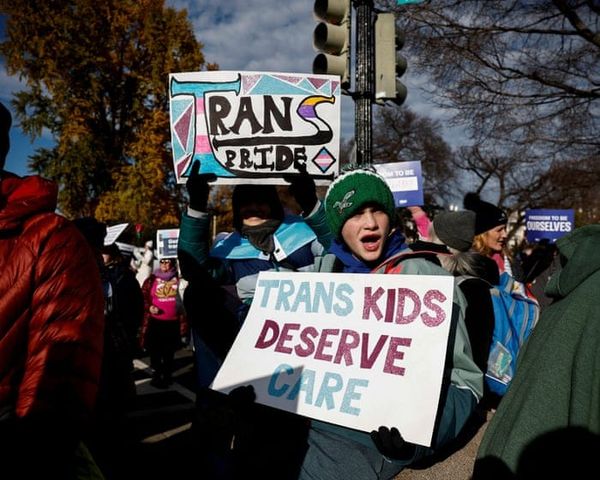
The U.S. Court of Appeals for the District of Columbia handed down a split decision Monday that the administration will almost certainly frame as a partial victory — and that is, in structural terms, something more insidious than a loss. According to reporting by The Guardian US, a three-judge panel ruled that transgender service members currently in uniform cannot be expelled, but that the armed services may continue to block transgender people from enlisting. The government is expected to challenge the ruling, and the case is widely expected to reach the Supreme Court.
Read the ruling charitably and it looks like a protection. Read it structurally and it is a slow erasure. The court has drawn a line that protects individuals while dismantling the category. Transgender people already serving are shielded — for now. Transgender people who would serve are barred. The institution will not expel its current trans troops. It will simply wait for them to age out, retire, or be worn down, while ensuring no one replaces them. This is not a compromise. It is a mechanism.
The majority opinion, described by The Guardian as calling the enlistment ban "arbitrary, and based on animus," applies that language to the recruitment prohibition — and then allows it to continue anyway. That tension is not a judicial anomaly. It is the load-bearing contradiction of the ruling. A policy the court found to be rooted in animus is permitted to govern who may enter military service going forward. The court acknowledged the discriminatory motive. It did not find that acknowledgment sufficient to stop the policy.
The DC Circuit split decision creates a two-track system: transgender troops currently serving are protected from expulsion, but the Pentagon may continue enforcing a ban on new transgender enlistment. The ruling is expected to be challenged by the government and is likely headed to the Supreme Court.
To understand why this matters beyond the immediate parties, it helps to look at what the administration has done to the military's institutional culture in the same period it pursued this ban. The Defense Secretary blocked promotions for four officers — all Black or female — in the first major personnel purge of the current administration. The Air Force Academy installed Christian nationalist leadership as diversity programs were dismantled across the services. The transgender enlistment ban is not an isolated policy. It is one component of a coordinated effort to reshape who the military is and who it serves.
The accountability question the ruling forces into the open is this: who, exactly, bears the cost of a policy the court itself called arbitrary and animus-driven? Not the officials who designed it. Not the legislators who funded the institutions that enforce it. The cost lands on the individuals barred from service — people who, in many documented cases, have expressed the same desire to serve their country that courts have historically treated as a dispositive argument in favor of military inclusion. The animus is named. The remedy is withheld.
Systemic pattern analysis makes the mechanism visible. The two-tier structure the ruling creates — protecting current members, barring future ones — is a recognized tool of institutional attrition. It was used against openly gay service members before "Don't Ask, Don't Tell" was repealed: existing personnel were tolerated in practice while the formal bar on new enlistment remained. The policy didn't need to expel people. It needed only to stop the pipeline. Over time, the institution would self-sort. Monday's ruling replicates that structure with legal precision.
The "animus" finding in the majority opinion deserves more weight than it is likely to receive in coverage that frames this as a split decision favoring neither side. When a federal appeals court finds that a government policy is rooted in animus — a legal term meaning hostility toward a group rather than a legitimate regulatory purpose — that is not a procedural footnote. It is a substantive constitutional indictment. The court found that the people designing this policy were motivated by bias, not military necessity. And then it allowed the policy to continue in its most consequential form: the form that shapes who can enter the institution at all.
The human impact of the enlistment bar is not abstract. Transgender Americans who sought to enlist — who passed physical and mental fitness standards, who completed application processes, who made the decision to serve — are barred not because of any documented failure of performance or fitness, but because of who they are. The court's majority acknowledged this. The dissent in the split decision, whose reasoning The Guardian did not detail in full, presumably went further. What the ruling does not do is restore the option to those people.
The case's trajectory toward the Supreme Court matters enormously, and not only for the parties. The current court has already demonstrated, in contexts from voting rights to administrative authority, a willingness to defer to executive branch rationales that lower courts have found constitutionally deficient. The administration has treated federal court orders as negotiating positions rather than legal obligations across a range of policy areas. There is no structural reason to assume the Supreme Court's eventual ruling will apply the animus finding with the force it deserves — particularly given how the court has handled executive branch deference in analogous cases.
There is also a military readiness argument that almost never receives the analytical attention it merits. The services that enforce this ban are the same services currently stretched across multiple theaters, managing recruitment shortfalls, and drawing on a narrowing eligible population. The Pentagon has struggled to meet enlistment targets throughout this decade. Policies that categorically exclude willing, qualified candidates from a shrinking recruitment pool are not neutral administrative choices. They have operational consequences. The administration has not been asked to reconcile its readiness concerns with its exclusion policy — and neither the ruling nor its coverage has forced that reckoning.
What the DC Circuit produced Monday is a ruling that will be described as a partial win for transgender service members. In formal terms, that is accurate. Current service members cannot be expelled on the basis of this policy. That protection is real and should not be minimized for the individuals it covers. But the protection is time-limited by design — not by any explicit provision, but by the arithmetic of attrition. An institution that cannot recruit from a group will, over time, not contain members of that group. The court has preserved the present while authorizing the erasure of the future.
The case now moves toward a Supreme Court that will decide whether a policy found to be motivated by animus can nevertheless shape the composition of the U.S. military for a generation. The people most directly affected — those barred from enlistment, those currently serving under the uncertainty of ongoing litigation — will wait for that answer without the power to accelerate it. The institution that called their exclusion arbitrary will continue enforcing it in the meantime.