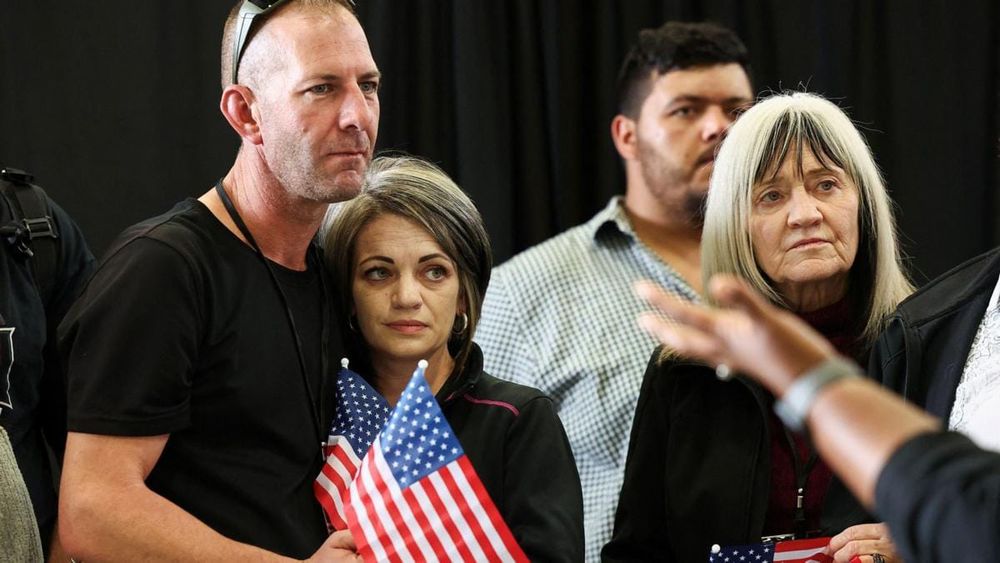
The United States government has admitted 4,499 refugees since October. Of those, 4,496 are white South Africans — Afrikaners whom the administration claims face racial persecution at home. The remaining three came from everywhere else on earth.
Three people. From a planet of eight billion. From a world that contains active genocide in Sudan, famine-driven displacement in Gaza, ethnic cleansing in Myanmar, mass atrocity in the Democratic Republic of Congo, and the largest refugee crisis since World War II. Three.
That number is not a policy gap or an administrative backlog. It is the policy. And it makes the racial architecture of the current U.S. refugee program impossible to misread.
The administration has been explicit about its reasoning. The White House has described Afrikaners — the white minority descended from Dutch colonial settlers, who held exclusive political and economic power under apartheid until 1994 — as a persecuted group deserving emergency refugee protection. South Africa's government has formally objected to that characterization, calling it a distortion of conditions in the country. South African officials have stated there is no systematic persecution of white citizens, and that the land reform policies the administration points to as evidence of persecution are democratically enacted domestic law, not ethnic cleansing.
But the administration's factual claims about South Africa are almost beside the point. What matters for understanding this policy is the structure it has produced — and who that structure serves.
The U.S. refugee admissions program was built, at least in principle, on need. The 1980 Refugee Act defines a refugee as a person with a well-founded fear of persecution based on race, religion, nationality, political opinion, or membership in a particular social group. Historically, admissions have skewed toward people fleeing active conflict, authoritarian violence, and statelessness — conditions concentrated in the Global South. The program has never been perfectly administered, and it has always been subject to political pressure. But its legal foundation was humanitarian, not demographic.
What the current administration has done is invert that foundation. It has not merely slowed refugee admissions — it has effectively halted them for the entire non-white, non-South-African world while running an expedited pipeline for a specific white ethnic group from a stable, democratic country. The result is a refugee program that functions as a racial preference system with humanitarian language attached as cover.
The accountability question here is direct: who had the power to produce this outcome, and what decisions made it possible? The administration controls refugee admissions through executive authority over the State Department's Bureau of Population, Refugees, and Migration and the Department of Homeland Security's refugee processing infrastructure. The President sets the annual refugee admissions ceiling. The current ceiling, set at historically low levels, combined with the explicit prioritization of Afrikaners, mathematically guaranteed the 4,496-to-3 ratio. This did not happen through bureaucratic drift. It required active choices at every level of the admissions process.
The Systemic Pattern lens makes the context sharper. This administration has used immigration enforcement as a racial sorting mechanism across multiple policy areas — from ICE detention practices that disproportionately disappear Black and brown detainees to deportations that separate non-white families while leaving procedural protections intact for others. The Afrikaner refugee program fits into that pattern not as an anomaly but as its clearest expression yet — a case where the racial logic of the broader immigration agenda is not implicit but written into the admission numbers themselves.
The counterargument worth engaging is this: every administration prioritizes certain refugee populations. The Obama administration prioritized Syrian refugees. The Biden administration created expedited pathways for Afghans and Ukrainians. Is the Afrikaner program simply another version of that political discretion?

It is not, for two reasons. First, the Syrian, Afghan, and Ukrainian prioritizations occurred in the context of active, documented mass atrocity — ongoing military conflict, aerial bombardment, and mass displacement verified by the UN, international NGOs, and independent journalists. The Afrikaner case involves a democratic country, a functioning legal system, and a land reform debate. The factual predicate is categorically different. Second, no previous administration reduced total global refugee admissions to near-zero while simultaneously running an accelerated track for a single ethnic group. The comparison is not between different prioritization choices — it is between humanitarian triage and demographic selection.
There is also the question of what this policy signals globally. South Africa is one of the most diplomatically significant countries on the African continent — a member of BRICS, a voice in multilateral institutions, and a country that has historically positioned itself as a mediator in regional conflicts. The U.S. government's claim that white South Africans face persecution is not just factually disputed; it is an intervention in South African domestic politics that carries real diplomatic weight. It has strained bilateral relations and handed political ammunition to factions within South Africa who benefit from portraying the post-apartheid democratic order as anti-white. The human rights framing is being deployed in a way that destabilizes, rather than supports, democratic governance in a key African nation — a pattern also visible in how the administration has intervened in European elections to boost illiberal leaders abroad.
Meanwhile, the people the refugee program was designed to protect — those fleeing documented mass atrocity, statelessness, and active conflict — are effectively locked out. The UN High Commissioner for Refugees estimated in 2024 that more than 117 million people worldwide were forcibly displaced. The U.S. has admitted three of them since October who were not Afrikaner South Africans.
What the 4,496-to-3 ratio makes undeniable is not merely a policy preference. It is the explicit use of the federal refugee apparatus to move a specific white ethnic group to the front of a line that has been closed to everyone else. The humanitarian language around the program — persecution, refuge, protection — is being applied selectively in a way that tracks race with near-perfect consistency. That is not an incidental outcome of administrative choices. It is the point.
The people waiting in camps in Chad, in processing centers in Bangladesh, in informal settlements across East Africa — they are not waiting because the system is slow. They are waiting because the system, as currently designed, was not built for them. The same federal infrastructure that has been handed virtually unlimited resources for enforcement has been redirected away from protection. The 4,499 number is not a data point. It is a policy statement — and it says exactly what it means.