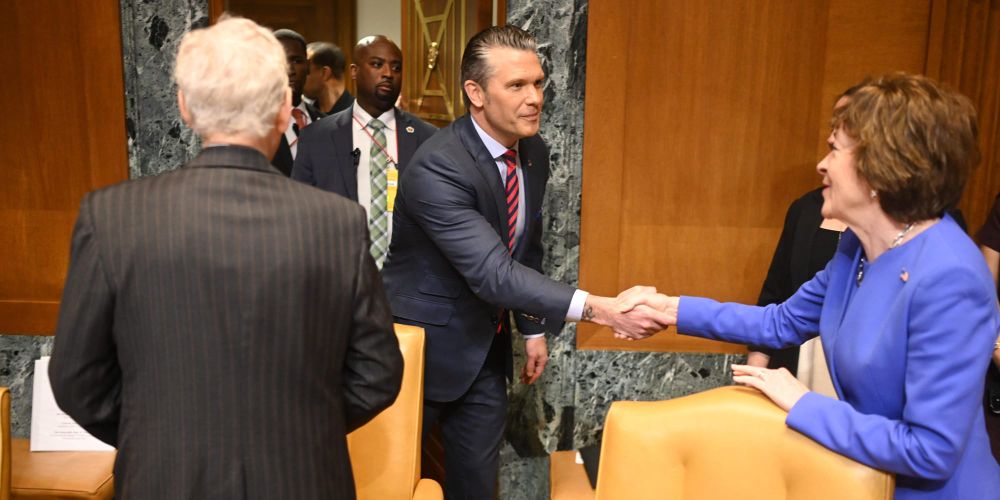
The number Pete Hegseth brought to Capitol Hill on Tuesday was $1.5 trillion. That is the Pentagon's budget request for the coming fiscal year — a figure larger than the entire GDP of Spain, larger than every discretionary program the federal government runs combined, and larger than any defense budget the United States has ever proposed in its history. What Hegseth did not bring was an accounting of how much of that sum is being spent on a war with Iran that Congress never voted to authorize, never debated in formal session, and has never been asked to fund through any appropriations process tied to the conflict itself.
That gap — between the number on the page and the war behind it — is the story of Tuesday's hearing. And it is a story that has been building for months.
According to The Intercept, Hegseth appeared before lawmakers to defend the $1.5 trillion request as Iran war costs have continued to climb. The article's framing — war costs skyrocketing, secretary asking for more — captures the surface of the problem. But the deeper problem is structural, and it has a name: the United States is prosecuting an active military conflict with no legal authorization, no public cost accounting, and no defined endpoint, and the Pentagon is now asking Congress to ratify that arrangement by writing the largest check in the department's history.
This is not how the constitutional system is supposed to work. The War Powers Resolution of 1973 requires the president to notify Congress within 48 hours of committing U.S. forces to hostilities and limits unauthorized military action to 60 days without congressional approval. That clock has long since expired on the Iran conflict. As Tinsel News has previously reported, the legal basis for the Iran war remains deeply contested, with no new Authorization for Use of Military Force passed by Congress and the administration relying on expansive readings of existing AUMFs that legal scholars across the political spectrum have called inadequate. What Tuesday's hearing added to that picture is this: the administration now wants $1.5 trillion, and it is asking lawmakers to approve that sum without disclosing what portion funds the unauthorized conflict.
The accountability failure here is not incidental. It is the strategy. An itemized war budget would require Congress to take a formal position on a conflict it has so far been permitted to tolerate through studied ambiguity. Some members have voted to continue funding the broader defense apparatus without ever casting a vote specifically on Iran. A line item changes that. A line item forces a choice. So there is no line item.
The Iran conflict has been conducted without a specific congressional Authorization for Use of Military Force. The administration has relied on existing post-9/11 AUMFs, a legal interpretation that constitutional scholars and members of both parties have challenged. Congress has not passed a formal war declaration or Iran-specific AUMF. The War Powers Resolution's 60-day clock has expired. No standalone Iran war appropriation has been passed.
Follow the money, and the architecture of evasion becomes clear. The Pentagon's budget is structured in ways that make war costs difficult to isolate even when lawmakers want to find them. Overseas Contingency Operations funds — the mechanism historically used to pay for active conflicts — have been folded into the base budget over the past several years, obscuring the true cost of military operations. When a secretary of defense presents a $1.5 trillion topline without breaking out conflict-specific expenditures, Congress is being asked to approve a number, not a plan. The distinction matters enormously for any institution that takes its appropriations function seriously.
That function has atrophied. Earlier estimates put the Iran war's cost at $12 billion with no congressional authorization for a cent of it. The Intercept's framing — costs skyrocketing — suggests that figure has grown substantially. But without an official accounting, the public and its representatives are left to piece together the cost of an active war from reporting, leaks, and inference. That is not oversight. It is theater staged to look like oversight.
The original thesis here is not that the war is wrong, or that Hegseth is lying, or that $1.5 trillion is too much or too little. The thesis is narrower and more damaging: Congress is being structurally prevented from performing its core constitutional function — the power of the purse — because the administration has designed a budget request that bundles an unauthorized war inside a massive topline number and dared lawmakers to vote against the whole thing. It is the budgetary equivalent of hiding a poison pill inside a bill too large to read.
The political incentives reinforce the structural ones. Members of Congress who vote against the $1.5 trillion request will be accused of defunding the military during an active conflict. Members who vote for it will have implicitly endorsed the Iran war's costs without ever being asked to endorse the Iran war. The administration gets authorization by omission. This is not a new trick — it is the same mechanism that kept the Iraq and Afghanistan wars funded for two decades without a single honest debate about their actual costs — but it is being deployed at a scale and with a budget figure that should force a reckoning.
There are members of Congress who have tried to force that reckoning. Senator Mark Kelly raised pointed questions about what the U.S. is actually achieving in Iran — a rare moment of institutional pushback. But individual dissent is not the same as institutional accountability. What is required is a formal demand: before this budget passes, the Pentagon must produce a line-item accounting of Iran war expenditures, a legal justification for the conflict's continuation, and a defined set of conditions under which the military operation ends. Without those three things, the $1.5 trillion request is not a budget. It is a blank check.
The human cost of that blank check is not abstract. Iranian civilians have borne the brunt of a military campaign that has, by most assessments, strengthened the regime it claimed to weaken, while producing an energy crisis whose costs are distributed globally but felt most acutely by people with the least capacity to absorb them. The $1.5 trillion being requested is American money, but the war it is funding has consequences that extend far beyond American borders and American politics. A Congress that approves this budget without demanding accountability for that war is not just abdicating its constitutional role — it is making itself complicit in whatever comes next.
The question Congress should be asking Pete Hegseth is not whether $1.5 trillion is the right number. The question is: how much of it is going to a war you never asked us to authorize, and what exactly are we buying with it? Until that question gets a straight answer, every vote on this budget is a vote taken in the dark.